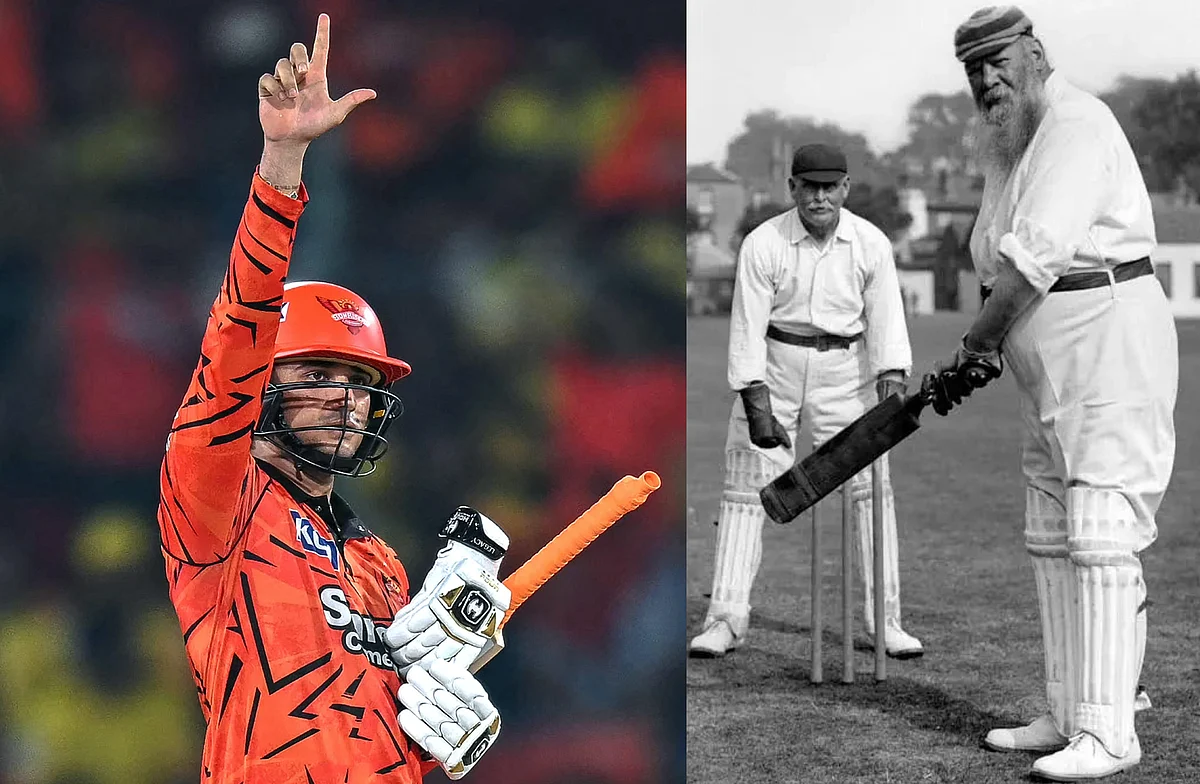
As the story goes, WG Grace, the bearded 19th-century English cricket legend who passed away in 1915, refused to walk back to the pavilion after being dismissed on the first ball he faced in an exhibition game.
Hailed as a pioneering figure in the sport, Grace’s batting genius drew hordes of people to the ground in county cricket — the highest level in England’s domestic cricketing system.
Grace played first-class cricket until eight years before his death at the age of 67, amassing more than 54,000 runs with 124 centuries.
But more than the runs and centuries, it was his dominant style of batsmanship that revolutionised the sport in the late 1800s.
Cricket was no longer a sport where batsmen would show a cautious approach to survive fast bowlers, as Grace turned it into a rare form of entertainment with his exhilarating shot-making.
Grace was also a towering figure in Test cricket, captaining England and scoring more than a thousand runs in 22 matches with two hundreds, having made his debut at Adelaide on September 6, 1880.
But it was during an exhibition match at a picturesque English ground that one of his most enduring myths took shape.
As the word spread that Grace, who was a physician by profession, would feature in the exhibition game, fans turned up in big numbers, hoping to catch a glimpse of the game’s biggest entertainer.
But he was dismissed on the first ball. Instead of walking back to the pavilion, Grace quietly put the bails back on the wicket before taking guard again.
As the bemused umpire looked at him, Grace responded in his inimitable style: “All these people that you see on the ground, they have come here to watch my batting, not your umpiring!”
Cricket, in its more than 150 years of history, has rarely seen a figure as charismatic as Grace, a man who towered above his contemporaries and became England’s first true box-office attraction, long before the explosion of the motion-picture industry.
Now, more than a hundred years later, as the 2026 season of the Indian Premier League (IPL) has unfolded, all we can see is the bowlers being reduced to mere spectators.
Barring a few matches, the bowlers are feeling as powerless as the 19th-century umpire in front of Grace, as batsmen have flexed their muscles, piling up big scores for fun on batting-friendly wickets.
Of course, it’s ludicrous to expect bowlers to dominate headlines in T20s. But it’s perfectly reasonable to expect a bit of contest between the bat and the ball, as an overdose of run fest could seriously discourage youngsters from becoming bowlers in future.
In an attempt to maintain the high entertainment value of the richest cricket tournament in the world, the authorities have ensured that more and more teams produce 200-plus scores, giving batters the complete freedom to treat bowlers with disdain.
The advent of the impact player is a clear indication that the cricket board wants the bat to give non-stop thrills, raising the stakes further for the broadcasters.
Even Muttiah Muralitharan, the former spin bowling wizard from Sri Lanka, felt for Jasprit Bumrah after the Indian pace spearhead was thrashed by an unheralded youngster — Salil Arora — in the game between the Mumbai Indians and Sunrisers Hyderabad.
"Salil hits a six, it is unbelievable - you do not think someone with the calibre of Bumrah comes and a young boy will hit a six off him because he will think about how am I going to survive Bumrah," said Murali, who is now a bowling coach at Sunrisers Hyderabad.
"But nowadays, no, it is about how am I going to hit a six - that is their approach. Confidence levels have gone up because people have shown this is the way to play the modern game, and youngsters are following that.”
This season, the IPL has already seen 35 200-plus scores, and the highest successful chase was 265 as seven batters have maintained a staggering strike rate of 200 plus.
Amid these incredible batting figures, Muralitharan explained why he doesn’t expect the bosses who run the IPL, one of the biggest money-spinners in the sporting world, to give bowlers a fair chance.
“I think if we give fair wickets, the spectators will say it is becoming boring because the T20 followers want entertainment, so they want to see the fours and sixes,” Murali said.
“That is why the tournament is built like that - an extra player to come and bat [impact player]. It is a big business at the moment, sponsors and everything, so you will lose the sponsors and interest of the people if you change it.”
WG Grace never changed the rules except for one exhibition game, where his cult status gave the sport one of its most iconic moments.
His mere presence swelled gate collections, making cricket an unrivalled spectator sport in the late 1800s when pacers hurled bouncers without restrictions on uncovered pitches — and yet Grace mastered the art of dominating bowlers.
His heroics still echo through the heart of every cricket romantic who longs for a true battle between bat and ball. Without that balance, even IPL entertainment could one day become monotonous and soulless.
IPL 2026: Batting Paradise
200+ totals: 35
220+ totals: 17
250+ totals: 4
200+ totals in losing causes: 10
Highest total:
265/4 – Punjab Kings
Highest successful chases:
265/4 vs 264/2 – Punjab Kings vs Delhi Capitals
249/4 vs 243/5 – Sunrisers Hyderabad vs Mumbai Indians
Best strike rates
Priyansh Arya (Punjab) – 250.44 (7 matches)
Vaibhav Sooryavanshi (Rajasthan) – 238.09 (9 matches)
Marcus Stoinis (Punjab) – 229.00 (8 matches)
Most sixes (IPL 2026)
37 – Vaibhav Sooryavanshi (Rajasthan Royals) – 9 matches
31 – Abhishek Sharma (Sunrisers Hyderabad) – 9 matches
26 – Priyansh Arya (Punjab Kings) – 7 matches