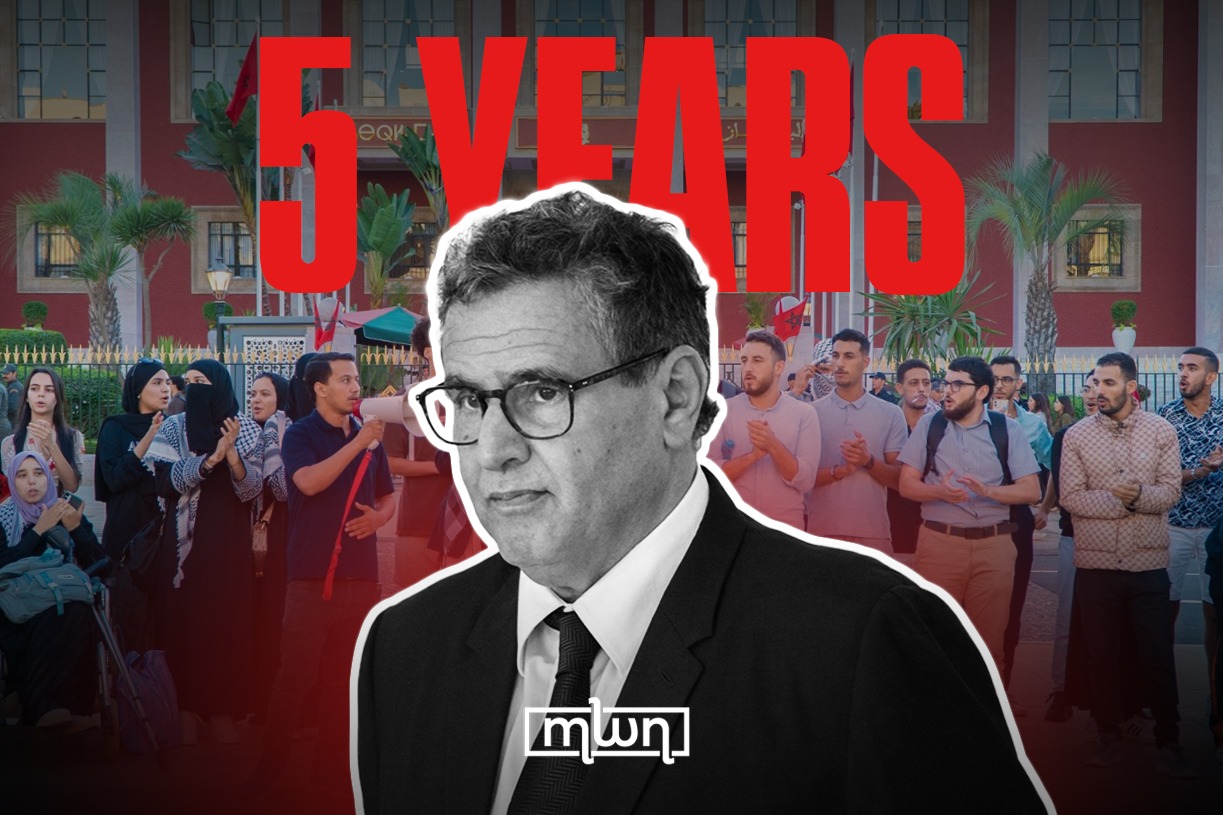
Marrakech – With legislative elections only months away, Moroccans are asking what the outgoing government has delivered. On Wednesday, Head of Government Aziz Akhannouch attempted to answer that question.
Standing before a joint session of both chambers of Parliament, the former National Rally of Independents (RNI) leader presented a sector-by-sector accounting of his five-year tenure, armed with statistics, reform timelines, and a clear electoral subtext.
The session, held under Article 101 of the Constitution, marked the last plenary of the current legislature. Akhannouch framed the exercise as one of political accountability, declaring that “true reform does not wait for the right moment but takes shape at the heart of challenges.” But the opposition was unmoved.
The prime minister opened with the economy. Growth rose from 1.8% in 2022 to 4.8% in 2025, he reported, with an average of 4.5% over 2021-2025 compared to 2.1% during the previous government cycle. Projections for 2026 exceed 5%. Inflation, which peaked at 6.6% in 2022, dropped to 0.8% by the end of 2025.
On the fiscal front, state revenues climbed from MAD 256.2 billion ($25.6 billion) in 2021 to MAD 424.2 billion ($42.4 billion) in 2025, a 65.6% increase. Tax revenues hit MAD 342.1 billion ($34.2 billion), up 59.4% from 2021.
Customs revenues in the first quarter of 2026 alone reached MAD 36.2 billion ($3.6 billion), up 6.8% year-on-year. The budget deficit narrowed from 5.5% to 3.5%, with a 3% target set for year-end 2026. Public debt fell from 71.4% of GDP in 2020 to 67.2% in 2025.
Morocco exited the GAFI grey list in 2023. Standard & Poor’s upgraded the sovereign rating to BBB-/A-3 with a stable outlook in 2025. Last month, Moody’s revised its outlook from stable to positive while confirming its Ba1 rating.
Investment and industry drove much of the government’s narrative
The top executive pointed to the new investment charter as a centerpiece. Since its adoption, the National Investment Commission approved 297 projects worth MAD 513 billion ($51.3 billion), expected to generate around 201,000 direct and indirect jobs. Over the full mandate, 381 projects totaling MAD 581 billion ($58.1 billion) and 245,000 jobs were validated.
Public investment rose from MAD 230 billion ($23 billion) in 2021 to roughly MAD 380 billion ($38 billion) in 2026, a 65% increase. Foreign direct investment receipts jumped 73%, from MAD 32.5 billion ($3.25 billion) to approximately MAD 56 billion ($5.6 billion).
Industrial exports reached MAD 408 billion ($40.8 billion) in 2025, up 44.5% from 2021, led by the automotive and aeronautics sectors. On the industrial infrastructure side, 64 projects were signed for over MAD 16 billion ($1.6 billion), adding some 4,400 hectares of industrial land.
Regional investment commissions approved 33 projects worth MAD 483 million ($48.3 million), projected to create around 940,000 direct jobs. Another 83 smaller projects, each under MAD 250 million ($25 million), totaled MAD 11 billion ($1.1 billion) in investment and more than 10,000 direct jobs.
Social spending dominated the second half of the address
Akhannouch indicated that approximately 15.5 million additional citizens now benefit from basic medical coverage. The state covered over MAD 27 billion ($2.7 billion) in contributions under the AMO-Tadamon program.
Direct social aid reached some 4 million families, including 5.5 million children, over 396,000 widows – 308,000 of them without children – and more than one million beneficiaries over age 60. Total disbursements stood at roughly MAD 52 billion ($5.2 billion) by end of January 2026.
The Compensation Fund absorbed MAD 135.6 billion ($13.56 billion) to stabilize prices of basic goods. Social dialogue agreements benefited over 4.2 million workers at a total cost of MAD 46 billion ($4.6 billion) through 2026.
Income tax was revised: monthly salaries below MAD 6,000 ($600) are now exempt, the top marginal rate dropped from 38% to 37%, and the family deduction rose from MAD 360 ($36) to MAD 500 ($50) per dependent.
On housing, over 96,000 families accessed decent housing through the royal support program.
Health and education reforms consumed significant budget allocations
Health and education were the central demands of the Gen Z 212 protests that swept across Moroccan cities in late September and October 2025, triggered by the deaths of eight women during childbirth at a public hospital in Agadir.
The Health Ministry’s budget more than doubled, from MAD 19.7 billion ($1.97 billion) in 2021 to MAD 42.4 billion ($4.24 billion) in 2026. “A demotivated doctor and an under-equipped hospital cannot deliver healthcare worthy of citizens,” Akhannouch told lawmakers.
A first phase upgraded 1,400 primary health centers at a cost of MAD 6.4 billion ($640 million). A second phase targeting 1,600 additional centers is budgeted at MAD 6.8 billion ($680 million). Between 2022 and 2025, 29 hospital projects added 3,168 beds.
Twenty more hospitals are under construction for 3,067 beds, with 15 additional projects planned for 1,810 beds. Four new medical faculties brought the national total to 11.
In education, preschool coverage reached 80%, enrolling 985,000 children. Pioneer (“Riyada”) schools expanded from 626 to 4,626 primary establishments serving nearly two million students, with the model extended to 786 middle schools for 677,586 students.
Over 80,000 teachers received training under the new pedagogical approach. Boarding facilities now serve more than 170,000 students, and school transportation covers 698,000. Back-to-school aid went to 3.4 million students at a cost of MAD 738 million ($73.8 million).
The new civil service statute for education covers 336,000 employees. The contractual teachers file, involving over 114,000 instructors, was described as “definitively closed.”
University faculty received their first pay revision in over 20 years, with a net monthly increase of MAD 3,000 ($300). Total cost of education sector union agreements will exceed MAD 17 billion ($1.7 billion) by 2027. Fifteen new university establishments added 70,000 seats, with a 16% increase in faculty and dormitory capacity reaching 60,000 beds.
Water, energy, and agriculture drew detailed figures as well
Renewable energy’s share in the electricity mix rose from 37.1% to approximately 46.1%. Eight green hydrogen projects were approved for roughly MAD 43 billion ($4.3 billion).
The national water program’s budget increased from MAD 115 billion ($11.5 billion) to MAD 143 billion ($14.3 billion). Desalination capacity hit 415 million cubic meters by end of 2025, targeting 1.7 billion by 2030 to cover 60% of drinking water needs. Seven major dams were built with 1.7 billion cubic meters of storage.
In agriculture, a MAD 20 billion ($2 billion) support program addressed climate impacts. Some 27 million quintals of subsidized barley and 8.5 million quintals of compound feed were distributed. A MAD 12.8 billion ($1.28 billion) livestock reconstitution program was launched.
Agricultural value added grew from MAD 102 billion ($10.2 billion) in 2020 to MAD 110.5 billion ($11.05 billion) in 2025, with a MAD 130 billion ($13 billion) projection for 2026. Registered agricultural workers at the CNSS rose 66%, from 283,000 to 470,000.
Tourism posted record numbers while employment remained contentious
Morocco welcomed 19.8 million tourists in 2025, up 53.5% from 2019. Tourism revenues reached MAD 138.1 billion ($13.81 billion), a 75.5% increase. The sector’s roadmap carried a MAD 6.1 billion ($610 million) budget. Artisanal exports surpassed MAD 1.23 billion ($123 million), up 56% from 2019.
On employment, Akhannouch cited 850,000 net jobs created between 2021 and 2025, averaging 170,000 annually compared to 90,000 under the previous government. He reiterated the pledge of one million non-agricultural jobs by the end of 2026.
The opposition pushed back sharply. The Party of Progress and Socialism (PPS) deputy Ahmed El Abadi called the speech “disappointing and full of wooden language,” accusing the government of ignoring tens of thousands of business failures and record unemployment levels.
He flagged what he described as a mathematical inconsistency between announced job figures and actual growth rates. Unemployment stood at approximately 13% at the end of 2025, a figure the opposition called a negligible improvement.
Istiqlal parliamentary group leader Omar Hamraoui offered a contrasting view, calling the record positive and aligned with the royal strategic vision.
Akhannouch closed with a personal register, telling lawmakers that “our ambitions are high because Moroccans deserve more.” In a thinly veiled message to voters ahead of the fall ballot, he stressed that “work is the only language that counts, and results remain the only final judge.”
Akhannouch hawks a reality-defying success tale
A recurring issue with government reviews in Morocco is the blurring of lines between royal initiatives and executive action. Many of the flagship programs cited – from social protection to housing aid – are royal projects that predate or transcend any single government.
Critics argue the executive should not claim credit for structural reforms driven by the monarchy regardless of who holds office.
Akhannouch will not run in the upcoming September legislative elections and has already stepped down as RNI party leader. Mohamed Chaouki, a parliamentarian and head of the Committee on Public Finance Oversight, was elected as his successor at the party’s extraordinary congress in El Jadida in February.
This means Wednesday’s address was ultimately both a closing statement and a political handoff of a period marred by the most widespread public backlash a Moroccan government has faced in over a decade. Just a few months back, Akhnnouch’s government was rattled by unprecedented Gen Z 212 protests that brought thousands into the streets demanding his resignation.
Critics accused Akhannouch of only paying attention to citizens when elections draw near. And leading opposition figures branded the 2024 Casablanca desalination contract awarded to his own Afriquia Gaz company a “political scandal,” with former Head of Government Abdelilah Benkirane demanding his resignation over the deal.
Beyond the protests and parliamentary clashes, economists have described Akhannouch – one of the country’s wealthiest individuals and majority owner of conglomerate Akwa Group – as the embodiment of Morocco’s deeply rooted crony capitalism.
The Forbes-listed billionaire watched his personal fortune swell from $1 billion in 2020 to $1.6 billion in 2026 – a 60% increase amassed while millions of Moroccans sank deeper into poverty, purchasing power was gutted, and the middle class was effectively wiped off the map.
While Akhnnouch strived this week to sell his tenure as a success story on the whole, statistics tell a more nuanced story. A recent Afrobarometer survey found only 33% of Moroccan youth trust Akhannouch, whose 2019 threat that “Moroccans who lack education must be re-educated” has since crystallized into a lasting symbol of a billionaire premier governing with contempt for the very people he was supposed to serve.
Multiple ministers in his cabinet faced accusations of abuse of power, conflicts of interest, and profiting from state resources through public contracts. Criticized throughout for his lack of charisma and ideological depth, Akhannouch leaves office as a figure who, for many Moroccans, represented the fusion of wealth and power at its most unrestrained.
The post What Has Aziz Akhannouch Achieved in Five Years of Government? appeared first on Morocco World News.