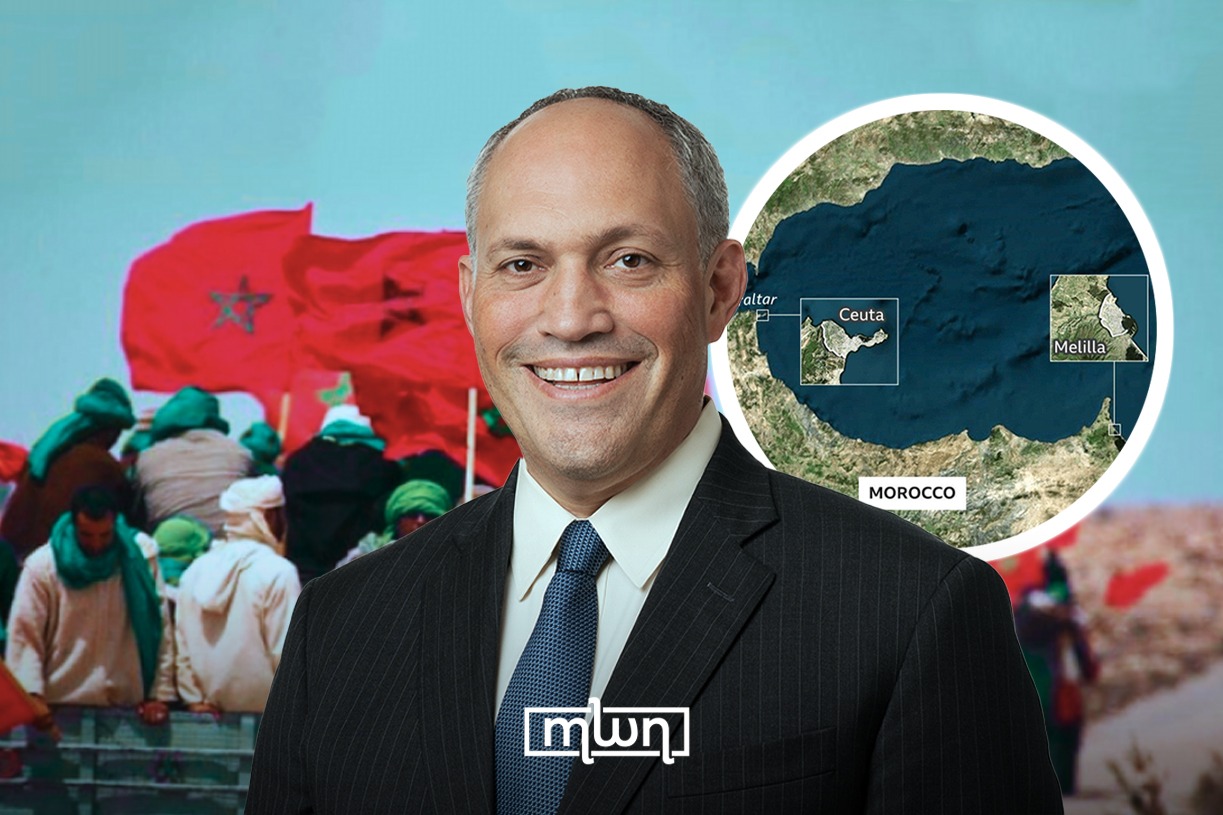
Marrakech – Only days after calling on US President Donald Trump and Secretary of State Marco Rubio to formally recognize Ceuta and Melilla as occupied Moroccan territory, Michael Rubin has dropped another political bombshell.
The former Pentagon official and senior fellow at the American Enterprise Institute (AEI) is now urging Morocco to reclaim the spirit of the 1975 Green March and send unarmed civilians into the two Spanish-held enclaves.
In an op-ed published on March 16 by the Middle East Forum, Rubin laid out what Spain’s far-right and ultranationalist currents have long feared most – a direct, unambiguous call for Morocco to march into Ceuta and Melilla, dismantle the colonial fences, and raise the Moroccan flag.
“Moroccans should gather, send bulldozers to the border, and then enter Ceuta and Melilla unarmed to raise the flag,” Rubin wrote. He argued that Spanish Prime Minister Pedro Sánchez “and the Spanish press bleat, but they have no grounds to act.”
Rubin invoked the precedent of King Hassan II, who on November 6, 1975, dispatched approximately 350,000 unarmed Moroccans into the Western Sahara. Spanish forces stood down. Just over a week later, Madrid signed the Madrid Accords and agreed to withdraw.
“Hassan II had history on his side,” Rubin wrote. “The region was Moroccan for more than a millennium before Spain’s imperial arrival.”
Rubin did not spare the Polisario Front. He branded the separatist movement “a Cold War relic that Algeria still nurtures.” He wrote that Sahrawis imprisoned by the Polisario in the Tindouf camps “flee Tindouf at every opportunity, to the point that the Polisario holds family members hostage to prevent flight to Morocco.”
King Mohammed VI, Rubin argued, built upon the Green March legacy with his stewardship of the Sahara, noting that on a per-capita basis, the region receives more state investment in schools and infrastructure than other parts of Morocco. He described both Dakhla and Laayoune as “models for sustainable urban development.”
The senior AEI fellow went further, arguing that even NATO would have no legal basis to intervene. He cited Article 5 of the alliance’s foundational treaty, which limits mutual defense obligations to armed attacks in Europe or North America. Article 6, he noted, explicitly excludes territories south of the Tropic of Cancer.
“Neither Ceuta, Melilla, nor the Canary Islands would trigger a NATO response,” Rubin wrote, “just as NATO would not need respond to an attack on Hawaii or Puerto Rico.”
Europe’s border runs through occupied African territory
The op-ed represents a no-holds-barred and full-throated escalation from Rubin’s March 12 piece, in which he branded Spain “a colonial power, running colonies across the Strait of Gibraltar on the northern coast of Morocco.” In that earlier article, he dismissed any pretense of Spanish legitimacy over the enclaves. “Neither maps nor history lie,” he wrote.
The historical record, as laid out in the earlier piece, dismantles Madrid’s narrative of unbroken sovereignty. Ceuta, a seven-square-mile enclave, was wrested from its inhabitants by Portuguese invaders in 1415 and later transferred to Spain. Melilla, slightly smaller at 4.7 square miles, succumbed to Spanish conquest in 1497. Far from being integral to Spain, the two cities historically carried second-rank status – open-air prisons, military installations, and dens of smuggling rather than cities of civic value.
Spanish archives themselves betray the fiction of permanence. The Lisbon Treaty of 1686 first gave nominal recognition. For centuries, Madrid considered trading the enclaves to Britain in exchange for Gibraltar or abandoning them altogether.
In 1811, the Cadiz Cortes declared that they were not Spanish territories and suggested their return to Morocco. Only in 1913, during the rapacious scramble for colonial spoils, did Spain elevate them to “plazas de soberanía.” Full sovereignty was not asserted until 1955, on the very eve of Morocco’s independence – and even then, the enclaves remained under military administration.
Beyond Ceuta and Melilla, Spain maintains a constellation of occupied outposts: the Chafarinas Islands, Peñón de Vélez de la Gomera, and a string of barren rocks it guards with garrisons and gunboats. In 2002, when Moroccan soldiers briefly raised their own flag on tiny Perejil Island, Madrid dispatched commandos to retake it – the same imperial reflex that once unleashed Franco’s legionnaires with poison gas across the Rif.
The enclaves today function as parasitic anomalies on Moroccan soil. Ringed with barbed wire, double fences, watchtowers, and EU-financed surveillance drones, they serve as Europe’s militarized southern border posts where African migrants are beaten back or left to drown when trying to cross.
Bereft of agriculture or industry, they thrive only through contraband, undermining Morocco’s customs revenue by an estimated $1.5 billion annually. When 8,000 migrants surged into Ceuta on May 17, 2021, it was a brutal reminder of the instability these colonial relics generate.
The farce reached new extremes last September when Spain invited the NATO Parliamentary Assembly to convene in occupied Melilla – a calculated maneuver observers viewed as internationalizing the Iberian country’s colonial grip and embedding the enclave within the Atlantic alliance as though it were a natural extension of Europe. Talk of a possible visit by King Felipe VI to the enclaves has also resurfaced, a provocation Morocco views as a direct assault on its sovereignty.
Madrid’s double standard is staggering. Spain demands Britain return Gibraltar because it is a foreign enclave on Spanish soil, yet refuses to apply that identical logic to Ceuta and Melilla. Spanish media shout about “territorial integrity” when Gibraltar is mentioned, but whisper “historical sovereignty” when Morocco raises its claims.
Anti-imperialism rings hollow from a colonial capital
Rubin’s latest salvo takes direct aim at Sánchez’s anti-colonial posturing. The Spanish prime minister has been one of the few European leaders to explicitly label Israel’s campaign in Gaza a genocide. His government recognized Palestine as a state in May 2024, imposed a full arms embargo on Israel, and barred ships and aircraft carrying weapons to Israel from using Spanish ports or airspace.
Sánchez also refused to allow the United States to use jointly operated military bases in southern Spain for operations linked to strikes on Iran, calling the US-Israeli military campaign “unjustifiable” and “illegal.” The refusal triggered a direct confrontation with Trump, who called Spain “unfriendly” and threatened a full trade embargo against Madrid.
For Rubin, the moral posture is fraudulent. He called Sánchez “a hypocrite” and argued that Spain’s anti-Israel fervor is driven not by principle but by political desperation.
Spain denounces illegal Israeli settlements in the West Bank and calls for Palestinian statehood, yet refuses to apply the same principle to its own colonial possessions on African soil. Madrid condemns occupation east of the Mediterranean while perpetuating it south of the Strait of Gibraltar.
“Sánchez has become like Turkey’s Recep Tayyip Erdoğan: He rose to power promising clean government, and like Erdoğan, he failed to deliver,” Rubin wrote. “When confronted with growing discord, Sánchez, like Erdoğan, sought to distract his base by creating an enemy. Both men chose the Jews.”
Rubin noted that Sánchez’s own Socialist Party and even his wife are now subjects of investigation, reinforcing the portrait of a leader grasping for foreign distractions to mask domestic dysfunction.
The US official also cited Israeli American scholar Jose Lev Alvarez Gomez, who noted that Spain “remained silent on Iran, even as Islamic Revolutionary Guard Corps and Basiji gunmen massacred tens of thousands of Iranians.” Gomez further pointed out that Spain “relied on Israel to counter its own Basque terror scourge.”
He added that while Sánchez made political theater out of boycotting Israeli military products, “Spain just purchased many of the same from Germany, all containing Israeli components.”
‘Do the right thing’
Analysts note that Spain’s fervor on Palestine is not born of altruism but of insecurity. Madrid is terrified of Morocco’s rise – its growing partnerships with Washington, Beijing, and the Gulf; its ascendance in renewable energy, phosphate dominance, automotive and aerospace industries; and its modernization of military hardware with Turkish drones, Israeli systems, and American tanks. Morocco’s 21st-century trajectory threatens Spain’s old role as Mediterranean gatekeeper.
The AEI fellow drew a contrast with Britain’s Labour government under Keir Starmer, which rescinded British claims to the Chagos Islands. “At least Starmer is true to his principle,” Rubin wrote. “Sánchez is a hypocrite.”
Rubin recalled that Trump ended his first term by recognizing Morocco’s sovereignty over the Western Sahara. He described the move as “righting a historical wrong that had chaffed Morocco for decades.”
As Spain “turns against the West and doubles down on anti-Americanism, anti-Zionism, and anti-Semitism,” Rubin contended, the moment demands action. “Sánchez will not do the right thing voluntarily,” he concluded, “but perhaps his legacy nevertheless can become the end of Spanish imperialism in Africa.”
The call comes at a time of severe diplomatic rupture between Spain and Israel. Madrid formally terminated the appointment of its ambassador to Israel. Israel’s mission in Madrid is similarly reduced. Both countries are now effectively without ambassadors in each other’s capitals. Spain only recognized Israel in 1986, four decades after the country’s founding.
Rubin’s directive to Madrid was blunt: “Do the right thing: make good on his anti-colonial rhetoric, and end Spain’s occupation in Africa.” He added that “authorities in Cádiz should begin preparations to receive displaced Spanish settlers, whether Madrid acquiesces or not.”
Morocco has never relented in demanding the restitution of Ceuta, Melilla, and every occupied islet. Rabat regards them as the unfinished reckoning of decolonization.
Read also: Samir Bennis: Spain Must Return Its African Enclaves To Morocco
The post US Think Tank Urges Morocco to Launch Second Green March Into Ceuta, Melilla appeared first on Morocco World News.