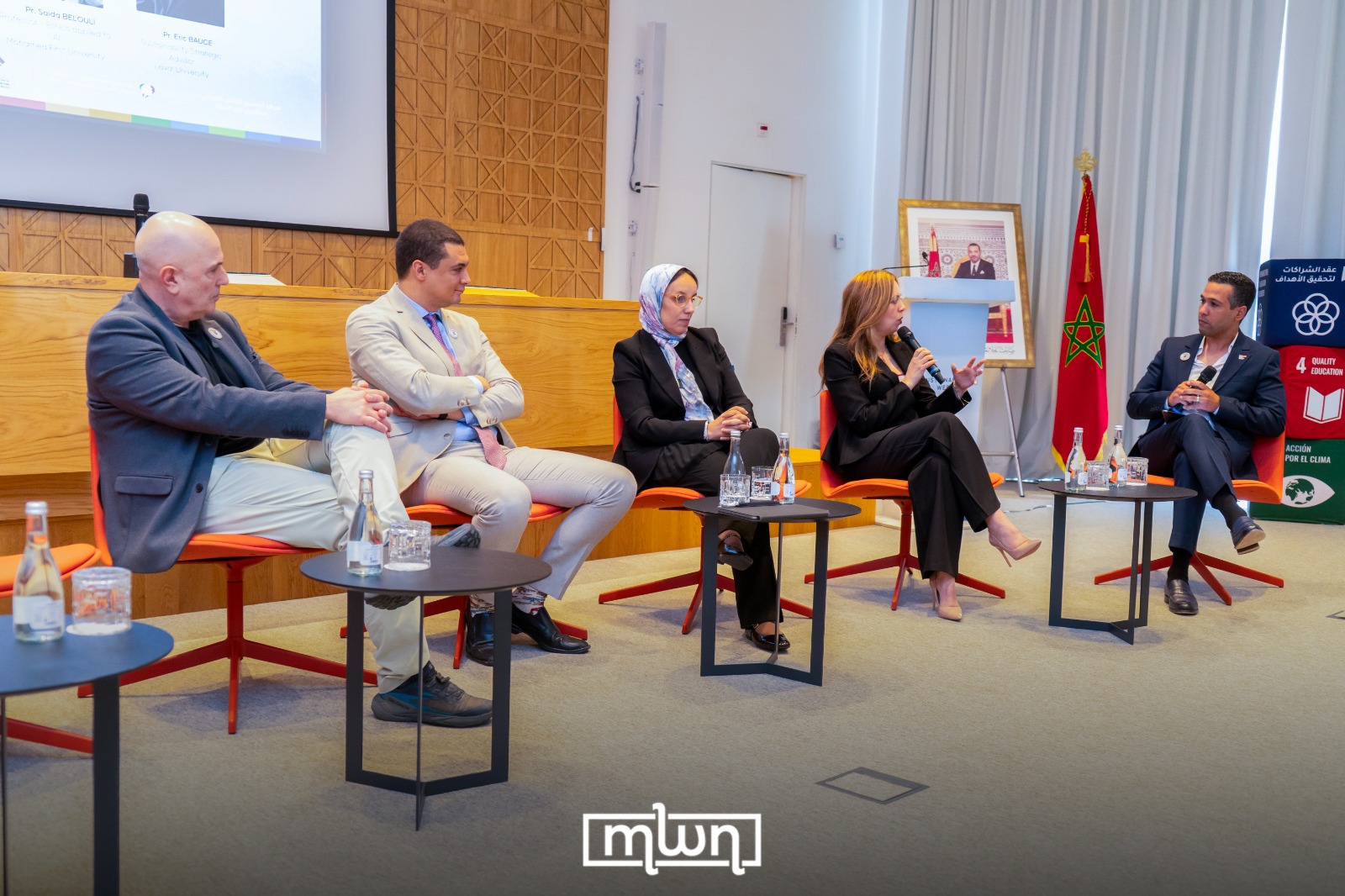
Benguerir – As global data center electricity consumption surges past 460 terawatt-hours and AI workloads threaten to consume nearly half of all server energy worldwide, the Mohammed VI Polytechnic University (UM6P) opened its 2026 Sustainability Week on Tuesday with a pointed question: Can artificial intelligence be harnessed for environmental good without devouring the planet’s resources in the process?
The three-day event, running April 21-23 in Benguerir, coincides with World Earth Day and brings together academics, policymakers, entrepreneurs, and civil society actors to examine the fraught intersection of AI innovation and ecological sustainability. The program spans two flagship panels, immersive workshops, an art-for-sustainable-development exhibition, experimental farm visits, and a solidarity market showcasing local cooperatives.
Opening remarks by Khalid Baddou, UM6P’s Chief Institutional Affairs Officer, and Fadwa Baladi, Head of the university’s Sustainable Development Office, set the tone before two back-to-back morning panels unpacked the theme from complementary angles.
The first, “AI & Sustainability – Challenges & Opportunities,” assembled voices from UM6P’s College of Computing, Mohamed First University, the Hassan II International Center for Environmental Training, and Canada’s Laval University to interrogate the dual nature of AI as both an accelerant of climate risk and a potential instrument of decarbonization.
The second panel, “AI & Sustainability – Academic & Entrepreneurial Perspectives,” widened the lens to include UM6P’s Faculty of Medical Sciences, its College of Agricultural and Environmental Sciences, the International Water Research Institute, and founders from the circular-water and insect-protein startup space – a deliberate effort to ground the conversation in applied research and market-ready solutions rather than abstraction alone.
The programming arrives at a moment of heightened global scrutiny. Morocco ranks sixth worldwide in the 2026 Climate Change Performance Index, the highest position held by any African or Arab nation, earning high marks for greenhouse gas emissions management, energy use, and climate policy.
Yet with international estimates projecting that data centers could rival the electricity appetite of Japan by year’s end, even a climate leader must confront the resource costs of the technologies it embraces.
The event is anchored in UM6P’s broader ambition to position Benguerir’s green city campus as a living laboratory for sustainable development – a vision that now faces a new test as AI infrastructure proliferates across the continent.
‘Not just a label, but a reality’
On the sidelines of the event, Baddou told Morocco World News (MWN) that UM6P’s commitment to sustainability rests on three interconnected pillars: education, scientific research, and the innovation ecosystem. The university, he said, has cultivated a corps of “sustainable development ambassadors” among its students who actively promote a culture of environmental responsibility across campus.
The research dimension is already yielding tangible results, he explained. UM6P laboratories are engaged in work on renewable energy, water recycling, and desalination “at a larger scale,” while the university’s startup ecosystem is designed to attract and incubate ventures that address sustainability challenges.
The track record is not aspirational but verified, he stressed, pointing to the fact that the university has accumulated “several ratings and rankings and certifications” over the past few years. “We are walking the talk,” Baddou said, “and we are making of sustainability not only a label, but a reality.”
Pressed on how the university reconciles its embrace of AI with the technology’s environmental costs, Baddou was candid. UM6P already uses AI and digitalization to manage the energy consumption of campus buildings, he noted, extracting operational efficiencies from precisely the technology whose broader footprint raises alarm.
But he did not minimize the tension. Every prompt entered into a large language model, he said, activates data centers that “consume energy” and use “water to cool.” Without what he called an “ethic” and a “willingness to use AI in a logical manner,” the balance tips toward harm.
The day’s programming was itself an exercise in confronting that duality, he suggested, framing it as an effort to “bring together what are the opportunities, what are the challenges, and how we can bridge both.”
Baladi, for her part, described sustainability as a strategic priority woven into UM6P’s teaching, innovation, and operations. “Performance today requires data, precision, and the ability to anticipate,” she told MWN, presenting AI as a “game-changer” that the university intends to leverage through collaboration among academia, researchers, and policymakers.
The Sustainability Week is designed to translate UM6P’s ambitions into “real scalable solutions with a real impact within Morocco, Africa, and beyond,” she affirmed.
Morocco’s environmental record ‘speaks for itself’
Ayman Cherkaoui, Director of the Hassan II International Center for Environmental Training – the academic arm of the Mohamed VI Foundation for Environmental Protection, chaired by Princess Lalla Hasna – offered a sweeping account of Morocco’s institutional architecture for environmental education and South-South cooperation.
The center, operational since 2019, works across the entire learning continuum, Cherkaoui told MWN, from preschool through university and into civil society and the private sector, covering the foundation’s core themes of ocean stewardship, climate action, and biodiversity. Its geographic ambition is equally broad: local, national, regional, and global, with Africa occupying what he called “a very particular place in our hearts.”
Cherkaoui pointed to three continental initiatives as evidence of that commitment. The African Youth Climate Hub, announced by Princess Lalla Hasna at the UN Secretary-General’s Climate Action Summit in 2019 and developed in partnership with UM6P, runs an annual incubation cycle that winnows hundreds of applications down to ten project holders working on adaptation, mitigation, and loss and damage.
A second initiative, the African Green Universities and Youth Education Network, connects more than 40 universities across 14 African countries to collaborate on greening their curricula and campuses.
A third, more recent program trains young Africans in ocean sciences through a pipeline that moves from online coursework to laboratory internships in Morocco and fieldwork aboard scientific research vessels operated by the National Institute of Fisheries Research.
Asked to assess Morocco’s sustainability credentials, Cherkaoui was direct. “The international rankings speak for themselves,” he said, noting that the kingdom’s climate commitments and achievements are “recognized among the top five in the whole world” on a routine basis.
He cited the foundation’s programs – Clean Beaches, the Lalla Hasna Sustainable Coastline Awards, and the Blue Flag international label – as expressions of a philosophy rooted in “shared responsibility” rather than blame. “It is not about finger-pointing,” Cherkaoui clarified. “It is about being together – in Morocco and all over the world – to look at the problem and find the solutions together.”
The remark carried particular weight in a week when the global discourse on sustainability increasingly pits the accelerating demands of AI infrastructure against the fragile progress of climate commitments – a tension Morocco’s own green-city experiment in Benguerir is attempting to resolve in real time.
‘Policymakers should learn AI before they regulate it’
Lamiae Azizi, Associate Professor and Director of UM6P’s AI Accelerated Research Centre (AI-ARC), brought a granular technical perspective to the conversation. The environmental cost of AI is real and measurable, she told MWN, noting that the infrastructure underpinning AI systems – models, algorithms, data centers – demands “huge computational power in terms of electricity and water.” But, she added, the ledger is not one-sided.
AI solutions have demonstrated “great positive impact on optimization of resource use” and contributed to decarbonization across sectors, including supply chains and healthcare, where the technology is enabling what she described as “sustainable hospitals” and improved patient outcomes. As she sees it, the challenge is less about whether AI can serve sustainability than about whether institutions will move quickly enough to shape its trajectory.
On the regulatory front, Azizi offered a sharp assessment. Despite widespread talk of AI governance, she said, “there are no real AI regulations per se” – only fragmented rules touching data privacy, data security, and specific use cases. The reason is structural, she argued, explaining: “Technology considers that regulations go against innovation. And in that sense, nobody wants to be having regulations that impede actually this innovation.”
She pointed to the world’s two leading AI powers as evidence. Both the United States and China “have said no to regulations,” she observed, and European countries that initially moved toward binding frameworks have since “stepped back” under competitive pressure. The result is a global regulatory vacuum widening in lockstep with the technology’s capabilities.
Her recommendation to policymakers was blunt and carried a note of irony: do not wait for AI systems to mature before acting, because “AI of today is not AI of tomorrow.” But before drafting rules, she said, legislators should first acquire fluency in the technology they seek to govern.
“One key recommendation is actually maybe to get trained to AI themselves before having regulations about AI,” Azizi urged – and then added what she called “a spoiler”: they might consider “using AI to help them design these regulations at the end of the day.”
The Sustainability Week continues through Wednesday and Thursday with workshops on women in AI, participatory sessions on sustainability in professional pathways, and cultural programming designed to extend the conversation beyond the academic sphere.
The post UM6P’s Sustainability Week Wrestles With AI’s Double-Edged Promise appeared first on Morocco World News.