Rabat – Mining operations around the world generate large amounts of waste every year. Much of this material is stored in massive stockpiles, which requires long-term land management and monitoring. But some of this so-called waste still contains valuable minerals.
Zouhir Balagh, a PhD researcher at UM6P’s Geology and Sustainable Mining Institute, and his team have turned this familiar problem in phosphate mining into an inventive solution, with a way to convert dolomite-rich mining waste into useful products for farming and animal feed.
The idea is now protected by an international patent published through World Intellectual Property Organization, and it points to a practical route from underutilized stockpiles to marketable, slow-release nutrients.
Seeing value in waste
Morocco World News spoke with Balagh to learn what first pushed him look at mining waste as a resource. He explained that from the very beginning of his PhD studies at UM6P’s Geology and Sustainable Mining Institute (GSMI), researchers are encouraged to adopt a circular economy mindset — to see materials not as single-use resources, but as part of a continuous value chain. Within that framework, a simple but powerful observation stood out. Dolomite-rich wastes generated during phosphate processing became a natural focus of investigation. Although labeled as “waste,” he noted that these materials still contain valuable minerals.
“When we analyzed them scientifically… we found that they still contain valuable elements such as magnesium and calcium,” he said. Observation led to a basic question. Why keep extracting new raw materials when a large volume of potentially useful material is already being stored and managed?
“Materials should not be defined only by their first use,” Balagh told MWN. His team wanted a circular model where a material’s second life is designed, not discarded.
A straightforward chemical loop
The patented process, published as an international application in January 2026, dissolves dolomite-rich residue with phosphoric acid, a chemical that is already produced inside the phosphate industry, to free calcium, magnesium, and phosphorus into solution. From that shared solution, the team controls simple chemical conditions to precipitate three separate products, each with a specific agricultural or feed use.
After dissolution, the team adjusts parameters such as pH to make calcium precipitate first, the material they produce for animal feed additives, then recover magnesium as a slow-release fertilizer (struvite), and finally convert remaining phosphorus into a stable form (hydroxyapatite) that also behaves like a slow-release fertilizer.
“We design the performance directly into the material,” he said, describing how the mineral structure itself controls nutrient release without synthetic coatings.
Many commercial slow-release fertilizers rely on polymer coatings to slow nutrient loss. Those coatings add cost and sometimes raise environmental concerns. The team uses minerals they produce, especially struvite and hydroxyapatite, which naturally dissolve slowly in soil, releasing nutrients over time without added polymers. “The slow-release effect comes directly from the mineral structure itself,” Balagh explained.
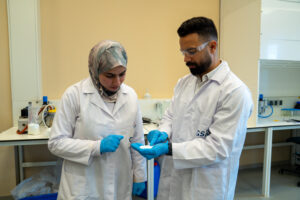
Struvite has been studied widely as a slow-release phosphorus fertilizer and is valued for its low water solubility and steady nutrient delivery, which can reduce losses and improve use efficiency. Struvite can be an effective, slow-release phosphorus source for crops.
Research also shows growing interest in hydroxyapatite and other calcium phosphate materials as slow-release P sources, particularly where long-term nutrient delivery matters.
The process yields three practical outputs, Balagh explains. This includes a calciumbased product suitable as an animal feed additive (dicalcium phosphate), which improves livestock performance and productivity. “Calcium is essential for bone… it affects their health and productivity,” Balagh said.
It also yields a magnesium-rich slow-release fertilizer (struvite) that supplies magnesium, a key element for photosynthesis because it is a central component of chlorophyll. Balagh emphasized magnesium’s role: “Magnesium is a key component in chlorophyll… it directly affects crop productivity.”
And finally, a phosphate-based, slow-release fertilizer (hydroxyapatite) that supplies phosphorus in a stable, long-lasting form.
These three products map directly to agricultural needs. Soils often show localized deficiencies of magnesium and calcium, and steady phosphorus delivery is a longstanding agronomic goal. Global fertilizer use has been trending upward after recent fluctuations, and major industry forecasts expect consumption to continue growing as food demand rises. This presents a context that strengthens the case for locally produced, affordable nutrient sources. According to the International Fertilizer Association’s outlook, global fertilizer consumption is expected to exceed previous records in the coming years.
From lab proof to industrial scale
Balagh and his team moved carefully from theory to practice. He revealed that the idea started with thermodynamic simulations that showed the reactions were feasible, then laboratory tests and parameter optimization followed.
The patent application covers a set of claims detailing the unique sequence and conditions they developed. Balagh noted that the World Intellectual Property Organization accepted all the key claims, underscoring the novelty of the method.
Why this could matter beyond Morocco
Three features make the innovation particularly attractive. First, it supports better resource management and landscape optimization. Converting mining stockpiles into marketable products reduces the volume of stored materials while creating additional value from existing resources.
Second, it encourages domestic value creation. Producing feed additives and specialty fertilizers locally can reduce dependence on imports and create new revenue streams for the mining and fertilizer sector. Morocco’s phosphate industry is already a global supplier, and diversifying product lines could strengthen its economic resilience while expanding its agricultural input portfolio.
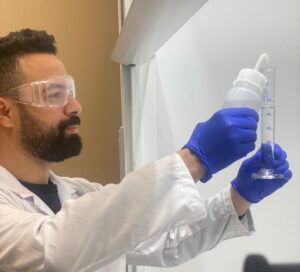
Third, the approach promotes cost efficiency and sustainability for farmers. By removing the need for polymer coatings and designing slow-release properties directly into the mineral structure, the process reduces production steps and associated costs. This could make slow-release fertilizers more affordable, which is a critical factor if farmers are to adopt them at scale.
When asked about the challenges the team faced, Balagh highlighted interdisciplinary ones. The team had to combine chemistry with geology, mining engineering, and agronomy to address feedstock variability, mineral bioavailability, and scale-up design. He said much of the early literature undervalued dolomite as a resource, so the team had to chart new experimental ground. “The existing literature had not fully explored the valorization potential of dolomite-rich residues,” he recalled, which pushed them to combine skills from several fields to find a workable route.
The next steps are pilot-scale validation, economic feasibility studies, and life-cycle assessments to quantify environmental benefits and costs. If these are positive, the team hopes industry partners will take the method to full industrial implementation.
Balagh summed up the project’s wider meaning with a sentence that cuts to the heart of circular-economy thinking: “Instead of investing more money to extract new resources, why can’t we recover value from what is already available and use this waste?”
That question, paired with chemical know-how and a patent to protect the process, is what makes this work notable. It offers an example of how mining sites can shift from being a source of residual burden to a source of agricultural value, helping farmers, supporting feed producers, and reducing environmental pressures in the process.
The post UM6P Breakthrough Turns Mining Waste into High-Value Fertilizers and Feed appeared first on Morocco World News.