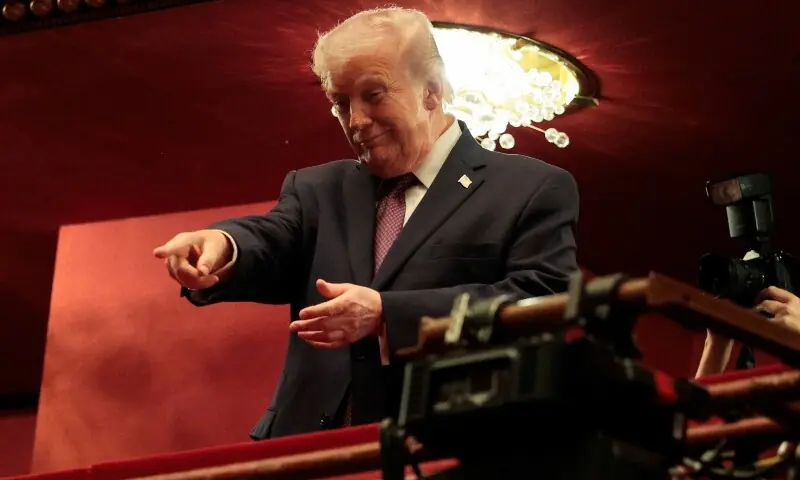
WASHINGTON: US President Donald Trump is set to address his nation at 9pm (EST) on Wednesday to provide what the White House has described as “an important update on Iran,” fuelling speculation that he may declare an end to the five-week conflict — with or without a negotiated settlement.
US media outlets, reporting the announcement, noted that Trump has brushed aside the need for a formal agreement to end hostilities. Speaking to reporters at the White House on Tuesday, he said US forces would likely leave Iran in “two or three weeks.”
“We leave because there’s no reason for us to do this,” Trump said. “We’ll be leaving very soon.”
In remarks that appeared to redefine the war’s objectives, he suggested that a negotiated settlement was no longer essential. “Iran doesn’t have to make a deal. It’s a new regime. They are much more accessible,” he said, adding that if the war has prevented Iran from developing a nuclear weapon, “then we’ll leave whether we have a deal or not.“
Domestic pressure, uncertain exit
The evolving tone comes amid mounting domestic pressure. USA Today noted that “Trump’s move to address the public comes as some two-thirds of Americans say they want the administration to end the fighting, even if it means the nation does not achieve the president’s goals.”
The Wall Street Journal reported that the conflict, “now in its fifth week, was initially forecasted to last four to six weeks, according to the Trump administration.”
The newspaper had earlier reported that Trump told aides he was willing to end the campaign even if the Strait of Hormuz remained largely closed, postponing the complex and risky operation required to reopen it.
NBC News reported that Trump told its team in a phone interview on Tuesday morning that “we’re doing great” and that the conflict is “coming to an end.”
The New York Times observed that Trump “could lay out any plans for an endgame to Americans,” citing White House Press Secretary Karoline Leavitt, who confirmed that the president would provide “an important update on Iran.”
Yet beyond the rhetoric of an imminent withdrawal, the strategic debate in Washington remains far from settled. While the president signals a desire to wind down US involvement, influential voices in policy and media circles are increasingly calling for a negotiated peace.
Pakistan-China initiative gains attention
Trump’s announcement followed a joint statement issued in Islamabad and Beijing outlining a five-point Pakistan-China peace initiative aimed at “restoring peace and stability” in the Middle East.
Vali Nasr, a prominent US scholar of Iranian affairs, described the joint statement as a significant signal. “The upshot of China-Pakistan 5-point statement on the war is that China’s answer to being asked to get involved was definitely not no,” he wrote on a post on X.
He added that the statement “is an opening for Beijing to step in,” noting that Pakistani leaders — who have been in contact with Washington — were also in Beijing, “which makes all this all the more interesting.”
In an earlier post, Nasr said Iran had “asked for guarantees in any deal with US,” and that Pakistan’s foreign minister went to “Beijing to get a guarantor for the potential deal.”
Another Washington-based scholar, Michael Kugelman, observed that the initiative “signals Beijing’s endorsement of the US-Iran peace process that Islamabad has sought to advance.”
For Islamabad, the initiative reflects a calibrated attempt to balance its ties with Washington and Beijing while projecting itself as a responsible regional actor advocating de-escalation and multilateral engagement.
‘Finishing the job’ or managing the conflict
Even as diplomatic openings emerge, a parallel debate has intensified in Washington over whether the United States should escalate militarily to “finish the job.”
Richard N. Haass, president emeritus of the Council on Foreign Relations, has warned against both abandonment and overreach.
He cautioned that “finishing the job (seeking victory in the war) did not serve the US well in either Korea or Iraq. It is unlikely to in Iran. The good news is the availability of viable alternatives.”
According to Haass, the slogan masks a lack of clarity about objectives — whether regime change, dismantling Iran’s missile and nuclear capabilities, seizing enriched uranium, or wresting control of strategic assets such as Kharg Island. Each option, he argues, carries heavy military, political and economic risks.
While acknowledging that a “benign Iran” would be the ideal outcome, he contends that regime change “is not something that can be engineered from the outside or expected from within” in the near term.
Instead, Haass proposes reopening the Strait of Hormuz as an urgent priority, possibly through a jointly managed “Strait of Hormuz Authority” involving the United States and Arab states bordering the waterway.
He has also argued for halting targeted killings of Iranian leaders, avoiding strikes that alienate civilians, and pursuing negotiations to cap Iran’s nuclear programme in exchange for sanctions relief.
In his view, US policy “must be based on managing the Iran that is, not the one we would prefer.”
A pivotal address
Trump’s address is therefore likely to do more than signal troop movements. It could clarify whether Washington intends to pivot toward structured diplomacy, declare unilateral strategic success, or maintain pressure under a conditional ceasefire tied to Iran’s nuclear activities and conduct in the Strait of Hormuz.
For Pakistan, which has aligned itself with China in advocating diplomacy and a UN-led process, any peaceful resolution of the conflict would serve as a validation of its stance and potentially elevate its diplomatic profile.
Much now hinges on what the US president tells Americans — and the world — on Wednesday night, and whether his words bring clarity to a conflict whose political endgame remains as contested as its military phase.