The Tadoba-Andhari model: Balancing rising tiger populations with human costs
•It is tiger time in India.
•All over the country, across at least 25 of the 58 tiger reserves, millions of people across economic classes and geographies are on the move despite the summer heat.
•Piling into jeeps, fancy SUVs, or forest department buses, and armed with mobile phones, point and click cameras or dangerously long lenses, they must jostle for just the right angle while hushing lit...
هذا الخبر من Indian Express. خبر يقدم أدوات ذكاء اصطناعي للتلخيص والترجمة والاستماع.
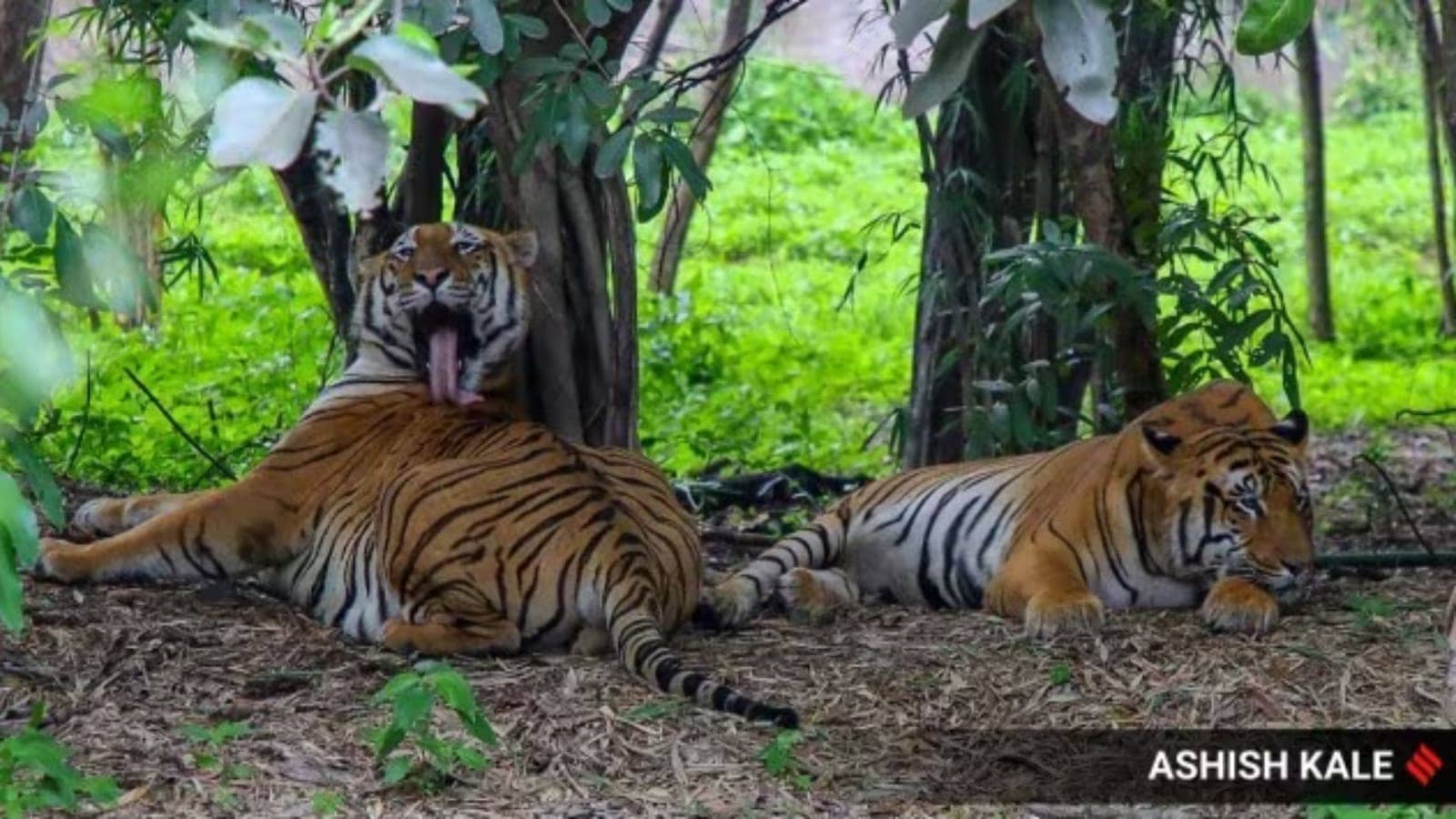
It is tiger time in India. All over the country, across at least 25 of the 58 tiger reserves, millions of people across economic classes and geographies are on the move despite the summer heat. Piling into jeeps, fancy SUVs, or forest department buses, and armed with mobile phones, point and click cameras or dangerously long lenses, they must jostle for just the right angle while hushing little children and girding for the unexpected bumps in the jungle. All to catch a glimpse of arguably the world’s most striking predator, globally seen almost nowhere else in the wild. When safari goers finally spot a stripe, the mood of the entire vehicle changes. People get a recognisable “tiger face”, a mixture of awe, delight and smugness. Passersby just know, and experience FOMO in turn. We were particularly lucky recently in the Tadoba-Andhari Tiger Reserve (TATR) in Maharashtra, when a two-day trip led us to 10 individual tigers, including the famous Junabai with her four young cubs. It led me to understand that TATR is somewhat of an outlier among tourist-friendly tiger reserves. First and foremost, the terrible news. TATR witnesses lethal human-tiger conflict. There are about 10 tiger-related human deaths a year in TATR alone, and around 45 in its district of Chandrapur. Add to that the cattle deaths from wild animal attacks, and we can understand just how vulnerable local communities feel. TATR has around 100 tigers. There have been no reported conflict deaths in the core zone of 625 square kilometres, from where entire villages have been voluntarily relocated over the past decades. Despite strict control over numbers, 1,17,000 tourists drove safely through the core in the past year alone. Tiger numbers in Tadoba-Andhari keep growing, a metric of successful tiger conservation. However, that means that tigers must keep dispersing beyond the buffer zone, itself more than 1,000 square kilometres, with 95 inhabited villages and a population of 1.25 lakh. Yet, 2,63,000 tourists took their chances at wildlife sightings in the buffer last year. Despite the conflict, there appears to be unusual stability in the tiger reserve. The Forest Department there routinely refines its management practices. It is very quick to release the compensation for both human and cattle deaths. More importantly, it has tried to ensure that locals have a solid stake in forests and tourism. All tiger reserves are mandated to do that by the NTCA, but much innovation has been initiated or imported into TATR. Without local co-operation, no wildlife reserve can even operate. The farmers around the Nagarahole tiger reserve in Karnataka recently demonstrated their angst against tiger-related conflict by causing a shutdown of all tourism facilities for six months in the prime season. It did not solve the conflict problem. Yet it caused immense loss to the local tourist economy and the public exchequer, as some parks like Kabini are run by a government monopoly. Now, a new compromise is being crafted where all stakeholders can see some benefit. There is no need to reinvent the wheel. In TATR, as in many well-managed parks in Madhya Pradesh, a win-win has long been orchestrated. Thanks to earlier visionary bureaucrats, there has been genuine financial decentralisation. That process continues to be strengthened today. Many villagers, especially those relocated from the core areas, benefit from the booming tourism economy. At least half the households get direct employment from the forest department itself, with 400 locals as safari guides alone. It supports value-added forest produce collection with honey and amla sales. It invests in zero-waste management employing women workers. It conducts safety protocol training and school trips for thousands of children to appreciate nature and wildlife. Booking for safaris is easy online, regulated within the carrying capacity of the forest across 22 gates. A significant proportion of the ticket revenues of Rs 40 crore a year is redistributed locally to reduce wildlife conflict, improve livelihoods and increase awareness. Poaching is now negligible, as a tiger is worth more alive than dead. TATR has ambitious plans to build strategic partnerships for moving the tourism focus beyond just tigers. The field director spoke of agrotourism, stargazing, cycling, boating, ayurvedic spas and butterfly parks. TATR has its own water bottling plant, again creating employment locally, and dispatches glass water bottles with every tourist to avoid single-use plastics. The young guide who accompanied us agreed that the strategy was working reasonably well. While some villagers lament the more restricted access into the core forest for mahua and other minor forest produce, most accept the trade-off for more stable income, and better access to modern infrastructure – especially broadband. Naturally, there remain many problems to solve. For example, like all reserves, TATR must rethink ubiquitous water hole projects. These add unnatural numbers to the prey base and the predator population, leading to the conflict nobody needs. We cannot take for granted villagers around these protected areas who have centuries of cultural practices, belief systems and lived experience that allow them to bear the burden of protecting our biodiversity. Urbanites cannot live with spiders, let alone tigers. Yet, we drive defensively on our chaotic streets and highways, knowing deep within that we could still become a statistic like the 1,60,000 people who die in road accidents in India each year. We know we need vehicles, but we must better manage people-traffic movement to achieve maximum mobility with minimum fatalities. Equally, India understands that we need our tigers and our biodiversity, even if we use only economic logic to show how it contributes billions of rupees of ecosystem services annually. We must aim for maximum natural capital regeneration with minimum loss of life. TATR shows one of many paths to co-existence with potentially dangerous wildlife that make all our lives worth living. The writer is Chairperson, Rohini Nilekani Philanthropies and the author of ‘Samaaj, Sarkaar, Bazaar – A Citizen First Approach’المصدر: Indian Express | Source: Indian Express
ملاحظة تحريرية | Editorial Note: نُشر هذا المقال في الأصل بواسطة Indian Express. خبر (Khabr) هي منصة إعلامية أردنية مرخّصة تعمل بالذكاء الاصطناعي. نضيف قيمة تحريرية من خلال: تحليل ذكي للأخبار، ملخصات تلقائية، رواية صوتية بالذكاء الاصطناعي، ترجمة متعددة اللغات، وتدقيق الحقائق. هدفنا جعل الأخبار أكثر وضوحاً وسهولةً للقارئ العربي.
This article was originally published by Indian Express. Khabr is a licensed Jordanian AI-powered news platform (Registration #82086). We add editorial value through: AI-powered news analysis, automated summaries, AI audio narration, multi-language translation (Arabic, English, French, Turkish), and AI fact-checking. Our mission is to make news more accessible and understandable for Arabic-speaking audiences worldwide.