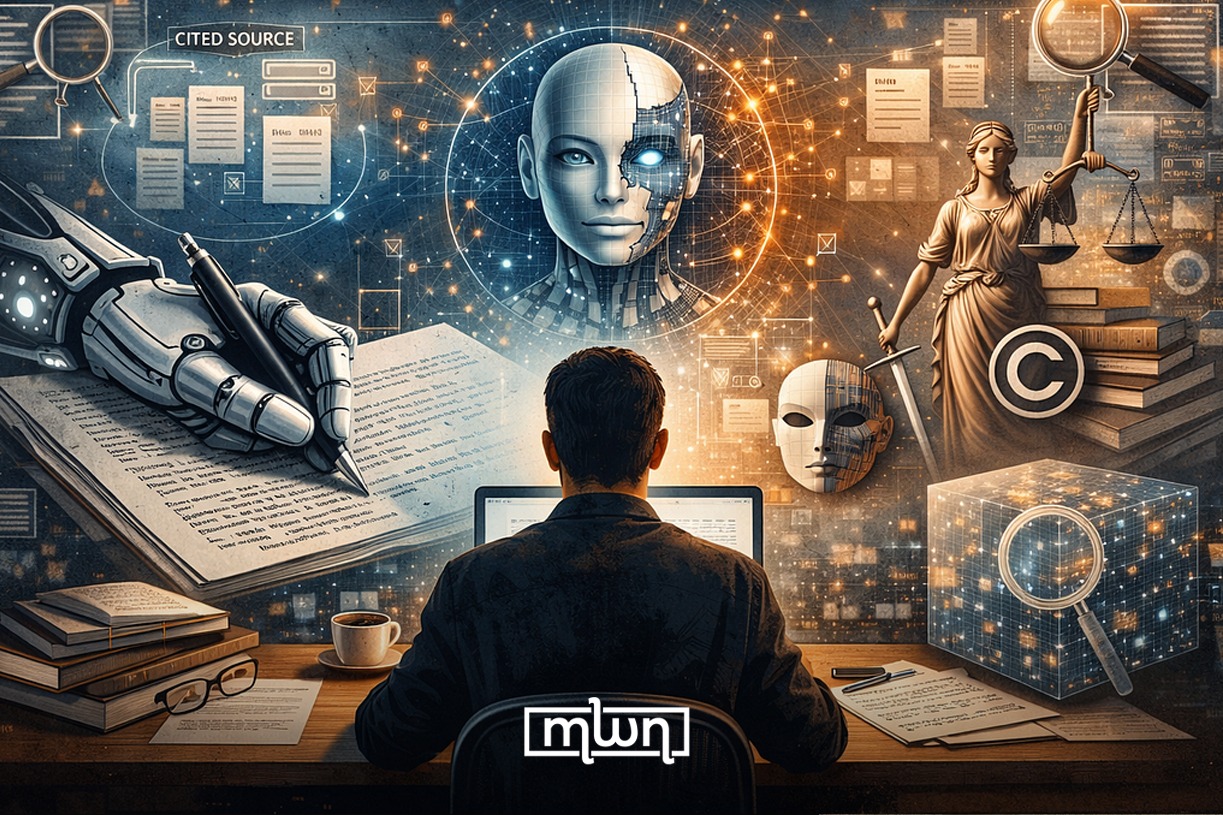
I often find myself returning to the subject of AI, and to the striking speed with which educational institutions have rushed to adopt it. At this point, it feels less like a smooth transition and more like a race, with everyone scrambling to reach the finish line first. I see this as a symptom of something deeper: our collective inability to know, let alone predict, the future. Futurology has offered some utility in mapping broad trajectories, but it has largely failed to anticipate the particular character of what we are now facing. I, therefore, do not think it can serve as a reliable compass to guide us away from this unfolding crisis.
What puzzles me is how total this capture has become. Nearly every conference title I have come across in recent months centers AI in relation to some abstract or concrete subject. My own university is no exception. There is mounting pressure to acquire AI literacy, to become job-ready in a market increasingly defined by these tools. The reassurance offered, one I heard no fewer than five times at a recent career day , is that AI will not replace human effort but will instead optimize it.
I find this reassurance to be extremely hollow and hard to believe. It rests on a generous, and I think inaccurate, assumption about human nature, namely that people will always strive to do their best work regardless of the minimal amount of effort required. That is simply not always the case. When an easier path exists, many will take it, and AI is very often that easier path. There is a real disconnect between how we imagine generative AI tools will be used and what most students and employees are actually using them for.
Against the outsourcing of thought
What concerns me most, however, is the domain in which this is playing out. As a humanities student, someone invested in philosophy, the arts, and the full breadth of human cultural expression, I cannot find a defensible middle ground. The humanities are not incidentally human; they are constitutively so. Our scholarship exists to study and dissect the human across time, geography, and civilization. To outsource that thinking to a machine is a blatant contradiction in terms and, I would argue, a form of intellectual self-destruction.
We need to pause and reflect before jumping on this bandwagon. I understand how difficult that is when every week brings a new model or a new product from a multi-million dollar company. Yet that relentless novelty is precisely the problem. It manufactures a kind of morbid curiosity that draws people down paths they have not thought carefully about. People are becoming increasingly prone to a chronic fear of missing out on the latest updates and their optimized functions, haunted by the very real possibility of replaceability.
I genuinely believe we are starting to lose focus, our grip on reality beginning to loosen up by the millisecond. We are leaving behind the essential humanity of disciplines that have always belonged to us. Consider philosophy. The birth of the author was a watershed moment in our civilizational progress, the emergence of individual human consciousness as the source and guarantor of meaning. To dissolve that through language models is erasure. I can only conceive
of it as an assault on civilization and on the accumulated achievements of the human mind. I am not a pessimist when it comes to technology, but I believe that our relentless abuse of AI will undo the birth of the author entirely.
And yet I think we have already moved past mourning the author. We are now living in the age of the polyvalent, the passe-partout: the generalist who is also fluent in leadership, entrepreneurship, and whatever other competencies happen to be in demand. Not especially deep in any one area, but serviceable across all of them. Perhaps a capable coder, maybe even a polished public speaker, but fundamentally a generalist. I believe that with the death of the author, we are also witnessing the rise of this figure.
In his landmark 1967 essay “The Death of the Author,” French philosopher Roland Barthes coins this infamous title and challenges the idea that language is stable and that the interpretation of the text is restricted to its authorial intent. Drawing upon a Derridean deconstructionist framework, Barthes argued that the onus of meaning-making is the responsibility of the author.
Critics of his “Reader-Response Theory” particularly call out the staunch disregard for context and history as part of the analytical toolkit available to the reader, which enables a form of interpretive solipsism that ascribes meaning to personal whims. My personal vendetta is more so with the use of a clever symbolic phrase while failing to realize its purely metaphorical function. The 21st author is arguably more alive than ever. The publishing industry remains today a multi-billion dollar sector that is producing super stars, and while one can argue that the shift towards prioritizing commercial viability is in fact a death in and of itself for the author as a figure, yet to frame this transformation as “death” or erasure is ultimately misleading.
The author is ongoing a reconfiguration, without his consent, into a generationalist know-it-all who is required to perform authority and expertise across a wide range of disciplines. Much like the entertainment industry’s “idol,” the modern day author is legally required by his many contracts to sustain an outpour of marketable ideas and generate profit for his publishing company. It is hard to imagine writing as a mystified process that requires deep thinking and contemplation when the bureaucratic nature of publishing is so visible to the naked eye.
While the essay can serve as a cautionary tale against idolizing authorship, it seems to completely miss the mark on the significance of the material conditions under which text is produced and places too much faith, in my opinion, on the reader’s ability to create meaning that is unconstrained or untainted by personal bias. The birth of the generalist can also be understood as the intensification of the same mechanisms through which the author is being reinvented, making the former a symptomatic extension of the neo-liberal tendencies present in contemporary knowledge economies.
The ‘generalist’ problem
You can see it clearly in how companies now recruit. They want someone who can be deployed anywhere, who can respond to any problem, who is never stumped because they are never truly specialized. For those with a genuine niche, a specific intellectual passion that does not map cleanly onto market demand, this is a quietly hostile environment.
I want to make it clear, however, that I am not arguing against breadth of learning. The more one learns, the richer one becomes as a thinker and as a person. What I am arguing against is the cultural tolerance, even celebration, of a kind of competent mediocrity. Filler positions with grand titles and no real substance. Voices that are loudest in meetings precisely because they have nothing particular to say. We have reached a turning point where we are now building institutions that accommodate and reward such inadequacy, all the while penalizing anyone who dare criticize this chaos branded as a new order.
By accepting the death of the author and the slow disappearance of the authentic thinker, we are ushering in a mediocracy. Thinking has acquired a price tag. It has become something to sell, to market, to pitch to potential employers, and this should keep you up at night. We have reached a strange unprecedented epoch where thinking requires far more effort than writing, because we have severed the two activities. Writing has become automatic and available on demand, while genuine thought demands isolation, stillness, and peace of mind to achieve. This severance is dangerous. The data on intergenerational IQ decline is there for anyone who cares to look it up, and I suspect those who remain skeptical need only sit in on a classroom or a conference to see for themselves what has become of serious intellectual discourse.
Perhaps the deepest blow to the arts, the humanities, and the literary world is not AI at all, but institutionalization. Everything now is an institution of some sort. You go to college to receive an education and are then told you must secure an internship, that the end goal is a job, a respectable office job considered dignified and set apart from manual labor, because you have the education, because you have the qualifications, because that dignified desk job is your rightful destination.
So the author, the philosopher, the artist enters the institution in search of education and leaves with a kind of manufactured consciousness that stifles his creativity and makes him a contented worker, one satisfied with a status quo that grants him a dignified life, grateful, above all, that he is not the one cleaning toilets or carrying heavy furniture, not performing the kind of labor deemed essential yet, somehow, never quite respectable.
Despite my lack of faith in futurology, combined with its failure to predict or prevent this hellscape of a reality we’re attempting to survive, I will still bet it all on the possibility that by some grace from the universe we will preserve whatever is left of human wit and intelligence. While I also have no faith in the institution in its most bestial unhuman manifestations, I will always be of the opinion that it is possible for change to happen from within.
The post The Great Intellectual Surrender appeared first on Morocco World News.