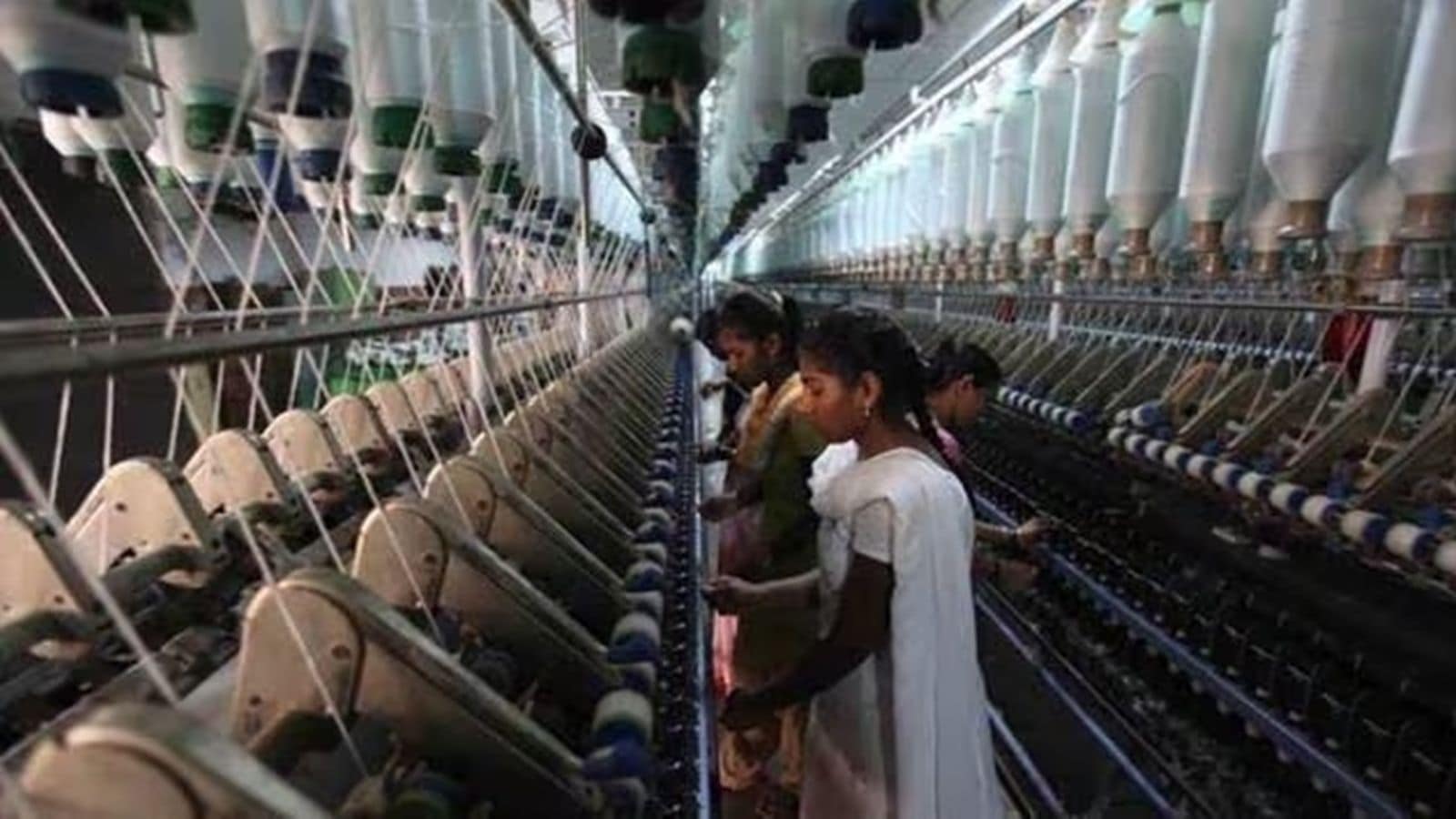
At a small stitching unit tucked inside a narrow lane in Royapuram in Tiruppur town, the whirr of machines fades in and out in the afternoon heat. Half-stitched corporate uniforms and a bundle of sports uniforms lie piled on a wooden table. A ceiling fan rotates slowly. Outside, a worker keeps checking his phone for confirmation of a payment. With the Tamil Nadu Assembly election campaign in the final stretch, the West Asia crisis is quietly shaping conversations in the state’s textile hub. And, beyond leaders in Delhi or Chennai, the one name that is driving those conversations across the board is US President Donald Trump – though no one is sure what that will mean come April 23 polling day. In the 2021 Assembly elections, while Tiruppur (North) was won by the AIADMK, which is this time an ally of the BJP, by 40,000-plus votes, Tiruppur (South) saw the DMK, which otherwise swept the 2021 polls, finish first by a narrow 4,000-odd votes. Those polls were held in the midst of the Covid shock, which had also dealt a severe blow to Tiruppur’s textile-driven economy. Now, more than one person qualifies their reference to Trump with three words: “a mad man”. Nagul, who supplies corporate uniforms and sportswear to clients across Indian cities, points out that before the West Asia crisis, there was the 50% tariff on India imposed by the Trump administration. “The last three months have been difficult. Those who used to order a thousand pieces want only 100–200 pieces. The Rs 10 lakh monthly business has fallen to Rs 2 lakh… Meanwhile, raw material prices are rising – Rs 20-25 per kg for cotton polyester, for example.” India’s textile sector, which contributes roughly 3% of the global apparel trade, is heavily dependent on markets such as the United States, Europe and the United Kingdom. For Tiruppur, the Gulf market is one of the largest, with around Rs 450 crore to Rs 500 crore worth of knitwear headed there every month. In the wake of the war, logistics costs have surged on an average by as much as 400%, the prices of chemicals and man-made fibres by about 20%, and cotton prices by about 5%, along with a broader spike in energy and polymer prices. Manufacturers are bearing the brunt as they can’t pass on the costs to their buyers. Amidst the mixed news coming from the Strait of Hormuz – still “closed”, Iran declared Saturday – shipments of many exporters remain stuck. Naveen Kumar, a mid-sized exporter in Tiruppur, says his container with a load worth several lakhs has been unable to leave Dubai port for the past one-and-a-half months. “If we reroute via Singapore, costs will increase further. This month, we paid salaries from our own pocket. Everything is getting disrupted… totally sabotaged.” Kumar Duraiswamy, an exporter himself and the joint secretary of the Tiruppur Exporters’ Association, lists the disruptions that have hit the industry over the past decade – starting with demonetisation and GST reforms, and followed by the Covid-19 pandemic, the Russia-Ukraine war, the post-pandemic slowdown in Western markets, and the recent US tariff pressures. What this has meant post-Covid, Duraiswamy says, is that export demand has shifted towards low-cost, high-quality products, with growth increasingly led by value retailers and large-scale manufacturers. But India has a fragmented manufacturing ecosystem with a limited number of large factories, he points out. The risk of order cancellations is now rising, particularly for seasonal products where timing is critical. The 11% import duty on cotton is further hurting competitiveness, with Brazilian cotton 10% to 14% cheaper, Duraiswamy says, adding, unless such structural issues are addressed, demand could shift to competing countries such as Pakistan and Bangladesh. Every stage of the chain is stressed, says Sekhar, a small stitching unit owner. “Stitching, ironing, packing… rates of all have increased. Fabric prices have gone up. Electricity costs have gone up three times.” Sekhar gives the example of an order pending with him for 60 pieces of sports wear for a corporate event. “The client has yet to decide and pay… but there is a deadline. So I have already sourced materials and started work.” If the trend continues, he says, cuts are inevitable. “I will be forced to let go of five of my 10 workers if the situation continues for three more months.” Prominent industry faces in Tirupur are seeking help from banks and the government to tide over the bump, including measures such as deferment of loan repayments, restructuring of stressed accounts, enhanced working capital limits based on past performance, and faster credit disbursement without additional collateral requirements. They have also called for reduction in interest rates to viable levels, time-bound policy decisions, and extension of export support schemes such as the Rebate of State and Central Taxes and Levies. Small and medium enterprises account for nearly 95% of Tiruppur’s exporters. These support a network of workers, handling dyeing, printing, embroidery and packing. Nearly 4 lakh workers live in hostels attached to factories in Tiruppur, and the West Asia crisis left them grappling with the surge in prices of LPG cylinders and in other basic needs. At a dyeing unit on the outskirts of Tiruppur, workers wait besides idle machines as supervisors discuss alternative schedules. Durai Palanisamy, chairman of the Southern India Mills’ Association (SIMA), advises the government to prioritise the textile sector in LPG allocation, noting how labour-intensive the industry is. Besides the impact on labour, Palanisamy’s estimate is that 20-30% of production is hit due to LPG shortages, because of gas-dependent processes such as singeing – where protruding fibres on fabric surfaces are burned off – and gas-fired boilers getting affected. As for the alternative suggested, Palanisamy points out that modern units cannot revert to coal or firewood easily. Arindhar Sahani, a worker from Uttar Pradesh, says that for now they are not feeling the pinch. The few labourers who did go home went due to the wedding season back in UP, he says. “There was some fear initially, but now it is manageable.” Dharmaraj, an auto driver in Khaderpettai who also works at a stitching unit, believes it is only elections that have kept the LPG shortage reaching their homes. “But look at the Royapuram stretch (in the town), eight out of 10 tea shops have closed, or function only thrice a week, due to the LPG shortage. Labourers are sourcing wood to prepare meals. Hotels are struggling. Everything is becoming costly,” he says. Dharmaraj believes this will be very much on people’s minds when they vote. Plus, the “madness” of Trump. “If there is one person everyone wants to defeat in this election, it would be Trump.” Arun Janardhanan is an experienced and authoritative Tamil Nadu correspondent for Read More
المصدر: Indian Express
| Source: Indian Express