The bike that could save billions
المصدر: Dawn | Source: DawnAmjad has been delivering food in Karachi for six years. His bike, a machine so ubiquitous in Pakistan it might as well be a national symbol, burns through five litres of petrol a week. When oil prices spiked in March 2026, his fuel bill jumped by nearly a third overnight. He does not own the bike. He pays daily rental to a fleet owner and splits whatever margin remains between revenue and costs. Some nights, after fuel and rental, he clears less than Rs500. He has heard about electric bikes. He asks the same question everyone in his position asks: how does one pay an upfront cost for an electric bike?
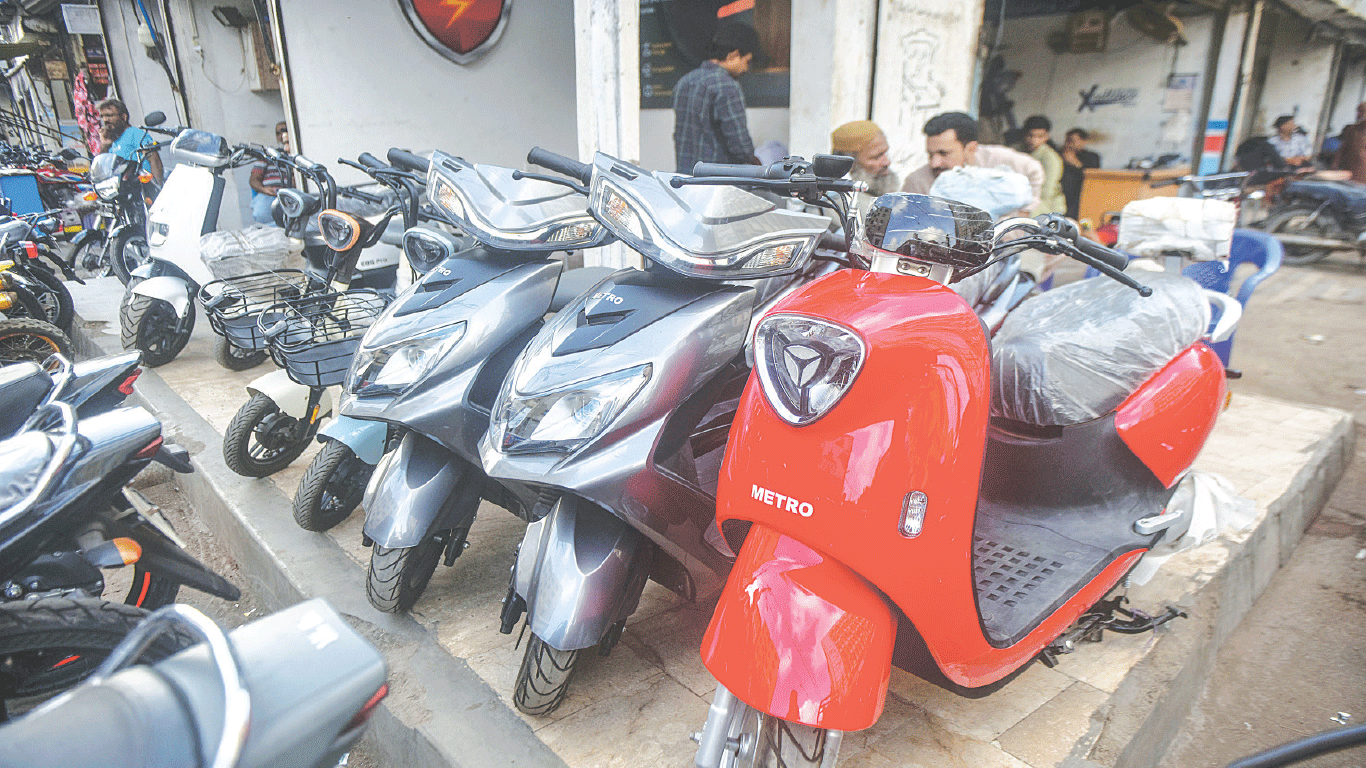
That question is the crux of Pakistan’s electric motorcycle problem. The economics are not in dispute. An electric motorcycle running on 1.4 kWh of charge per trip costs Rs40 in electricity versus Rs300–325 in petrol for the same 60 km. Annual operating savings run around Rs70,000 per bike, enough to pay back the price difference in under two years.
Pakistan has 30.52 million registered motorcycles, consuming roughly 3.2m metric tonnes of petrol annually, translating to roughly $2.5 billion in import costs from this single vehicle class alone. The arithmetic for switching is overwhelming. The barrier is not the numbers. It is the sticker price of an entry-level electric bike when the buyer has no savings, no credit history, and no government programme to bridge the gap.
What Vietnam did
In 2022, Vietnam had a motorcycle fleet problem that looked a lot like Pakistan’s, with 45m registered two-wheelers, a petrol import bill climbing with every crude price cycle, and an economy in which the motorbike was less a transport choice than a survival instrument. VinFast launched its VF electric scooter at around $500, comparable to an entry-level petrol equivalent.
With battery swap stations, every electric bike charged converts an idle capacity payment from a fiscal liability into productive revenue
The government simultaneously removed registration tax on electric two-wheelers, mandated that ride-hailing platforms transition their fleets to electric, and provided a targeted purchase subsidy for the first tranche of buyers. Within two years, electric two-wheelers crossed 15 per cent of new sales. The key difference between Vietnam then and Pakistan now is not technology, cost, or consumer willingness, it is policy execution.
The swap model
The objection most frequently raised against electric motorcycles in Pakistan is the charging infrastructure. Where do riders charge if they live in a one-room rental with shared wiring? The answer — operational at scale across Southeast Asia — is the battery-swap station.
In Vietnam, Indonesia, and parts of China, riders do not charge batteries, they swap them. A depleted battery is exchanged for a fully charged one at a kiosk the size of a large refrigerator. The whole process takes 90 seconds. A single swap station serving 200 riders per day costs between $5,000 and $8,000 to set up and occupies less than 50 square feet. This is not a public infrastructure problem requiring government capital. Rather, it is a franchise opportunity.
Indonesia launched a structured battery-swap programme in 2023. Fleet operators, exactly the kind of owner Amjad rents from in Karachi, were offered subsidised electric bikes on the condition that they contracted with swap-station operators for battery supply. The fleet owner’s fuel cost became a fixed monthly contract instead of a volatile daily exposure to oil prices. His drivers, the Amjads of Jakarta, got predictable costs and zero range anxiety. Pakistan’s food delivery, logistics, and ride-hailing platforms are natural anchors for an identical model.
The surplus nobody is using
Pakistan has 46,605 MW of installed generation capacity. Peak summer demand reaches 28,000–30,000 MW. The structural surplus, the capacity for which the country pays around Rs2 trillion in annual capacity charges regardless of whether a single electron is generated, is 16,000-18,000 MW. At night, between 10PM and 6AM, when industrial demand drops and most of Pakistan sleeps, the available surplus expands to 20,000–25,000 MW. Moreover, during the day, the marginal cost of electricity drops to as low as Rs6 per kWh, given the prevalence of behind-the-meter solar across the country.
Electrifying 5m motorcycles by 2028 would add approximately 1TWh to annual electricity demand, representing under 1pc of current national consumption, drawing almost entirely during off-peak hours. The grid is underutilised; battery charging becomes an optimisation problem, where fleet operators align charging and pricing of battery swaps according to the most favourable rate available.
Every electric bike charged converts an idle capacity payment from a fiscal liability into productive revenue for electricity distribution companies while simultaneously displacing imported petrol. In such a scenario, everyone wins, including the grid, the consumer, as well as the balance of payments.
Amjad’s answer
Back in Karachi, Amjad’s question — who pays the first cost? — has a workable answer. It involves three mechanisms that do not require inventing anything new.
The first is fleet conversion. Pakistan’s food delivery, logistics, and ride-hailing platforms operate tens of thousands of motorcycles through fleet-owner intermediaries. A government programme offering zero-duty import of electric two-wheelers for registered commercial fleet operators, combined with a Rs15,000-20,000 per-unit purchase subsidy funded from the Petroleum Development Levy (PDL), would trigger immediate fleet conversion at scale.
This would literally be the first reasonable use of PDL, which is currently being used to bridge the budget deficit. Within twelve months of programme launch, a credible commitment to fleet conversion could put 300,000-500,000 electric bikes on the road.
The second is a scrappage scheme for individual riders. Pakistan has approximately 9.4m motorcycles over 10 years old; disproportionate fuel consumers running on degraded engines. A structured exchange offering Rs10,000-15,000 trade-in credit on an old petrol bike toward the purchase of a new electric unit would accelerate fleet turnover for precisely the income segment that can least afford the upfront cost. The fiscal cost at 500,000 exchanges per year, Rs7.5bn annually, is a fraction of the fuel import savings it generates.
The third most crucial element is a standardised battery. Pakistan needs to adopt interoperability standards for electric two-wheelers, or any relevant configuration dominant across Southeast Asia, which mandates interoperability across all manufacturers. Without this, battery-swap networks fragment by brand and never achieve the density that makes them viable. With it, a private sector swap network can emerge without a single rupee of public capital for infrastructure.
The March 2026 oil price shock, when Dubai crude briefly doubled in a fortnight, was a preview. Pakistan’s petroleum import bill at peak-shock pricing would have exceeded $23bn annually, more than twice the country’s liquid foreign exchange reserves. The motorcycle fleet alone, at 3.2m metric tonnes of petrol annually, represents a recurring foreign exchange exposure of $2.5bn that the country has the technology to eliminate within three years.
Amjad does not need a presentation on the balance of payments. He needs a bike he can afford to run when petrol spikes. The policy tools to give him one exist. Vietnam, India, Indonesia, China, etc have all used them. Electrification is a solvable problem, which not just improves the overall balance of payments, but also improves net household income due to lower expenditure on transport.
The writer is an assistant professor of practice at IBA, member of the Thar Coal Energy Board, and CEO of NCGCL
Published in Dawn, The Business and Finance Weekly, April 20th, 2026
ملاحظة تحريرية | Editorial Note: نُشر هذا المقال في الأصل بواسطة Dawn. خبر (Khabr) هي منصة إعلامية أردنية مرخّصة تعمل بالذكاء الاصطناعي. نضيف قيمة تحريرية من خلال: تحليل ذكي للأخبار، ملخصات تلقائية، رواية صوتية بالذكاء الاصطناعي، ترجمة متعددة اللغات، وتدقيق الحقائق. هدفنا جعل الأخبار أكثر وضوحاً وسهولةً للقارئ العربي.
This article was originally published by Dawn. Khabr is a licensed Jordanian AI-powered news platform (Registration #82086). We add editorial value through: AI-powered news analysis, automated summaries, AI audio narration, multi-language translation (Arabic, English, French, Turkish), and AI fact-checking. Our mission is to make news more accessible and understandable for Arabic-speaking audiences worldwide.