Swiss researchers test ANYmal robot for autonomous Mars simulation missions
المصدر: ARY News EN | Source: ARY News ENSwiss researchers have developed a semi-autonomous, dog-like robot that is being tested for use in space exploration, particularly on Mars.
This robot could significantly speed up the search for minerals, water, and signs of ancient life on other planets or exoplanets, as it does not require constant human direction.
In recent trials, the robot completed its assigned missions three times faster than equivalent human-guided alternatives.
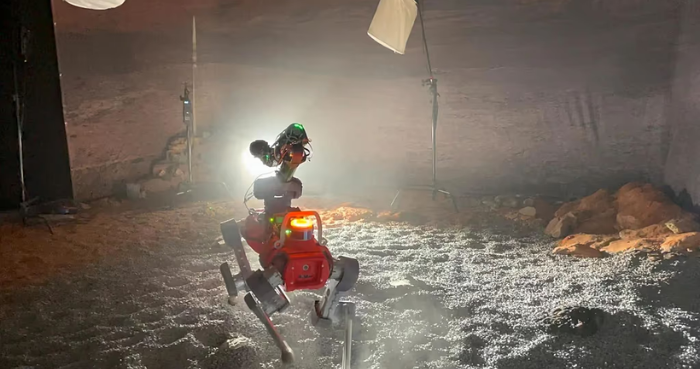
Researchers at the University of Basel’s “Marslabor,” a simulation facility designed to replicate the dusty, rocky terrain of Mars and the Moon, have been testing a four-legged robot named ANYmal.
ANYmal, which resembles a robotic dog more than a traditional rover, is equipped with a sophisticated scientific payload: a robotic arm carrying a microscopic imager and a Raman spectrometer, a device capable of scanning and identifying the chemical fingerprint of rocks.
The robot’s goal was to operate autonomously: navigate the simulated Martian environment, locate rocks of scientific interest, analyze them with its instruments, and transmit the data, all without human intervention.
ANYmal demonstrated superior speed in autonomous missions, completing them in just 12 to 23 minutes, significantly faster than the 41 minutes required for a human operator.
Its trials, detailed in Frontiers in Space Technologies, successfully involved sequentially analyzing multiple rocks and identifying various materials, including soft sulfate minerals, gypsum carbonates, basalts, and lunar-analog materials like dunite and anorthosite. While autonomous operation was faster, human oversight yielded results that were marginally more accurate and slightly more detailed.
Mars rovers currently operate under near-constant supervision from Earth, which covers only a hundred meters per day. The pace of exploration could be dramatically accelerated by using a robot capable of making its own scientific decisions.
This study also highlights the scientific benefits of legged robots, specifically their ability to navigate challenging, uneven terrain, such as obstacle-filled zones that wheeled rovers cannot traverse.
Overall, the research suggests a future where robots like ANYmal will serve not only as remote tools but also as autonomous scientific agents. They will be able to independently search for biosignatures, chemical traces that might reveal ancient life on distant planets.
ملاحظة تحريرية | Editorial Note: نُشر هذا المقال في الأصل بواسطة ARY News EN. خبر (Khabr) هي منصة إعلامية أردنية مرخّصة تعمل بالذكاء الاصطناعي. نضيف قيمة تحريرية من خلال: تحليل ذكي للأخبار، ملخصات تلقائية، رواية صوتية بالذكاء الاصطناعي، ترجمة متعددة اللغات، وتدقيق الحقائق. هدفنا جعل الأخبار أكثر وضوحاً وسهولةً للقارئ العربي.
This article was originally published by ARY News EN. Khabr is a licensed Jordanian AI-powered news platform (Registration #82086). We add editorial value through: AI-powered news analysis, automated summaries, AI audio narration, multi-language translation (Arabic, English, French, Turkish), and AI fact-checking. Our mission is to make news more accessible and understandable for Arabic-speaking audiences worldwide.