Supreme Court refuses to shield lawyer after ‘unfounded allegations’ against Bombay High Court judge
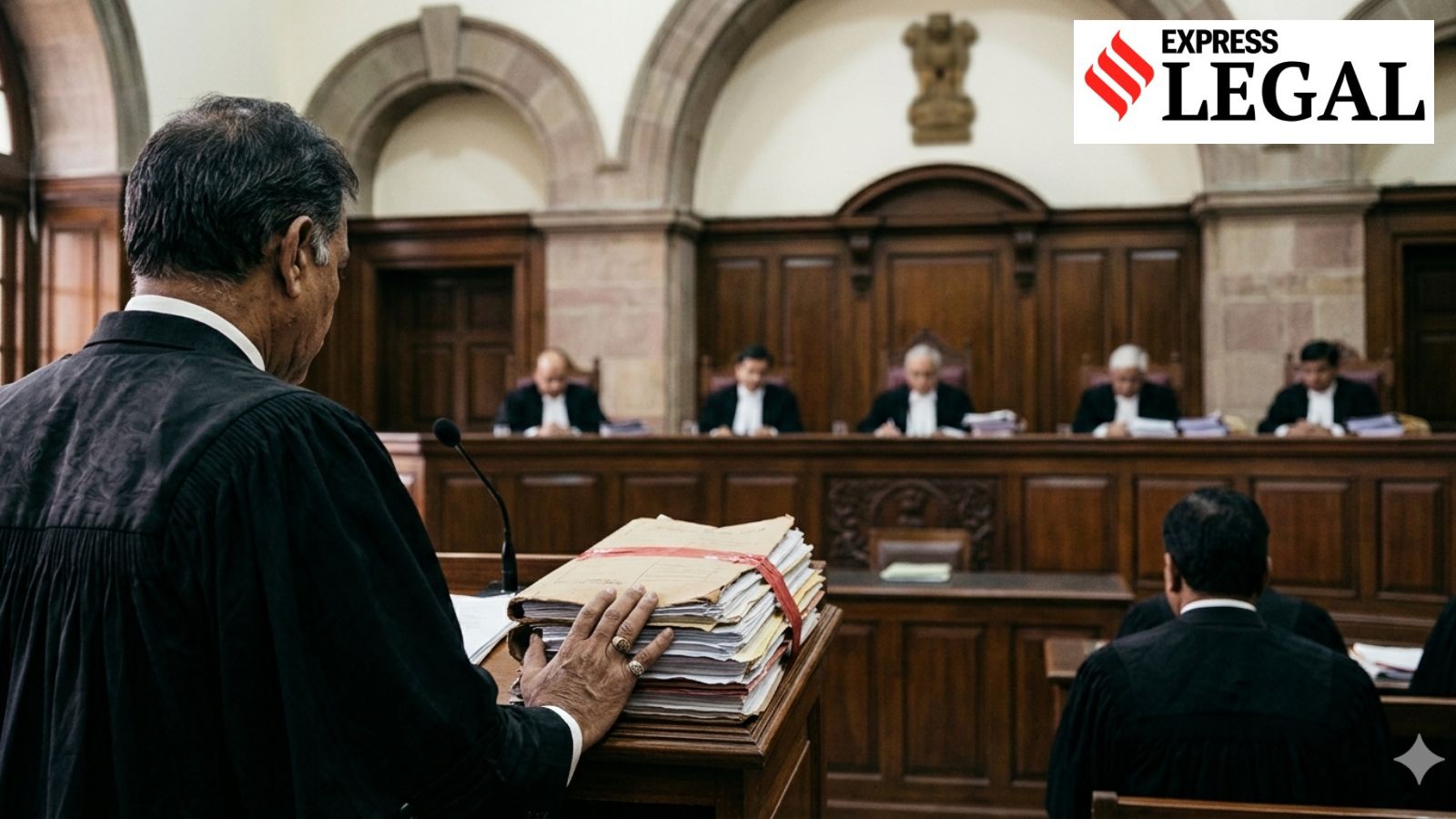
Weather ePaper Today’s Paper Journalism of Courage Home ePaper Politics Explained Opinion India Business Premium Cities UPSC Entertainment Sports World Lifestyle Tech Subscribe Sign In TrendingUPSC OfferIPL 2026US NewsPuzzles & GamesLegal NewsFresh TakeHealthResearch🎙️ Podcast Advertisement function checkAndLoadWindowSizeScript() { if (window.jQuery) { // jQuery is loaded, include your script jQuery(document).ready(function($) { // Your existing script for checking window width if (window.innerWidth) var page_w = window.innerWidth; else if (document.all) var page_w = document.body.clientWidth; if (page_w > 1024) { $(".add-left, .add-right").show(); } else { $(".add-left, .add-right").hide(); } }); } else { // jQuery is not loaded, check again after 0.2 seconds setTimeout(checkAndLoadWindowSizeScript, 200); } } // Initial call to the function checkAndLoadWindowSizeScript(); NewsLegalSupreme Court refuses to shield lawyer after ‘unfounded allegations’ against Bombay High Court judge Supreme Court refuses to shield lawyer after ‘unfounded allegations’ against Bombay High Court judge The Supreme Court was hearing criminal appeals filed by an advocate challenging the Bombay High Court’s orders arising out of suo motu contempt proceedings initiated over statements made during a press conference. Written by: Vineet Upadhyay8 min readNew DelhiApr 21, 2026 07:00 AM IST Public confidence in the judiciary constitutes an indispensable foundation of the rule of law, and any attempt to scandalise or sensationalise judicial proceedings undermines that very foundation, said the Supreme Court. (Image generated using AI) Make us preferred source on Google Whatsapp twitter Facebook Reddit PRINT Supreme Court news: The Supreme Court has refused to halt contempt proceedings against a lawyer for publicly levelling allegations against a sitting Bombay High Court judge, holding that such allegations, if left unchecked, possess an inherent tendency to erode public confidence in the administration of justice. A bench of Justices Vikram Nath and Sandeep Mehta was hearing criminal appeals filed by advocate Nilesh C Ojha challenging the Bombay High Court’s orders dated September 17 and October 16, 2025, arising out of suo motu contempt proceedings initiated over statements made during a press conference concerning a pending case. “Allegations of this character, if left unchecked, possess an inherent tendency to erode public confidence in the administration of justice. While accountability and scrutiny are integral to a constitutional democracy, imputations of personal nature against a Judge must rest on unimpeachable material and be pursued strictly in accordance with law, failing which, they risk undermining the very edifice of judicial independence,” the apex court said on April 20, underlining the limits of permissible criticism in a constitutional democracy. The case traces back to April 1, 2025, when advocate Ojha addressed a press conference a day before his writ petition filed on behalf of a client seeking a CBI probe into a death was listed before the Bombay High Court. During the media interaction, advocate Ojha made allegations against a sitting judge (referred to in the judgment as “Justice X”), suggesting that she should not hear the matter due to an alleged conflict of interest. The following day, April 2, 2025, the matter was mentioned before a division bench of the high court, which directed administrative steps in line with roster allocation. On April 4, 2025, the concerned judge wrote to the chief justice of the Bombay High Court, stating that the allegations had tarnished her reputation and impugned her standing within the judiciary. Acting on the letter, the chief justice took suo motu cognisance and constituted a five-judge bench to examine the issue. On April 8, 2025, the high court observed that the statements made in the press conference had the tendency to scandalise the court and interfere with judicial proceedings. A show cause notice was issued on April 9, 2025, formally initiating criminal contempt proceedings against Ojha. In the months that followed, Ojha filed multiple applications, including one seeking discharge from the contempt proceedings and another seeking to implead the judge concerned as a party. On September 17, 2025, the high court rejected the impleadment plea, holding that a judge who merely provides information to the chief justice cannot be treated as a complainant or necessary party in contempt proceedings. Significantly, the court also took note of fresh allegations made in the application and directed registration of a separate contempt case. A subsequent plea seeking recall of the order was dismissed on October 16, 2025, with the high court terming the objections including allegations of bias as “frivolous” and an abuse of the process of law. Upholding the high court’s approach, the Supreme Court emphasised that judicial independence is a foundational feature of the Constitution and rests on public confidence. The Supreme Court noted that the legitimacy of courts flows not from coercive authority but from the trust reposed in them by the people, making any attempt to erode that trust a serious concern. The top court cautioned that unfounded or intemperate allegations against judges whether against an individual or the institution carry the potential to diminish the credibility of the justice delivery system. While fair and reasoned criticism remains permissible, the Supreme Court made it clear that reckless allegations without basis fall outside constitutional protection. Drawing a distinction, the apex court reiterated that litigants have the right to challenge judicial orders before higher forums, but such challenges must remain within the bounds of propriety. The Supreme Court stressed that criticism must target the decision, not the judge and must avoid attributing motives without evidence. The judgment places particular emphasis on the conduct expected from lawyers, noting that advocates, as officers of the court, carry a heightened duty to uphold institutional dignity. The Supreme Court observed that taking allegations to the public domain through a press conference, especially in a pending matter was inconsistent with professional ethics and the standards of restraint required of legal practitioners. It further held that grievances against judicial actions must be pursued through established legal remedies rather than public commentary capable of influencing perceptions about judicial integrity. On a prima facie view, the Supreme Court found that the allegations made by Ojha went beyond legal criticism and extended to imputing motives without any demonstrable foundation. Such assertions, particularly against a sitting judge, require a high degree of responsibility and credible substantiation, the court noted. The bench warned that if such allegations are left unchecked, they could erode public confidence in the administration of justice. While accountability and scrutiny are essential in a democracy, imputations against judges must be based on unimpeachable material and pursued strictly in accordance with law. Concluding that no case for interference was made out, the Supreme Court dismissed the appeals and allowed the high court to proceed with the contempt proceedings. It clarified that its observations were prima facie in nature and should not influence the high court’s final adjudication on merits. Vineet Upadhyay is an Assistant Editor with The Indian Express, where he leads specialized coverage of the Indian judicial system. Expertise Specialized Legal Authority: Vineet has spent the better part of his career analyzing the intricacies of the law. His expertise lies in "demystifying" judgments from the Supreme Court of India, various High Courts, and District Courts. His reporting covers a vast spectrum of legal issues, including: Constitutional & Civil Rights: Reporting on landmark rulings regarding privacy, equality, and state accountability. Criminal Justice & Enforcement: Detailed coverage of high-profile cases involving the Enforcement Directorate (ED), NIA, and POCSO matters. Consumer Rights & Environmental Law: Authoritative pieces on medical negligence compensation, environmental protection (such as the "living person" status of rivers), and labor rights. Over a Decade of Professional Experience: Prior to joining The Indian Express, he served as a Principal Correspondent/Legal Reporter for The Times of India and held significant roles at The New Indian Express. His tenure has seen him report from critical legal hubs, including Delhi and Uttarakhand. ... Read Moreالمصدر: Indian Express | Source: Indian Express
ملاحظة تحريرية | Editorial Note: نُشر هذا المقال في الأصل بواسطة Indian Express. خبر (Khabr) هي منصة إعلامية أردنية مرخّصة تعمل بالذكاء الاصطناعي. نضيف قيمة تحريرية من خلال: تحليل ذكي للأخبار، ملخصات تلقائية، رواية صوتية بالذكاء الاصطناعي، ترجمة متعددة اللغات، وتدقيق الحقائق. هدفنا جعل الأخبار أكثر وضوحاً وسهولةً للقارئ العربي.
This article was originally published by Indian Express. Khabr is a licensed Jordanian AI-powered news platform (Registration #82086). We add editorial value through: AI-powered news analysis, automated summaries, AI audio narration, multi-language translation (Arabic, English, French, Turkish), and AI fact-checking. Our mission is to make news more accessible and understandable for Arabic-speaking audiences worldwide.