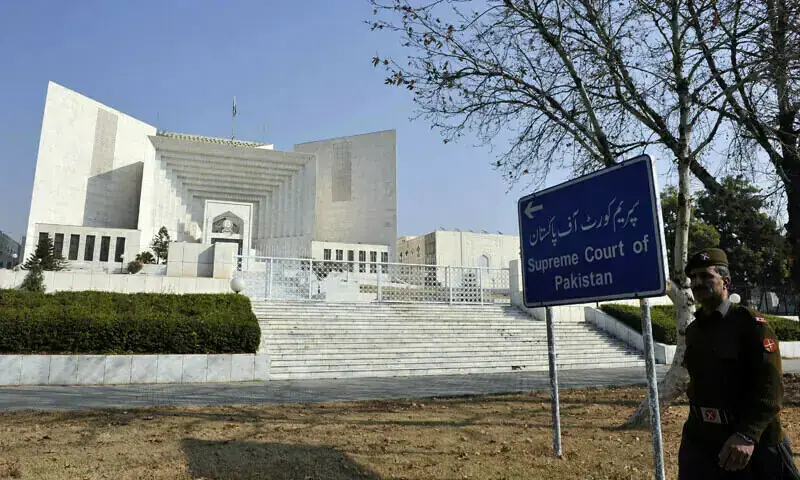
ISLAMABAD: The Supreme Court has affirmed that in contempt of court matters, the concerned court must provide an alleged contemnor an opportunity for a preliminary hearing before taking cognisance or fixing a date for framing charges against him.
Only after being duly satisfied that a prima facie case exists may the court fix a date for hearing to frame the contempt charge in open court and then proceed to decide the matter, observed Justice Muhammad Ali Mazhar in a judgement he authored.
Justice Mazhar, who headed a three-judge SC bench, was hearing a criminal appeal filed by petitioner Hira Rauf against the November 2024 Sindh High Court (SHC) contempt proceedings.
The SC set aside the contempt proceedings initiated by the single bench and upheld by the division bench of the SHC, holding that the fundamental requirement of a preliminary hearing for the alleged contemnor had been completely overlooked.
Sets aside SHC contempt proceedings for ignoring mandatory safeguards
The SC also underscored the mandatory nature of procedural safeguards enshrined in contempt of court law.
The controversy arose when petitioner Hira Rauf allegedly violated the SHC’s 3 September 2024 order in a case heard in its original jurisdiction. Respondent Rear Admiral (Retd) Mushtaq Ahmed subsequently filed a contempt application under Article 204 of the Constitution and Sections 3 and 4 of the Contempt of Court Ordinance, 2003.
After issuance of the contempt notice, a counter-affidavit was filed. However, the single judge observed that Section 17(3) of the contempt law required a date to be fixed for framing charges, and therefore set 11 December 2024 for that purpose after issuing notice to the Advocate General Sindh to assist the court.
Aggrieved, the petitioner challenged the order, but the division bench disposed of the matter on 19 November 2024 with directions for the parties to appear before the single judge for further proceedings.
During the hearing, Barrister Khawaja Naveed Ahmed, representing the petitioner, contended that both the single judge and the division bench had misinterpreted Section 17(3) of the contempt law, stressing that no preliminary hearing had taken place before cognisance was taken.
Advocate Muhammad Ahmed Masood, on behalf of the respondents, highlighted the alleged violation on which the court had decided to take cognisance, though he conceded that no preliminary hearing was conducted.
The SC was also informed of procedural lapses prior to the order passed by the single judge.
The court examined Section 17 of the contempt law, noting that subsection (3) makes it clear that before taking cognisance or fixing a date for framing charges, the alleged contemner must be afforded a preliminary hearing. Only after being satisfied that a prima facie case exists may the court fix a date for framing charges in open court and proceed with the matter.
In conclusion, the SC set aside the orders of both the single judge and the division bench to the extent of the contempt proceedings, but kept the contempt application pending.
If the court seeks to initiate contempt proceedings afresh, it must first provide an opportunity for a preliminary hearing based on the contempt application and the contemnor’s counter-affidavit, and then determine whether a prima facie case exists for proceeding in accordance with law.
Published in Dawn, March 25th, 2026