The era of maritime security guaranteed by international law alone is over. Three scholars analyze this paradigm shift of chokepoints from legal driven to deterrence driven; Edward Fishman (Chokepoints how global economy became weapon of war), Deborah Cowen (The Deadly Life of Logistics 2014), and Evander Knoxley (Nodes of Power: Corridors, Straits, and Geopolitics 2025) who predicted that we entered a phase where logistics is the sina-qua-none condition of sovereignty and where power is no longer exercised primarily through territorial conquest or conventional military dominance, but through control over strategic nodes -chokepoints, corridors, and regulatory infrastructures that govern the flow of goods, energy, data, and capital.
The current Hormuz Strait crisis of February/March 2026 in the Arab Gulf confirms that “chokepoints” and strategic straits are no longer a simple natural corridor of passage dictated by geography, but levers of power, geo-economic weapons through which states project their influence without resorting to direct military confrontation.
Logistics is never simply technical as stated by Deborah Cowen; it is always political; the violence that accompanies efforts to keep goods moving through strategic crossing points is not an externality, but a constitutive feature of the global trading system.
It this vain it should be recalled that in November 2020, the Polisario terrorist militias had blocked the strategic crossing point of Guergarate between the Kingdom of Morocco and Mauritania, where the flow of goods by road between Europe, Morocco and sub-Saharan Africa transits.
The Politics of Passage: Between Freedom of Transit and Geopolitical Constraints
The legal regime for land chokepoints is governed by several conventions that guarantee freedom of transit (Article V of the GATT and other relevant agreements, such as the 1921 Barcelona Convention on Freedom of Transit, and the “United Nations Convention on Transit Trade of Landlocked States” adopted by the UN in February 1965).
Shipments in transit remain subject to the discretion of the transit country’s procedures for land transport; transit states may impose specific requirements to grant access or transit rights; this discretion may lead to misuse or even abuse by imposing unfair restrictions or even non-tariff barriers to trade flows.
With respect to the regime of straits, the law of the sea—codified by the United Nations Convention on the Law of the Sea (UNCLOS), adopted at Montego Bay in 1982 and in force since 1994—establishes a distinctly sui generis legal order. Unlike the territorial sea, where sovereignty remains plenary, or the Exclusive Economic Zone and continental shelf, which confer functional rights of an economic nature, straits used for international navigation are governed by a principle of constrained sovereignty. Their legal status is structured around a fundamental tension: the need to preserve the authority of littoral States while safeguarding the uninterrupted circulation upon which global trade depends.
To this end, the Convention distinguishes between transit passage, which guarantees continuous and expeditious navigation and may not be impeded, and innocent passage, under which the coastal State retains the right to temporarily suspend navigation for reasons of security.
However, in practice, legality is often eclipsed by power relations; some countries that have not ratified the Montego Bay Convention exploit this vagueness to try to impose a restrictive regime of innocent passage, as is the case of the Strait of Hormuz, where any naval manoeuvre becomes a pretext for obstruction.
It should be underscored that maritime straits are not exposed to uniform levels of geopolitical stress. Some straits are more safe than other, for instance Gibraltar, Panama and Bosphorus are spared from insecurity.
The strategic importance and vulnerability of maritime straits vary according to their geopolitical environment, the nature of political regimes in adjacent coastal states, the volume and sensitivity of the flows they carry, and the availability-or absence-of viable alternative routes. In this regard, a useful distinction can be made between “bypassable” chokepoints, such as the Suez Canal, where rerouting via the Cape of Good Hope remains possible albeit at the cost of substantial delays, higher freight rates, and significant logistical disruption, and “non-substitutable” chokepoints, such as the Strait of Hormuz, whose closure would trigger immediate systemic shocks, reverberating across global energy markets, supply chains, and the broader world economy.
Disruptions in the flow of traffic or the closure of straits due to war, weather conditions, or acts of piracy lead to increased logistics and insurance costs, longer delivery times of up to two to three weeks, and increased volatility in supply chains that threaten peace and prosperity.
The logistical resilience of shipping companies has limits: it can compensate for a detour, but not a total closure without an alternative. Finally, these crises reveal that the security of energy flows and fertilisers (such as phosphates) is as much a geopolitical issue as a commercial one, and that global dependence on a few strategic passages constitutes a major risk for the global economy and international security.
The Bab Al Mandab Crisis, an example of Adaptation of maritime freight
The Red Sea crisis has served as an empirical laboratory for understanding the mechanisms of adaptation of maritime networks. As of November 2023, attacks by the Houthi militias have forced more than 650 container ships (representing about 10 million TEUs – Twenty-Foot Equivalent Units), to divert through the Cape of Good Hope, reducing volumes transiting through the Suez Canal by about 50% between December 2023 and March 2024. More significantly, high-efficiency core ports such as Singapore, Rotterdam and Shanghai maintain their dominance but face functional rebalancing, while bridge-control ports such as Antwerp, Hamburg, Busan and Kobe act as secondary transshipment buffers, and free-form bridge ports such as Manila, Haiphong and Genoa and Tangier Med strengthen their roles as elastic connectors for rerouting.
The costs associated with this adaptation are not negligible; the diversion through the Cape of Good Hope has increased greenhouse gas emissions by at least 46% compared to transits through the Suez Canal, economic costs have increased by at least 51% for entire fleets, and round-trip travel times have increased by 20 to 34 days.
However, the diversion of the Red Sea and Suez Canal fleets has not had any significant impact on the activities and volumes of African ports, with a few exceptions (Tangier Med is the figurehead), including major hubs such as Lomé (Togo), Pointe-Noire (Democratic Republic of Congo), Abidjan (Côte d’Ivoire), Durban (South Africa) and Dar-es-Salaam (Tanzania). which did not record any significant increase in volumes processed.
Although they are in slightly better conditions, African coastal countries should not relax on their laurels, they remain below the global average of the Logistics Performance Index (LPI below 3.0) (the author study), revealing a common need to improve infrastructure and modernize African ports that have not been able to benefit from the increase in maritime traffic via Cape Town following the insecurity of the Bab Al Mandab Strait and the upsurge in attacks on ships.
Hormuz Crisis 2026: Anatomy of Systemic Paralysis
The Strait of Hormuz has a unique vulnerability profile that makes these lessons particularly relevant. This recurrent vulnerability stems from the nature of Iran’s political regime, a revisionist power that stands up to the hegemon and attacks its allies in the region, and whose leaders have repeatedly threatened to close the strait in response to sanctions or military pressure. A total closure by regular forces would constitute a qualitatively different disruption from the Red Sea crisis, implying action by non-state actors, in this case the Houthi militias.
Even I recognize that political science is not an exact science, the scenario, so chanted by some think tanks, political scientists and policy planner sis cut of reality, considering that only regime change in Iran option would fully solve the problem of the blockade of the Strait of Hormuz, comes up against two major limitations: on the one hand, a regime overthrow is not a realistic planning scenario, as the current government, even bloodless and harshly weakened following the elimination of heads of power pyramid and nerves of its political apparatus, has shown its resilience in the face of external pressure and internal protest and simultaneous US-Israeli strikes by its strategic sites, particularly nuclear sites; on the other hand, even under another regime, the Strait of Hormuz would remain a critical geographical concentration point, only the threat profile would change. The real strategic issue is therefore not to try to eliminate vulnerability through regime change, but to develop strategic alternative workarounds that can make trade and energy flows resilient to any disruption, regardless of the political configuration in Tehran.
Anatomy of Resilience Strategies
The observation of the strategies for adapting to the crises of the straits reveals polyform strategies in the short, medium and long term, some cyclical deployed by the shipping companies, others structural are by the States hostage to these disturbances (China and India and GCC countries, in particular those “semi-landlocked or mono-seafront ” such as Kuwait, Iraq and to some extent Bahrain and Qatar.)
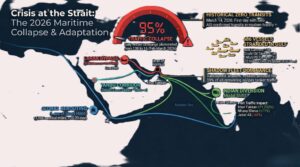
The first form of resilience is cyclical, which responds to an urgent need for freight already in place or destined for the Gulf. During the disruption of the Strait of Hormuz in February 2026, CMA CGM deployed a pragmatic multimodal system based on ports located upstream of the Strait – Khor Fakkan and Fujairah in the Emirates, Sohar in Oman, Jeddah in Saudi Arabia – used as secure unloading points. Cargo is transferred there before the critical passage, then transported by road and rail to the Gulf markets, with Jeddah acting as a regional hub, while Omani ports provide complementary connections to the Emirates and the northern Gulf, creating redundant routes.
Validated by the European Shippers’ Council, this architecture guarantees a minimum continuity of supply chains, but remains structurally limited: land capacities cannot absorb maritime volumes, which makes it a resilience mechanism targeted at high-value and time-sensitive flows, with no credible alternative for mass energy traffic.
The second form of resilience this time tackles structural vulnerability by shifting the centre of gravity of export infrastructure out of the Gulf, towards fronts directly open to the Indian Ocean. Oman appears to be the pivot of this strategy, which is part of Oman Vision 2040, with hubs such as Duqm and Salalah. Located outside the Strait, Duqm combines optimal positioning on East-West routes, integrated energy capacities – refinery and storage in Ras Markaz – and a dynamic of rapid expansion. Salalah, one of the most efficient ports in the world, completes this system. The challenge is not to bypass the strait for existing flows but to allow relocation upstream: by developing storage, refining and loading capacities at Duqm, exports can be directly directed towards the Indian Ocean, eliminating any exposure to the strait for the flows concerned. However, the realization of this model requires investments in pipelines linking Saudi and Emirati fields to these terminals, at a relatively modest cost in view of the stakes.
The third form of resilience aims to secure flows between the Gulf and the Mediterranean without depending on the Strait of Hormuz or the Red Sea, by favouring integrated land corridors – rail and pipelines – which are less expensive and faster to deploy, rather than new canal projects facing major technical constraints and geopolitical risks.
Within this emerging and promising form of resilience, several major connectivity initiatives can be highlighted: China’s Belt and Road Initiative (BRI); the India–Middle East–Europe Economic Corridor (IMEC), announced at the 2023 G20; and King Mohammed VI’s initiative to provide Sahelian countries with access to the Atlantic, along with its key extensions, notably the Nigeria–Morocco gas pipeline and the Dakhla–N’Djamena corridor. These are complemented by the development of logistics corridors linking Red Sea ports to Gulf markets, spearheaded by Saudi Arabia and its partners. Together, these projects articulate maritime routes and overland connections in a coherent multimodal framework, to which can be added transcontinental ambitions such as the Dakar–Port Sudan railway under the aegis of the OIC, or the Dakar–Djibouti corridor.
We can conclude by stating that maritime security environment shifted dramatically from soft legal driven format to hard power driven one and where no single actor can guarantee the openness of critical passages and where resilience depends on redundancy of routes and transportation modalities rather than deterrence alone.
it is also safe to say that the search for alternatives to Hormuz is not simply a technical problem but a political project that requires not only investment in infrastructure but also regional cooperation, political will and diplomatic commitment, because history teaches us that in any process of cooperation/integration, even functional cooperation, around common projects, or even any mega project, even on a national scale, whether it is a port, a large dam or a corridor, there are catalyst actors (core area) who are pulling forward, but there have almost always been actors who try to slow down the process or the project (counter core areas) for fear of endangering either the vested interests or future projects to expand their areas of influence.
The post Straits under Tension: Crossroads of Global Trade and Theaters of Strategic Rivalries appeared first on Morocco World News.