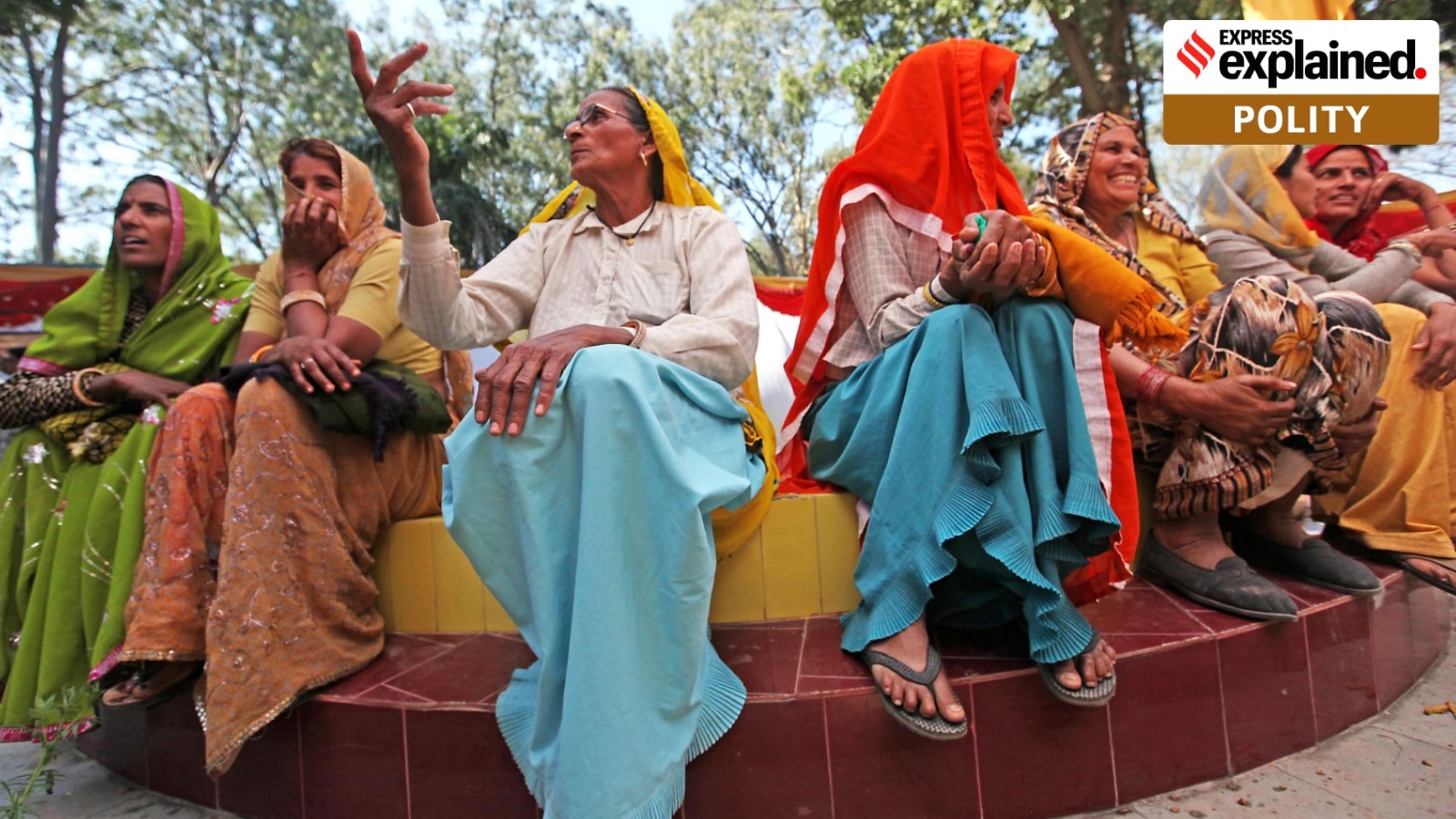
Weather ePaper Today’s Paper Journalism of Courage Home ePaper Politics Explained Opinion India Business Premium Cities UPSC Entertainment Sports World Lifestyle Tech Subscribe Sign In TrendingUPSC OfferIPL 2026US NewsPuzzles & GamesLegal NewsFresh TakeHealthResearch🎙️ Podcast Advertisement function checkAndLoadWindowSizeScript() { if (window.jQuery) { // jQuery is loaded, include your script jQuery(document).ready(function($) { // Your existing script for checking window width if (window.innerWidth) var page_w = window.innerWidth; else if (document.all) var page_w = document.body.clientWidth; if (page_w > 1024) { $(".add-left, .add-right").show(); } else { $(".add-left, .add-right").hide(); } }); } else { // jQuery is not loaded, check again after 0.2 seconds setTimeout(checkAndLoadWindowSizeScript, 200); } } // Initial call to the function checkAndLoadWindowSizeScript(); NewsExplainedExplained PoliticsStates’ rights, OBC inclusion: Before legislature, the debates over 33% women’s reservation in local bodies States’ rights, OBC inclusion: Before legislature, the debates over 33% women’s reservation in local bodies In the recent debates, delimitation was at the forefront. Back in 1992, despite a consensus on women’s inclusion in local bodies, MPs raised criticisms ranging from states’ rights being curtailed to the possibility of “elite capture”. Written by: Rishika Singh8 min readNew DelhiApr 18, 2026 06:37 PM IST Sarpanch Vidya Devi (third from left) with her team from Mahindergarh (Narnaul) in Haryana attending a workshop. (Express archives) Make us preferred source on Google Whatsapp twitter Facebook Reddit PRINT On Friday (April 17), the Constitution (One Hundred and Thirty-First Amendment) Bill, 2026, for delimitation and the subsequent application of 33% women’s reservation in the legislature was defeated in Lok Sabha. The Opposition primarily criticised it over the delimitation process and its advancement by the government. Back in 2023, parties across the political spectrum had lent their support to women’s reservation in the legislature with the passage of The Constitution (One Hundred and Twenty-Eighth Amendment) Bill. But the first nationwide quotas to ensure greater political participation of women came into effect in the 1990s. The Constitution (Seventy-third Amendment) Act, 1992 and The Constitution (Seventy-fourth Amendment) Act, 1992 took effect in 1993. They reserved 33% of the seats for women in Panchayati Raj institutions and urban local bodies, respectively. What prompted these Acts then, and what was the nature of political debates at the time? Here is a brief history. From committees, to states, to country First, it is important to understand the significance of the 73rd and 74th Constitutional amendments. Before these Acts, India’s Constitution mentioned only a two-tier form of government, and local institutions were found only in the Directive Principles of State Policy, which are not enforceable by courts but only meant to guide governments. The two Acts accorded constitutional status to the third tier of governance. Among other things, they mandated regular elections to local bodies, devolved some power and authorised state governments to provide grants-in-aid to the Panchayats from the Consolidated Fund of the State. They also mandated one-third women’s representation. Several states later extended this to 50%, and today, women constitute about 46% of the nearly three million panchayat and gram sabha representatives. In comparison, women’s representation in the current Lok Sabha is less than 14%. Before the Acts, several committees had suggested reforms in local governance, including the Balwantrai Mehta Committee (1957) and the Ashok Mehta Committee (1977). A few states had instituted some quotas, like Karnataka, which introduced 25% reservation for women in its Panchayat Raj Institutions under a 1983 Act. Political scientist Evelin Hust wrote in a 2002 working paper on political representation that, “Generally speaking, the device of reservation of seats is much less controversial in the Indian polity than in most of the European countries”, given the history of allocating quotas for groups like the Scheduled Castes and Scheduled Tribes. She added that the inclusion of women as a grouping with reservations “is partly related to the pressure of women’s movements and partly due to realpolitik.” The 1980s saw the landmark Shah Bano case that brought Muslim women’s rights into focus, as well as other women-led popular movements. James Manor, writing in The Oxford Companion to Politics in India, said that the Rajiv Gandhi government attempted to pass a decentralisation Bill in the late 1980s. It was ultimately furthered under PV Narasimha Rao, who had “long been a genuine enthusiast for democratic decentralisation.” In the recent debates, the issue of delimitation and federalism was at the forefront, as parties had already largely agreed on the need for women’s reservation since 2023. Back in 1992, despite a consensus on women’s inclusion, MPs raised criticisms of the two Acts with grounds ranging from states’ rights being curtailed, the possibility of “elite capture” — where powerful groups take control of resources — and women from marginalised groups being overlooked. MP Mentay Padmanabham highlighted in Parliament the Bill’s obligation for the state government to constitute a Finance Commission, “so that these Panchayat Raj institutions will not starve of funds.” “I would like to know, what is the financial condition of states to day? We have been hearing from various state governments that they are not able to maintain their own establishment, leave alone sparing any money for developmental activities,” he said. “Without examining the Centre-State financial relations in a proper perspective… appointing a Finance Commission to devolve finances from the State to the Panchayat Raj institutions is meaningless, it is a big fraud on Panchayat Raj institutions,” he said. Coming to the women’s quota, the late BJP MP Sushma Swaraj said provisions like reservation for SC/ST women within the 33% share were “genuinely welcome.” She said that in the past, political parties announced a certain share of women candidates in their manifestoes, say about 10%, but then claimed that they did not have “qualified candidates”. “So, this will mark a beginning. These panchayats will be the nurseries of the democratic system… municipal bodies and panchayats will be training grounds for governance,” Swaraj said. She added, “I know this is a male-dominated society, and that too a savarna male-dominated society. Dalits are given little space, but with a Constitutional mandate, it will become mandatory.” In another debate that year, however, MP Syed Shahbuddin raised a point about the social profile of women benefitting from a potential quota: “I do not regard the women either as a separate community or as a class or as a caste or even as a social group. In fact our historical experience is that reservation for women has been used by the vested interests in order to augment their power within the elected bodies because of the disparity in the level of education and consciousness among women…” “In principle… there is a possibility that the very elements who are today dominating the village life shall find their way back riding on the strength of the women members who will be elected largely from their group.” (Women’s Experience in New Panchayats: The Emerging Leadership of Rural Women by Nirmala Buch, 2000) This has been a central issue in discussions around women’s quota — that women are often not seen as a political class in themselves, but with other identities of caste, class, etc., playing a stronger role in determining their political priorities and treatment. Padmanabham similarly raised the issues of backward classes: “I am happy that this Bill contains reservations for SCs, STs as well as women… Why is not reservation for backward classes made mandatory in this Bill? This is again left to the discretion of the States. Why this discrimination… They should have made this provision also mandatory, and the State Government should decide which backward class should get how much percentage of reservations.” The inclusion of OBC women has long been a contested issue in women’s reservation, raised during discussions on past Bills — including the 2023 Act. The Samajwadi Party (SP) also raised the demand for reservation for Muslim and OBC women in the recent session. Despite certain limitations, quotas have achieved some clear successes in aiding the political inclusion of women. Nirmala Buch wrote in her paper that, based on a study in Madhya Pradesh, Uttar Pradesh and Rajasthan, speaking to women leaders at various panchayat levels, “The results are encouraging.” She wrote that the reservation had “legitimated entry of women in a critical mass in mainstream politics at the grass root level in the whole country and has created political space for women across caste and class. It is a major step for inclusive politics and… has a potential of changing the existing gender relations.” “A number of myths about these women are exploded which we hope can help us to avoid simplistic generalisations about rural Indian women’s dis-interest in politics, passivity, non participation in local political institutions, proxyism by their male kins and women’s universal political connectivity and belonging only to well off sections if entering panchayats,” she added. Rishika Singh is a deputy copyeditor at the Explained Desk of The Indian Express. She enjoys writing on issues related to international relations, and in particular, likes to track and analyse news from China. Additionally, she writes on developments related to politics and culture. She can be reached out at rishika.singh@expressindia.com. ... Read More
المصدر: Indian Express
| Source: Indian Express