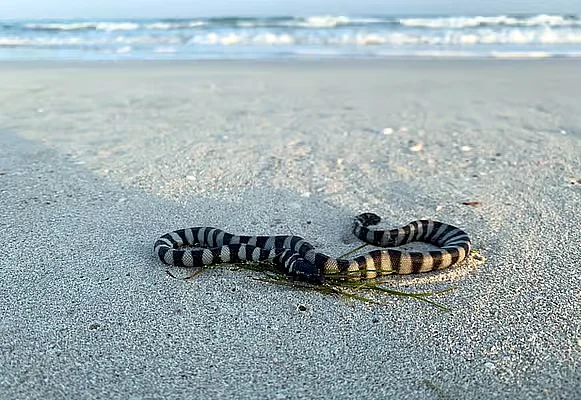
If you spot a sea snake on an Abu Dhabi beach, it should not be there — and it likely needs help. SeaWorld Yas Island Abu Dhabi says stranded sea snakes are often unwell or dehydrated, prompting the centre to launch public workshops teaching people how to safely report and contain the animals until rescuers arrive.
Rob Yordi, Zoological Vice President and General Curator at SeaWorld Yas Island Abu Dhabi, said many people wrongly assume the animals are dangerous pests that should be avoided or removed.
“The ones that come up on the beach are sick, they’re not doing well,” Yordi said. “They are a species that stays in the water all the time. If they come up on the beach, they need to have help.”
Stay up to date with the latest news. Follow KT on WhatsApp Channels
Sea snakes are found in Gulf waters and several species are known to inhabit the region. While highly venomous, Yordi stressed they are not aggressive and usually avoid humans.
“If you see one, they will probably swim away from you,” he said. “You’re not prey… they eat small fish.”
Instead of attempting to touch the animal directly, residents are being advised to contact rescue teams immediately. In some workshops, participants are given buckets so they can safely scoop stranded snakes into a container while waiting for responders.
“We teach people how to handle snakes — they don’t touch them,” Yordi said. “We give them buckets… and all they have to do is scoop them up and call us.”
He said quick action is crucial because stranded sea snakes can rapidly deteriorate in the sun.
“They get beached and then sitting in the sun and they dry out. They’re not designed to dry out, and that gets worse and worse,” he said. “The quicker we can get to them, the quicker our veterinary team can help.”
Nearly 100 rescues so far
SeaWorld Abu Dhabi says it now runs one of the largest sea snake rescue programmes in the world.
According to Yordi, the centre handled about 67 sea snake rescues last year, around 20 so far this year, and a smaller number during its early operations — bringing the total close to 100.
Before the rescue centre opened, he said many stranded snakes were simply left to die.
“Nobody was doing anything,” he said. “Now, we get them, figure out what’s wrong, treat them, get them healthy and get them back out into the Gulf.”
Fear turning into awareness
Yordi said public attitudes are beginning to shift as more residents learn what sea snakes are and why they matter to the marine ecosystem.
“Most people are just, ‘Oh, they’re poisonous. I’m getting rid of it,’” he said. “So no, no — we will come take care of it. You have a resource.”
Sea snakes help maintain balance in the ecosystem by feeding on certain fish species, preventing overpopulation, he added.
“If we take that away, then you’ve got the whole environment not in sync.”
The centre has been running rescue-awareness workshops since early 2024, including sessions with hotels and coastal teams on Saadiyat Island, where many calls involving sea snakes originate.
Yordi said the programme is already producing results.
“Now they’ll call us, and they have the bucket. They’ll send a picture," he said. “Or we get a pin and they stay.”
What to do if you spot one
Residents who encounter a sea snake on shore are urged not to touch it with bare hands or attempt to kill or move it roughly.
Instead, they should send rescuers a photo and location pin, keep watch from a safe distance, and wait for trained teams to arrive.
“The best thing for us is if we can get a picture and a pin,” Yordi said. “If we get those two things, that makes our job easy.”