Marrakech – Spain and Morocco have taken a major step toward building a submarine tunnel under the Strait of Gibraltar. A memorandum of understanding (MoU) was signed between Spain’s National Geographic Institute and Morocco’s National Center for Scientific and Technical Research (CNRST) to conduct joint research on the seismicity and geodynamics of the strait.
Spanish Transport Minister Óscar Puente and his Moroccan counterpart, Karim Zidane, met on December 4, 2025 at La Moncloa to formalize the agreement. The project has been under study for nearly half a century, since the two countries first committed to exploring a fixed link between Europe and Africa.
Spanish outlet OKDiario reported on Thursday that the Spanish government approved in mid-March 2026 a new transfer of €1.73 million to finance technical studies for the infrastructure. The project is reportedly being developed through SECEGSA, the Spanish Company for Studies on Fixed Communication across the Strait of Gibraltar, a public company created in the 1980s to advance the tunnel’s construction.
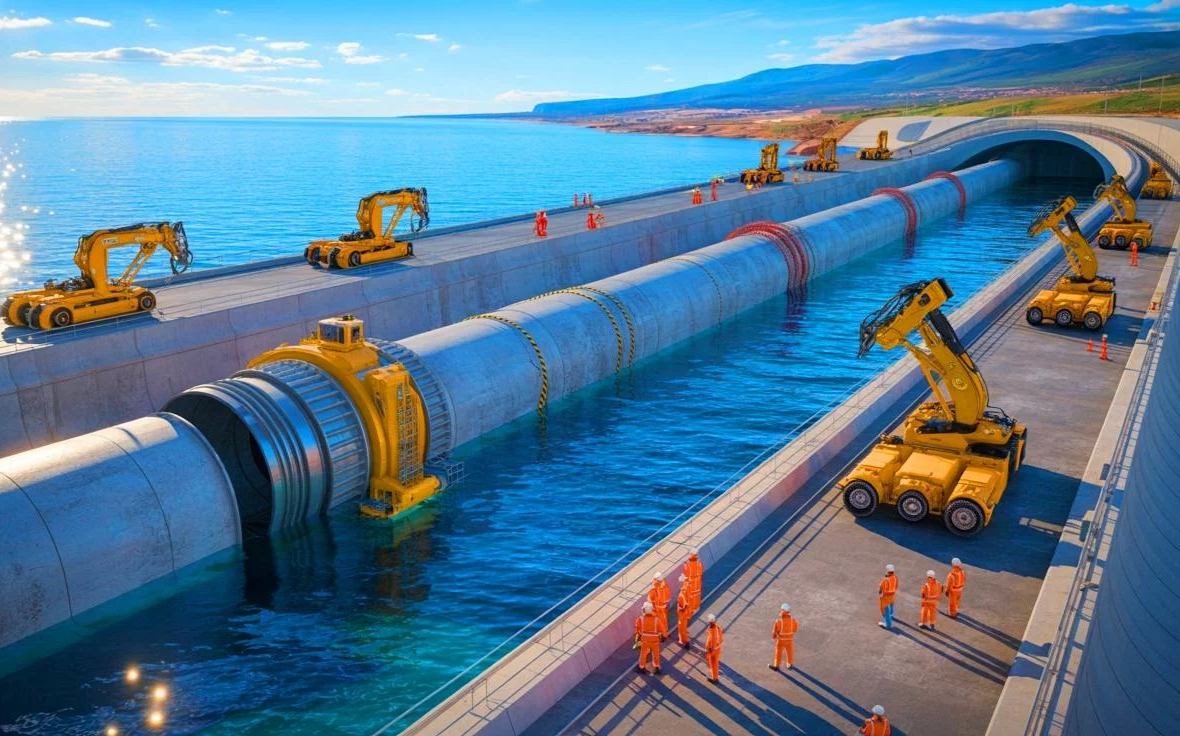
The planned tunnel would stretch approximately 65 kilometers in total. Around 40 kilometers would run under Spanish territory. The northern entrance would be located near Vejer de la Frontera.
The distance between terminal stations would be 42 kilometers, with 38.5 kilometers of actual tunnel length. Of that, 27.7 kilometers would be the submarine section. The deepest point would reach 475 meters, with a minimum rock cover of 175 meters and a maximum gradient of 3%.
The infrastructure would consist of two independent single-track railway tubes, each with a circular cross-section of 7.90 meters in interior diameter. A central service gallery of 6 meters in diameter would run between them for emergencies and maintenance.
Cross-passages of 6 meters in diameter would connect the tubes every 340 meters. A Secure Parking Zone would be built at the tunnel’s lowest point, equipped with stop zones, safety areas, intervention zones, and a smoke extraction gallery.
SECEGSA commissioned a feasibility study from Herrenknecht Ibérica, the Spanish subsidiary of the German tunneling machinery manufacturer. The study focused on whether it is technically possible to bore through the Umbral de Camarinal, an underwater ridge separating the Mediterranean Sea from the Atlantic Ocean.
The conclusion was positive. Herrenknecht confirmed the project is technically viable within current engineering limits, though it warned the execution would involve enormous logistical and economic challenges.
The subsurface beneath Camarinal consists of Flysch Complex materials, with layers of sandstone and clay of turbiditic origin, topped by more recent Pliocene and Quaternary deposits. This geological layering creates zones with highly variable behavior, even over short distances, making it one of the most demanding sections of the route.
Cost, timeline, and completion estimates
The estimated cost exceeds €8.5 billion for the Spanish side alone. If completed, the tunnel would allow the crossing between Spain and Morocco in approximately 30 minutes. The completion horizon is estimated between 2035 and 2040.
The memorandum sets the framework for three years of study on seismic activity, potential earthquakes and tsunamis, and the geodynamic behavior of the strait.
Spain’s National Geographic Institute notes that the Iberian Peninsula sits at the contact zone between tectonic plates, with the Azores-Gibraltar-Tunis fracture forming part of that framework – the same zone that produced the devastating 1755 earthquake.
If the findings are favorable, excavation of a reconnaissance gallery could be approved. The initial tender for that phase could take place in 2027. Completing it would require between six and nine years.
A marine research campaign is scheduled before the end of the first half of 2026. The campaign, commissioned to Spain’s Superior Council of Scientific Research (CSIC) with a budget of €553,187.38, was published in the Official State Gazette.
It will last approximately 15 days and include high-resolution bathymetry using multibeam echosounders, sub-bottom profiler analysis, seabed sediment and rock sampling, and laboratory testing with scientific interpretation.
Spain’s CSIC will carry out the campaign through three specialized institutes: the Institute of Marine Sciences, the Geological and Mining Institute of Spain, and the Spanish Institute of Oceanography. The Navy’s Hydrographic Institute and the United States Geological Survey are also participating as part of an international working group.
The strait itself presents additional constraints. More than 100,000 vessels transit it annually, and the research area falls within a Special Conservation Zone with an orca protection plan in place. Over 1,900 marine flora and fauna species have been recorded in these waters, requiring strict environmental permits and oversight.
All collected data will be integrated into a three-dimensional geological model of the Umbral de Camarinal. This model is considered essential for evaluating the technical viability of the tunnel before any construction begins.
The post Spain, Morocco Move Closer to Building Strait of Gibraltar Tunnel appeared first on Morocco World News.