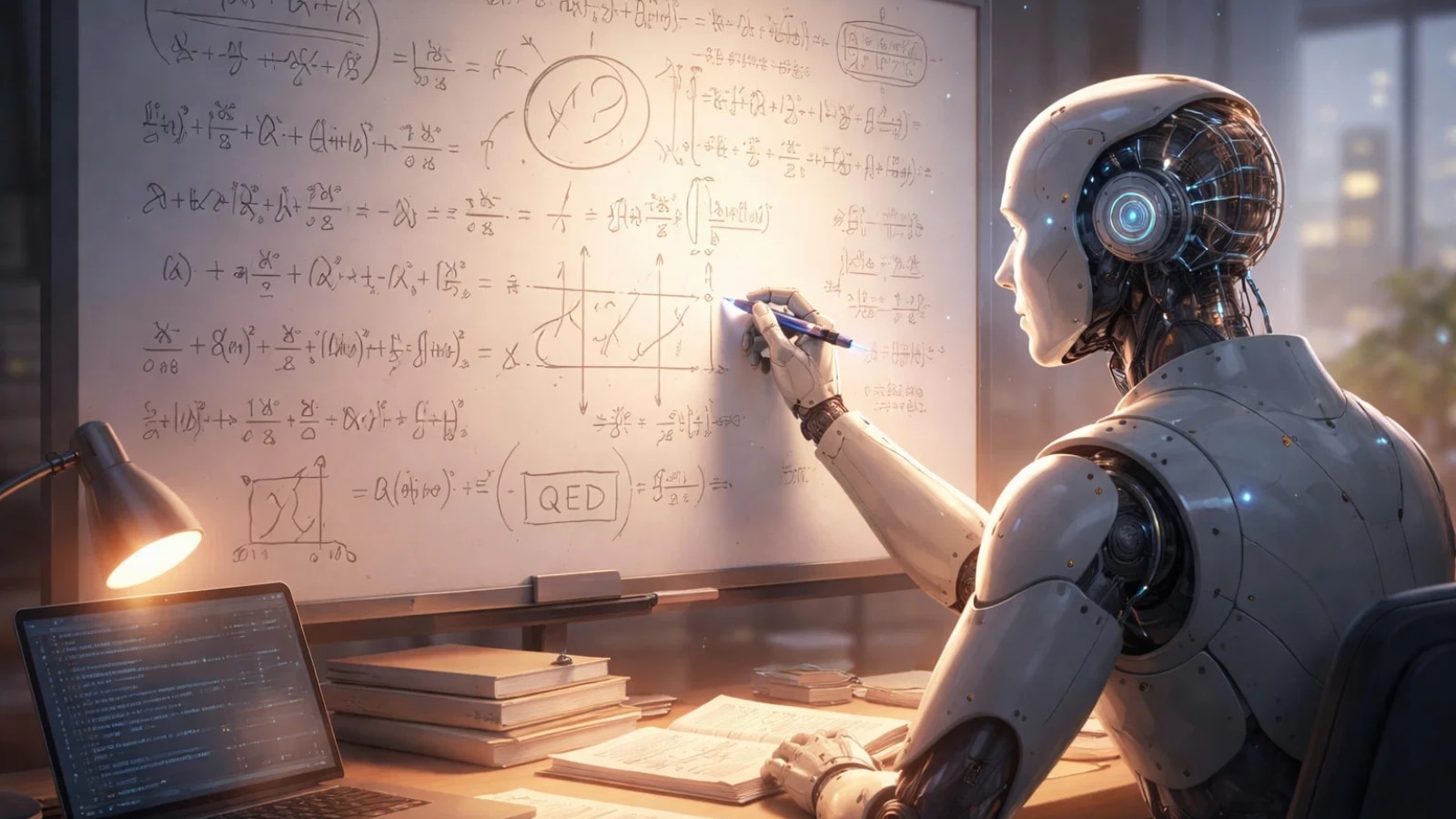
Solved in 80 hours: Peking University’s new AI framework cracks decade-old math without human help
Weather ePaper Today’s Paper Journalism of Courage Home ePaper India Cities UPSC Premium Entertainment Politics Sports World Explained Opinion Business Lifestyle Tech Subscribe Sign In TrendingUPSC OfferIPL 2026US NewsPuzzles & GamesLegal NewsFresh TakeHealthResearch🎙️ Podcast Advertisement function checkAndLoadWindowSizeScript() { if (window.jQuery) { // jQuery is loaded, include your script jQuery(document).ready(function($) { // Your existing script for checking window width if (window.innerWidth) var page_w = window.innerWidth; else if (document.all) var page_w = document.body.clientWidth; if (page_w > 1024) { $(".add-left, .add-right").show(); } else { $(".add-left, .add-right").hide(); } }); } else { // jQuery is not loaded, check again after 0.2 seconds setTimeout(checkAndLoadWindowSizeScript, 200); } } // Initial call to the function checkAndLoadWindowSizeScript(); NewsTrendingTrending GloballySolved in 80 hours: Peking University's new AI framework cracks decade-old math without human help Solved in 80 hours: Peking University’s new AI framework cracks decade-old math without human help The Peking University team's AI-driven framework not only solved Dan Anderson’s conjecture in commutative algebra but also produced a fully formalised proof on its own. By: Trends Desk3 min readNew DelhiApr 15, 2026 06:10 PM IST The researchers say the entire process took around 80 hours—something that would typically demand extensive collaboration among experts over a much longer period Make us preferred source on Google Whatsapp twitter Facebook Reddit PRINT A Chinese research team has reportedly used artificial intelligence to crack a long-standing mathematical problem first proposed by an American scholar more than a decade ago. The conjecture, introduced in 2014 by University of Iowa professor Dan Anderson, who passed away in 2022, had remained unresolved until now. As reported by the South China Morning Post, the team from Peking University detailed its breakthrough in a preprint posted to arXiv on April 4. Their AI-driven framework not only solved Anderson’s conjecture in commutative algebra but also produced a fully formalised proof on its own. At the core of the system is a reasoning engine called Rethlas, which works alongside a mathematical search tool named Matlas. Together, they mimic how human mathematicians approach complex problems—testing ideas, refining strategies, and exploring possible proofs. Once Rethlas generates a potential solution, a second system, Archon, takes over. Using LeanSearch, it converts the result into a format compatible with Lean 4, an interactive theorem prover and programming language supported by a vast library of mathematical knowledge. The researchers say the entire process took around 80 hours—something that would typically demand extensive collaboration among experts over a much longer period. “Using this framework, we successfully solved an open problem in commutative algebra and automatically formalised the proof with essentially no human intervention,” the paper states. The team believes this marks a shift in how mathematical research could be conducted in the future. By automating complex, time-consuming steps, such systems could free mathematicians to focus on higher-level thinking while still ensuring the accuracy of proofs. Unlike traditional proof assistants that depend on constant human input, this dual-system approach worked independently, though the researchers noted that human involvement could still help speed things up. This development joins a growing list of AI milestones in mathematics, including systems such as Google’s Gemini DeepThink, which won a gold medal at the 2025 International Mathematical Olympiad. However, most existing tools still rely heavily on human oversight—making this fully autonomous achievement stand out. Disclaimer: This article is for informational purposes and highlights advancements in artificial intelligence within the field of mathematical research. While it discusses AI-driven breakthroughs, the content should not be used as a substitute for professional academic or technical guidance in commutative algebra or theorem proving.المصدر: Indian Express | Source: Indian Express
ملاحظة تحريرية | Editorial Note: نُشر هذا المقال في الأصل بواسطة Indian Express. خبر (Khabr) هي منصة إعلامية أردنية مرخّصة تعمل بالذكاء الاصطناعي. نضيف قيمة تحريرية من خلال: تحليل ذكي للأخبار، ملخصات تلقائية، رواية صوتية بالذكاء الاصطناعي، ترجمة متعددة اللغات، وتدقيق الحقائق. هدفنا جعل الأخبار أكثر وضوحاً وسهولةً للقارئ العربي.
This article was originally published by Indian Express. Khabr is a licensed Jordanian AI-powered news platform (Registration #82086). We add editorial value through: AI-powered news analysis, automated summaries, AI audio narration, multi-language translation (Arabic, English, French, Turkish), and AI fact-checking. Our mission is to make news more accessible and understandable for Arabic-speaking audiences worldwide.