Rabat – While walking around Rabat’s International Publishing and Book Fair’s (SIEL) pavilions, one figure is impossible to miss. Ibn Battuta. His name appears across the fair, whether in exhibitions, panels, and cultural events.
This year’s theme, “Ibn Battuta and Travel Literature,” along with the motto “The book is a travel and travel is a book,” explains why organizers chose to focus on him. More than a historical figure, Ibn Battuta represents a way of seeing the world that feels deeply relevant today.
Born in Tangier in 1304, Ibn Battuta set out with the simple goal of performing the Hajj pilgrimage to Mecca. But what started as a religious duty became a lifelong journey of discovery.
Instead of returning home after finishing the religious journey, he continued traveling for nearly three decades. He crossed North Africa, the Middle East, East Africa, Central Asia, India, and even reached China. He covered around 120,000 kilometers in total, more than any other known traveler of his time.
Mapping a 30-year journey
But SIEL’s focus is not on how far Ibn Battuta traveled, but on how he turned travel into knowledge. When he returned to Morocco, his stories were recorded in “The Rihla,” or “The Journey,” with the help of the writer Ibn Juzayy. This book is a window into the cultures, traditions, and daily lives of people across the 14th-century world.
This explains how he fits the fair’s motto so well, as for Ibn Battuta, travel was not just movement, but also storytelling. And through his book, that journey continues. Readers today can “travel” through his words, discovering cities, meeting people, and understanding societies that existed centuries ago.
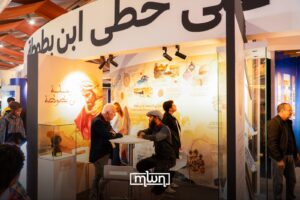
A dedicated section at SIEL 2026 brings his journey to life in a visual and engaging way. Maps showing the many regions he passed through allow visitors to follow the routes Ibn Battuta took across continents.
The space also includes an interactive screen where people can click on different locations he visited and read short stories and details about his experiences there. This section allows visitors to explore his journey step by step, almost as if they are traveling with him.
Morocco World News (MWN) spoke to Nezha Mouhssine, who was presenting a book dedicated to Ibn Battuta at the fair. Representing the Abdelhadi Tazi Foundation, she explained that their participation comes as a natural extension of the late Tazi’s work, which placed Ibn Battuta at the center of his research.
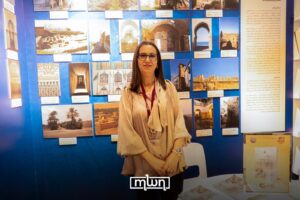
According to Mouhssine, this year’s focus on Ibn Battuta offers visitors, especially younger generations, an opportunity to rediscover a figure whose global journeys remain unmatched in history.
Mouhssine presented a simplified book tracing Ibn Battuta’s travels from his departure from Tangier in 1325 to his return three decades later. The publication, called “Following in the Footsteps of Ibn Battuta,” is a condensed version of Tazi’s extensive research. It is designed to make the story more accessible to a wider audience.
She told MWN about the scale and difficulty of Ibn Battuta’s journeys, saying that he traveled over 120,000 kilometers across dozens of regions under harsh and dangerous conditions.
“Travel at that time was extremely difficult. People moved by camel, mule, or on foot,” she said, noting that Ibn Battuta traveled for years before even boarding a ship around 1330.
“Even sea travel was risky, as ships depended on the winds, which could take travelers far from their intended destinations,” Mouhssine said.
A traveler ahead of his time
Ibn Battuta offers a different model in today’s world, where travel is easier but sometimes more superficial. He traveled slowly, stayed in places for long periods, learned from local communities, and adapted to different cultures.
He was not just passing through. He was observing, listening, and engaging. This depth is what makes his story still meaningful, especially at a cultural event like SIEL, which celebrates knowledge and exchange.
The choice to highlight Ibn Battuta is also a way to connect Morocco’s past with its present. As a Moroccan who became a global traveler, he represents openness to the world. His story reminds visitors that Morocco has long been part of global networks of culture, trade, and ideas.

More importantly, his story speaks to young people. Many of the activities at SIEL 2026, including those involving students and cultural performances, reflect themes from Ibn Battuta’s life. These include curiosity, courage, and the desire to learn. He left home at a young age, without knowing what he would find. That same spirit can inspire new generations today, not necessarily to travel the same distances, but to stay open, ask questions, and seek understanding.
The focus on travel literature this year also invites visitors to think about how stories are told. Travel writing is a genre that continues to shape how people see the world, whether in classic books or modern blogs and documentaries. Yet Ibn Battuta represents one of its earliest and most powerful voices.
The post SIEL 2026: Why Ibn Battuta Still Speaks to Our World appeared first on Morocco World News.