Samir Bennis to Osasu: Debate Must Return to Facts and Law
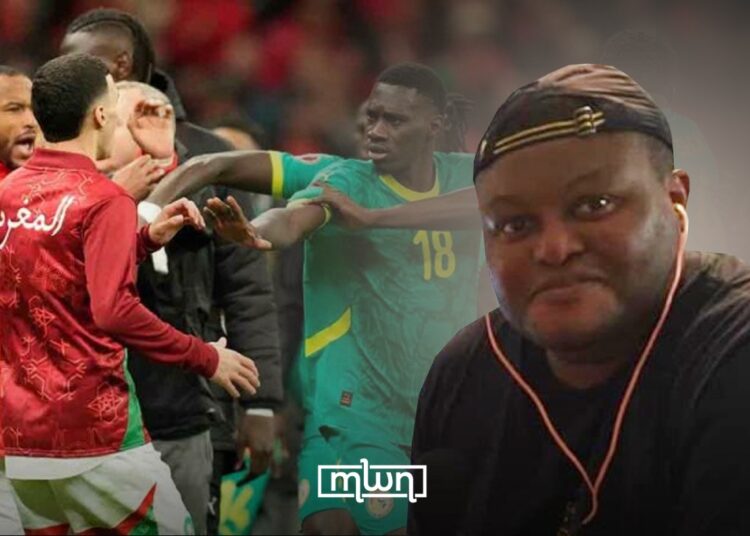
المصدر: Morocco World News | Source: Morocco World NewsRabat – As the debate around the AFCON final continues, the focus seems to no longer be only on what happened on the pitch but also on how the story should be told.
Political analyst and MWN co-founder Samir Bennis has pushed back against Nigerian journalist Osasu Obayiuwana, saying he’s moving away from facts and instead diving into narrative framing.
Samir’s response came after Osasu raised a new claim, namely that Morocco fans had targeted Nigeria goalkeeper Stanley Nwabali with a racist act during the semi-final.
The claim quickly spread online. But Samir questioned both the evidence and the way Osasu presented the issue.
“In his increasingly bizarre and perplexing media crusade against Morocco,” Samir wrote, “Osasu has failed to advance any well-founded argument capable of sustaining his evident bias.”
In his increasingly bizarre and perplexing media crusade against Morocco, Nigerian journalist @osasuo has failed to advance any well-founded argument capable of sustaining his evident bias in favor of Senegal. Instead, he has resorted to outrage-driven agenda-setting that will…
— Samir Bennis (@SamirBennis) April 14, 2026
A claim under scrutiny
The debate centers on a video shared online depicting the aftermath of an object being thrown to Nwabali. According to Osasu, this particular clip shows that it was a banana that had been hurled at the Nigerian keeper. For Samir, there is a fundamental problem with Osasu’s certain, self-righteous conclusion from this poorly filmed scene.
In particular, Samir pointed to the quality of the footage. “The video circulating online is of poor quality, making it difficult to verify with certainty what the object was,” he said.
The political analyst went on to note that the object appears small and unclear, making it “virtually impossible to determine its nature.”
For him, this is not enough to support a serious claim that the thrown object was a banana.
If the object had been a banana, there would likely be visible signs of impact, such as the object bouncing or breaking. Yet none of that can be clearly seen in the footage.
He further argued that if the object had been a banana, there would likely be visible there would likely be visible signs on impact, such as bouncing or breaking. None of that can be clearly seen in the footage.
Beyond the video, Samir raised a broader question.
If such an incident had taken place, why did it not appear in official reports? Why did the referee, match officials, or the Nigerian delegation not raise it at the time?
From legal debate to narrative shift
For weeks, the discussion around the AFCON final has focused on a legal question: did Senegal’s decision to leave the field amount to a forfeit under CAF rules?
That question is now before the Court of Arbitration for Sport.
But instead of staying on that ground, Samir says opponents of the CAF verdict, most of whom have essentially become Morocco-bashers, have shifted the debate to make up for the weakness of their legal case.
“Instead of engaging the legal core of the AFCON final dispute, Osasu chose a different route,” he wrote.
For Samir, this rhetorical route focuses more on emotion and framing than on regulation.
He also criticized the attempt to compare an unverified allegation with documented incidents, stressing: “There can be no equivalence between acts of violence, broadcast live, and an unverified allegation.”
Background adds to tension
The exchange comes in a wider context.
The AFCON final between Morocco and Senegal ended in controversy after Senegal left the pitch. CAF later awarded Morocco a 3-0 win by forfeit. Senegal immediately challenged that decision, and the case has since moved to CAS.
At the same time, incidents involving fan behavior have also been discussed. Some involved confirmed acts of vandalism and clashes with security.
Mixing those events with an unclear allegation creates confusion, Samir has warned, stressing that this approach risks distorting the real debate at hand.
A call to return to facts
Samir’s position remains that discussion should stay grounded in evidence and rules.
For him, the available reports, footage, and regulations all point in one direction. Senegal inexcusably left the field, and CAF rules define the consequence of that action.
More fundamentally, perhaps, he has also explained that his strong criticism of his opponent’s tenuous legal claims and outrage-driven narrative cannot and should not be misconstrued as informed by identity, nationality, or race.
“I am as African as you,” he told Osasu, thereby responding to those looking to deflect the debate from both Senegal’s misconduct in Rabat and the robust legality of the CAF verdict to instead descend into murky discussions about genuine Africanness or African authenticity.
Read also: Post-AFCON Controversy: Retreat Into Identity Politics Is Misguided, Unserious
The post Samir Bennis to Osasu: Debate Must Return to Facts and Law appeared first on Morocco World News.
ملاحظة تحريرية | Editorial Note: نُشر هذا المقال في الأصل بواسطة Morocco World News. خبر (Khabr) هي منصة إعلامية أردنية مرخّصة تعمل بالذكاء الاصطناعي. نضيف قيمة تحريرية من خلال: تحليل ذكي للأخبار، ملخصات تلقائية، رواية صوتية بالذكاء الاصطناعي، ترجمة متعددة اللغات، وتدقيق الحقائق. هدفنا جعل الأخبار أكثر وضوحاً وسهولةً للقارئ العربي.
This article was originally published by Morocco World News. Khabr is a licensed Jordanian AI-powered news platform (Registration #82086). We add editorial value through: AI-powered news analysis, automated summaries, AI audio narration, multi-language translation (Arabic, English, French, Turkish), and AI fact-checking. Our mission is to make news more accessible and understandable for Arabic-speaking audiences worldwide.