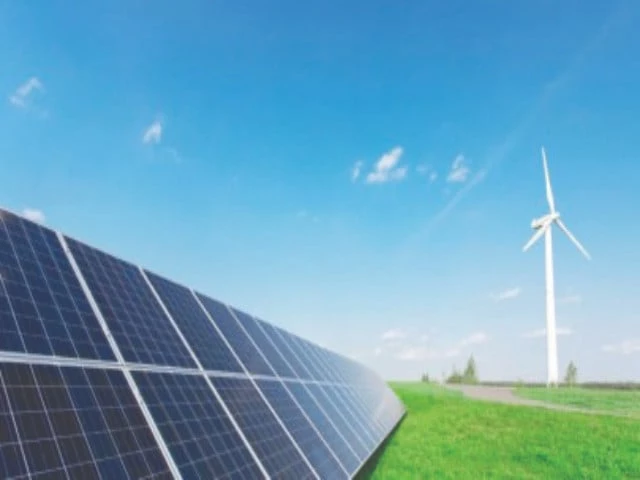
As the world fuel crisis deepens in the face of US-Israel and Iran war in the Gulf, different countries, including Pakistan, are mulling over shifting to nuclear and renewable energy as well as electric vehicles.
China has already helped Pakistan set up nuclear power plants, which are producing electricity at the lowest cost when compared with plants running on other fuels. Beijing has also assisted in utilising renewable energy resources such as hydroelectric power to steer Islamabad out of the difficult situation.
US and Israeli airstrikes and counterattacks by Tehran on vital installations, including energy facilities, have not only led to a sharp spike in international oil prices but have also caused energy shortages in scores of countries. The Strait of Hormuz, a critical waterway from where around 20% of the world's oil and liquefied natural gas (LNG) passes, is lying virtually closed in the aftermath of the war.
Global crude oil prices have crossed $100 per barrel and in Pakistan petrol prices have topped Rs300 per litre, causing ripple effects in almost all sectors of the economy. The runway oil prices are going to trigger a new world order where many countries will increasingly switch to renewable energy sources. Owing to oil rationing in Pakistan, educational institutions have already been shut down and they have shifted to the online mode while many offices are open for only two days a week for physical presence.
Keeping in view the current volatile regional and world situation, the electric vehicles and e-bikes have become a blessing in disguise for the consumers who already own them. To operate these vehicles and two-wheelers, oil consumption is not required as they run on batteries.
Pakistan has different sources of electricity production comprising oil-based plants, coal-fired plants, renewable energy, LNG-run plants and hydroelectric power. Solar net metering is a relatively new addition to the national grid; however, recently, the government has disincentivised this clean energy source, citing the growing burden of capacity payments. Plants powered by LNG also provide clean energy to consumers in the country. For around a decade, Pakistan has been importing around 10 LNG cargoes a month from Qatar but of late the two sides have reached an understanding to shift 24 cargoes to other destinations in the ongoing year due to a sharp drop in demand from power producers.
Moreover, the US-Israel-Iran war has forced the closure of a large LNG production facility in Qatar, which was supplying gas to Pakistan. Now, LNG supply has been halted and Qatar has declared a force majeure. Oil marketing companies (OMCs) too are encountering hurdles in the way of securing cargoes following the blockage of the Strait of Hormuz through which 90% of oil for Pakistan comes. However, Iran has released two crude cargoes, which were stuck during the war, and has also agreed to allow the crossing of Pakistan-bound oil shipments.
Meanwhile, the provision of oil from Saudi Arabia, the United Arab Emirates (UAE) and Kuwait has come under threat as oil facilities in these Gulf nations have been struck during the war. As an all-weather friend of Pakistan, China has helped Pakistan overcome energy scarcity over the past around one decade. Under the China-Pakistan Economic Corridor (CPEC) project, Beijing has invested over $20 billion in the energy sector. By fiscal year 2024-25, Pakistan's electricity generation capacity had accelerated to 46,605 megawatts, where thermal sources including coal, gas and oil dominated with a share of 55.7%, or approximately 25,900MW.
Hydroelectric power constitutes 24.4%, around 11,300MW, while renewables such as wind and solar account for 12.2%, or about 5,600MW. Nuclear energy makes up the remaining 7.8%, contributing roughly 3,600MW to the overall installed capacity.
Among renewables, China has provided assistance for setting up energy plants having production capacity of 4,800MW. It has helped establish wind plants with total capacity of 400MW. These projects include 50MW Dawood Wind, 100MW UEP Wind, 50MW Sachal Wind and 100MW Three Gorges Wind Plants.
The Quaid-e-Azam Solar Park and cluster projects with a cumulative production capacity of 900-1,000MW have been undertaken with critical support from China. The development of a few hydroelectric power projects, having total capacity of 3,400MW, has also received Beijing's backing. In total, these renewable projects have a combined production capacity of around 5,000MW – 400MW wind power, 900-1,000MW solar energy and 3,400MW hydel electricity. As the world is moving fast towards nuclear energy, renewables and electric vehicles, Pakistan has also stepped up efforts to address the energy security challenge. China's top EV brand BYD has already expanded its footprint to Pakistan by introducing its vehicles here.
المصدر: Express Tribune
| Source: Express Tribune
ملاحظة تحريرية | Editorial Note:
نُشر هذا المقال في الأصل بواسطة Express Tribune.
خبر (Khabr) هي منصة إعلامية أردنية مرخّصة تعمل بالذكاء الاصطناعي.
نضيف قيمة تحريرية من خلال: تحليل ذكي للأخبار، ملخصات تلقائية، رواية صوتية بالذكاء الاصطناعي، ترجمة متعددة اللغات، وتدقيق الحقائق.
هدفنا جعل الأخبار أكثر وضوحاً وسهولةً للقارئ العربي.
This article was originally published by Express Tribune.
Khabr is a licensed Jordanian AI-powered news platform (Registration #82086).
We add editorial value through: AI-powered news analysis, automated summaries, AI audio narration, multi-language translation (Arabic, English, French, Turkish), and AI fact-checking.
Our mission is to make news more accessible and understandable for Arabic-speaking audiences worldwide.