An American court has exposed the deep entanglement of the deposed Syrian regime in supporting Colombian terrorist groups and enabling vast money-laundering operations.
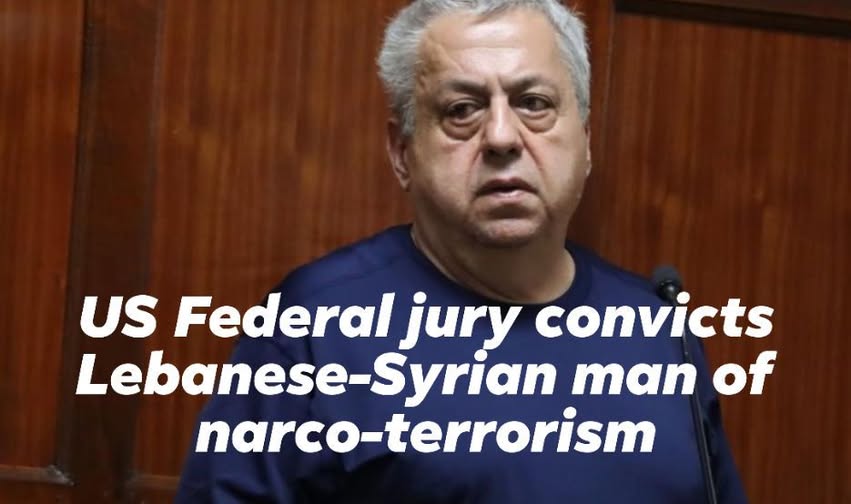
On Tuesday, March 24, a jury in the Federal Court of Alexandria, Virginia, convicted Antoine Kassis, 59, a dual Syrian-Lebanese national, on charges that included operating a transnational drug-trafficking network, conspiring to provide material support to a terrorist organization, and engaging in international money laundering.
The verdict strikes at the criminal syndicates that proliferated under the deposed al-Assad regime, which had turned Syria into a regional hub for the production and distribution of narcotics and weapons.
According to an official statement published by the U.S. Department of Justice, Kassis, described as a Lebanon-based drug trafficker, used his considerable influence within the Syrian government during the al-Assad era to smuggle cocaine and military-grade weapons. He then laundered the proceeds through associates in Colombia.
During the trial, Kassis acknowledged his familial connection to the deposed Bashar al-Assad. He also revealed that, beginning in April 2024, he entered into agreements with partners in Colombia and Mexico to supply the National Liberation Army of Colombia (ELN) with weapons diverted from the regime’s stockpiles. The ELN is designated by the U.S. Department of the Treasury as a foreign terrorist organization. In return, Kassis received hundreds of kilograms of high-purity cocaine.
He confessed to working directly with Maher al-Assad, the brother of the deposed president, as well as senior military officials in the former regime, to orchestrate these criminal operations.
Reports disclosed that Kassis paid the regime ten thousand dollars for every kilogram of cocaine imported through the port of Latakia.
Trial evidence further demonstrated that the regime generated substantial revenue by imposing “taxes” on narcotics at checkpoints, in addition to its involvement in the production and distribution of Captagon, a Schedule I controlled substance that became one of its most notorious exports.
Court records show that Kassis traveled from Lebanon to Kenya to meet an ELN arms specialist. There, he finalized a contract for a shipping container sent from Colombia, ostensibly filled with fruit, yet concealing five hundred kilograms of cocaine destined for Latakia. His principal responsibility was to oversee the distribution of cocaine throughout the Middle East, while his partners managed the laundering of profits through intricate networks spanning several continents.
Kassis now faces a mandatory minimum sentence of twenty years, with the possibility of life imprisonment. The final judgment will be issued on July 2, when the federal district judge determines the sentence in accordance with U.S. guidelines and other relevant legal considerations.
The dismantling of this criminal network resulted from a coordinated effort led by the Bilateral Investigations Unit of the U.S. Drug Enforcement Administration’s Special Operations Division. The operation drew support from DEA offices in Bogotá, Cartagena, Accra, Rabat, Nairobi, Amman, Istanbul, Panama City, Mexico City, and Madrid. This extensive international collaboration reflects the global determination to dismantle trafficking networks linked to authoritarian regimes.
Syrian Emergency Organization: “The Fall of the Shadow Man in the Assad Regime”
The Syrian Emergency Organization welcomed the verdict, describing it as “the fall of the shadow man in the al-Assad regime.” In a statement on the X platform, the organization affirmed that Kassis’s conviction exposes an intercontinental network of narcotics and weapons. It praised its own efforts, alongside those of the Sarate organization, in advancing the pursuit of justice.
The statement concluded that justice continues its course and that no sanctuary remains for those who financed atrocities against the Syrian people.
In a related development, Major General Abdul Qader Al-Tahan, Deputy Minister of Interior, stated during Syria’s participation in the sixty-ninth session of the UN Commission on Narcotic Drugs in Vienna earlier this month that Syria has inherited a grave legacy from the policies of the deposed regime, which had transformed the country into a principal center for Captagon production and smuggling. He emphasized that the new Syrian government is working closely with neighboring states, regional partners, and international organizations to confront this phenomenon and reinforce regional security.
Christina Albertin, Regional Representative of the United Nations Office on Drugs and Crime, commended Syria’s post-liberation efforts to curb the production and trafficking of synthetic drugs such as Captagon, describing these steps as a positive contribution to regional stability.
This judgment stands as a testament to Syria’s transition into a new phase, free from the criminal networks that once thrived under the deposed regime, while international efforts continue to pursue accountability for those implicated in its crimes.
This article was translated and edited by The Syrian Observer. The Syrian Observer has not verified the content of this story. Responsibility for the information and views set out in this article lies entirely with the author.
The post Relative of Bashar al-Assad Convicted for Cocaine and Arms Trafficking to Colombian Terrorists first appeared on The Syrian Observer.