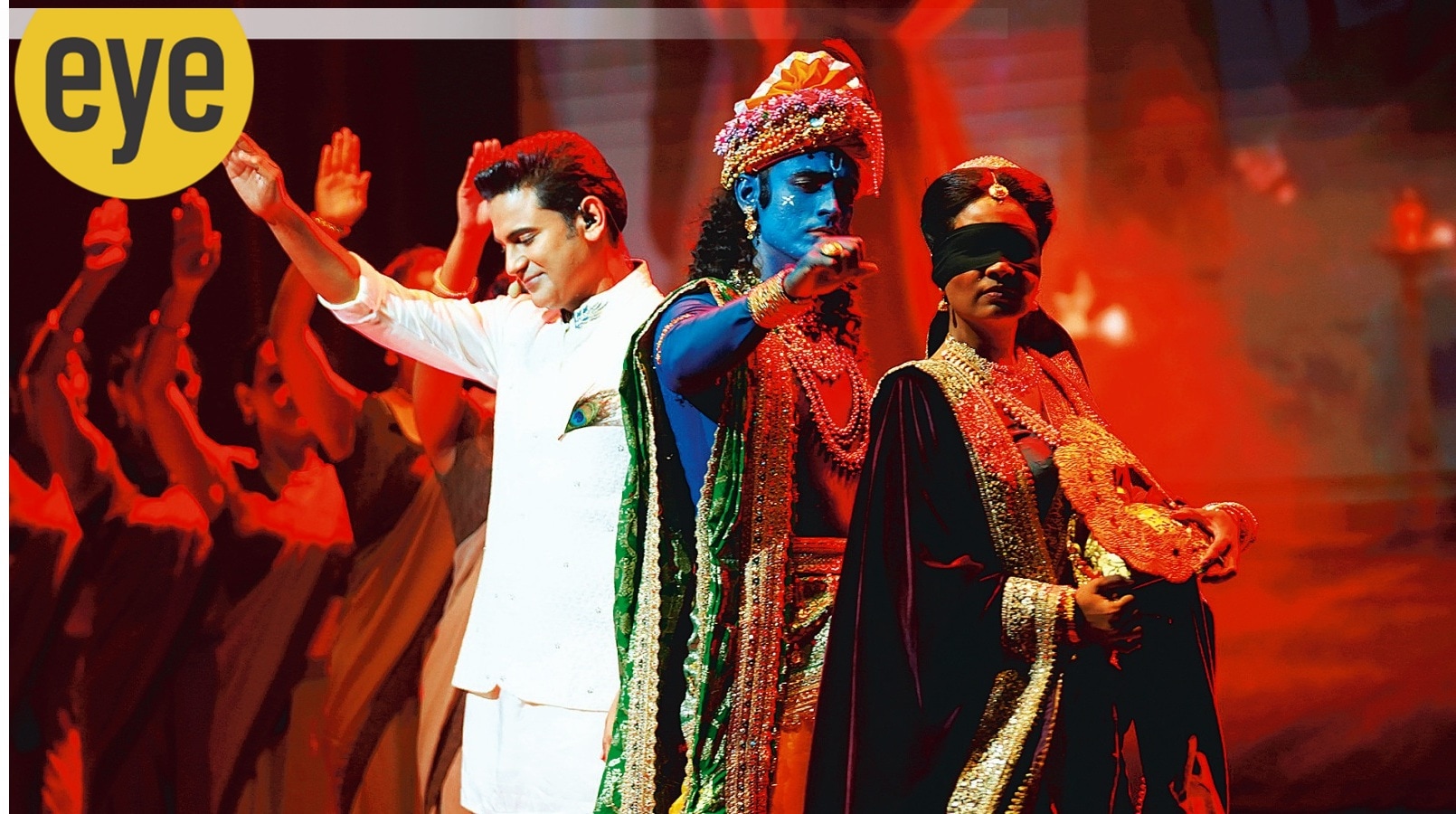
Weather ePaper Today’s Paper Journalism of Courage Home ePaper Politics Explained Opinion India Business Premium Cities UPSC Entertainment Sports World Lifestyle Tech Subscribe Sign In TrendingUPSC OfferIPL 2026US NewsPuzzles & GamesLegal NewsFresh TakeHealthResearch🎙️ Podcast Advertisement function checkAndLoadWindowSizeScript() { if (window.jQuery) { // jQuery is loaded, include your script jQuery(document).ready(function($) { // Your existing script for checking window width if (window.innerWidth) var page_w = window.innerWidth; else if (document.all) var page_w = document.body.clientWidth; if (page_w > 1024) { $(".add-left, .add-right").show(); } else { $(".add-left, .add-right").hide(); } }); } else { // jQuery is not loaded, check again after 0.2 seconds setTimeout(checkAndLoadWindowSizeScript, 200); } } // Initial call to the function checkAndLoadWindowSizeScript(); NewsEyeRamayana to Mahabharata: The rise of epic theatre in India Premium Ramayana to Mahabharata: The rise of epic theatre in India With grand sets and costumes, soaring music and spectacle, mythologies and epics have taken over the stage, commanding attention usually reserved for films. Written by: Dipanita Nath13 min readNew DelhiApr 19, 2026 08:22 AM IST A scene from Rajadhiraaj Make us preferred source on Google Whatsapp twitter Facebook Reddit PRINT The landmark Kamani Auditorium in Delhi was ready for the launch of a big play on January 22, 2024. Money, profitability, losses, nothing was of concern to the founder of Felicity Theatre, the entrepreneur and actor Rahul Bhuchar, who had spared no effort to make the musical, Humare Ram, larger than life. It was a fitting coincidence that this was also the day of the praan pratishtha or the consecration ceremony of the Ram temple in Ayodhya. The stage in Humare Ram was illuminated with video projections of palaces and natural landscapes; Bollywood playback singers Shankar Mahadevan, Sonu Nigam and Kailash Kher had recorded the songs; star power was present with Ashutosh Rana playing Ravan and performing a song. Bhuchar, one of the playwrights, was in the role of Ram. Yet, the seats in the hall were kept empty. “Only two people were present in the audience that day. They were prabhu Shri Ram and Hanuman ji maharaj. We performed to seek their blessings,” says Bhuchar. In theatre, a zero show is a nightmare. For Humare Ram, it was ritual. The play upholds an assertion of faith in plot and process in mainstream urban theatre, and has struck a chord with the public. Humare Ram, which shows both familiar and lesser-known episodes from the Ramayana, has become a modern-day blockbuster with nearly 450 shows. Famous actors have come to watch it, including Alia Bhatt, and Ranbir Kapoor, who was filming for Ramayana. There were plans for a 12-city international tour, including a second run in Dubai, before the war in West Asia broke out. As with all runaway wonders, Humare Ram has fuelled a theatre movement in which gods and epic heroes are taking centre stage. Mythology, which was already booming in music videos, television series and political discourse, is now a lavish spectacle on stage. While films such as Dhurandhar come to the screen, guns blazing, to fire up patriotic feelings, mortals having a crisis of faith may now find peace, if not perspective, in a theatre nearby. The buzz is that the next big play will be Humare Mahadev, which is being conceptualised by Gaurav Bhardwaj, an award-winning advertising professional and the director of Humare Ram. “I am an ardent devotee of Lord Shiva, who is an ardent devotee of Lord Ram (and vice versa). Directing Humare Ram felt like a spiritual calling. I hadn’t ever directed for theatre before but my instinct said ‘yes’ to it. I did not reason with the impulse, analyse it or let any limitation hold me back. I chose to go with the flow. I am working on Humare Mahadev with the same grit,” he says. Bhardwaj, reportedly, didn’t take any money for directing Humare Ram and is doing Humare Mahadev out of bhakti alone. Felicity Theatre’s Mahabharat: The Epic Tale, which is from the perspective of the antagonists — Duryodhan, played by Puneet Issar, and Karna, played by Bhuchar — has had more than 125 shows. Since January, it has been on a nationwide tour. There have been 10 shows in Delhi, two in Pune and two each are planned for Surat, Vadodara, Ahmedabad and Mumbai. Issar is reviving another play, Jai Shree Ram. His co-star from BR Chopra’s television series Mahabharat, Nitish Bhardwaj, is reprising the role of Krishna in the play Chakravyuh. Before Humare Ram, there was another mega production, Dhanraj Nathwani’s Rajadhiraaj — Love. Life. Leela, which features some of the biggest names in art and culture. It brings to life the story of Krishna through script, dialogue and lyrics by Prasoon Joshi, music by Sachin-Jigar, set design by Omung Kumar, costumes by Neeta Lulla, choreography by Bertwin D’Souza and Shampa Gopikrishna and story research from the Sahitya Akademi’s Yuva Puraskar winner Raam Mori. The direction is by theatre artiste Shruti Sharma. With a large ensemble of actors and dancers and the energy of live singing, the immersive theatrical experience has travelled across Mumbai, Delhi, Dubai, Ahmedabad, Surat, Bengaluru and Chennai. “We have witnessed a wide range of emotions across different age groups, from children as young as four to an older audience. There have been moments of tears and reflection, spontaneous dance and enthusiastic applause, which has been incredibly heartening for the entire team,” says Bhoomi Nathwani, Executive Producer of Rajadhiraaj. Her family, led by father-in-law, the industrialist and politician Parimal Nathwani, are ardent Krishna devotees. For a long time, Bollywood has not attracted the kind of attention that these mega mythologies command. When film personality and writer Manoj Muntashir’s Krishna — Radha Se Ranbhumi Tak had its first show on a weekday afternoon of February 27 this year, there was a houseful crowd of 2,000, some of whom had paid Rs 15,000 for a ticket. Most of the people had come before time and waited in the flower-bedecked lobby of the Grand Theatre at the Nita Mukesh Ambani Cultural Centre (NMACC) in Mumbai like devotees outside a temple. “I was supposed to be flying out to Bangkok today. But, as a Krishna bhakt, I did not want to miss this play. So, I postponed my trip,” said Varsha Daga, who was with her mother and sister. Many in the audience had cancelled meetings, and a few pulled strings to get the tickets. By the time the show ended, the hall was resounding with chants of ‘Radhe Radhe’. Muntashir is planning to make plays on Draupadi and Karna next. “We are a country of believers. When Ramanand Sagar’s Ramayan was being shown on television, the roads used to be empty; if there was an electricity failure during BR Chopra’s Mahabharat, people used to set fire to the power station,” says Muntashir. “In the last few years India has started becoming Bharat. We have begun to return to our roots and discover our identity. The best way to understand ourselves as Indians is to look inwards at our epics,” he adds. The arts have historically been tied to the social and political forces of the day, either as platforms to promote ideologies, or critique them. As from top down, Indians began to exhibit their religious practices, music videos, influencer reels while television series stepped up with stories from epics. When this surge coincided with the post-COVID demand for live entertainment, the curtains rose on epic dramas. “We wanted to create a performance that narrates Krishna’s leelas in a way that connects with all generations. What better art form than theatre? We set out to design a large-scale stage production that brings together storytelling, music and spectacle to interpret these timeless tales for modern audiences,” says Bhoomi. The epic productions keep true to text, with agreeable rather than radical re-interpretations. Against a backdrop of images of billowing clouds, velvet curtains and gilded throne rooms, actors emphasise practices such as respect for women and the marginalised as godly virtues. The dialogues are rousing, the punchlines sharp and good and evil clearly marked. The plays aim to make audiences proud that mythical heroes indeed walked the earth and are India’s civilisational forefathers. “In my mind, Ram ji was not mythological. He is a historical personality. Your great-grandfather and great-great-grandfather existed, that is why you are here. But, if I ask you to name them, you would not know. The fact is that prabhu Shri Ram existed and that is why we are existing today. Simple logic. I am clear on that. I never call the Ramayana a myth,” says Bhuchar. The face of Ram in Humare Ram, Bhuchar was “a happy-go-lucky guy” from Delhi who was focused on his family business of real estate and hotels, among others. His journey to Humare Ram began on a regular weekend more than 15 years ago, when he walked into a play in Mandi House and liked what he saw. He attended theatre workshops and began to perform in and produce plays. One of his early contributions was to bring Mumbai celebrities as actors in plays, a formula that mostly worked at box office. “I was genuine even then, maybe that is why prabhu chose me to play him. I do not act in Humare Ram,” he says. “More and more people are getting into spirituality. You hear of spiritual jamming and bhajan clubbing. I have realised that if I practise my righteous path, people will definitely feel it. They will see that ‘he’s coming out of a fancy car and wearing branded clothes but still, he is so spiritual’. I feel that practising spirituality as a regular person is the best way to preach it,” adds Bhuchar. He plans to stage 8,000 shows of Humare Ram, one for every year since Ram is said to have lived. Muntashir, too, stands on stage in regular clothes. He studied hundreds of books over a year-and-a-half before writing Krishna — Radha Se Ranbhumi Tak. “I wanted to make a show that would be entertaining but also fundamentally rooted in truth,” he says. The play uses Artificial Intelligence to enhance the illusion of reality. The wings and backdrop feature three layers of LED screens that recreate the marvels of Gokul, Vrindavan and the court of Hastinapur. Radha and Krishna dance under an AI-generated full moon in windswept fields. Flowers open in slow detail, palace roofs explode and crumble like egos, autumn leaves drift. The theatre floods with the magic of technology as the lyrics remind audiences: “Hai yeh kahani bilkul sacchi, kehne wale kehte thhe.” Some people rise from the seats swaying to the rhythm, some dab their eyes, overcome with emotion. The legendary Prithviraj Kapoor would famously stand among people with his shawl held like a jhola to appeal for funds to support backstage artistes and retired senior performers. Most of today’s large-scale mythologies on stage have no such worries. In the genre of commercial theatre, stories, stagecraft and the success of plays are planned like business ventures geared towards a return on investment. The big mythological plays cost between a few lakh rupees and crores —funding that no longer relies on ticket sales to break even. Krishna-Radha Se Ranbhumi Tak, for instance, is produced by Saregama. Zee Theatre’s Business Head Alenkar Pathare says that Humare Ram has a strong devotional appeal that also enables an immersive experience in the theatre format. Zee’s entire idea, going forward, is to get into strategic partnerships with makers and producers of plays similar to Humare Ram and Rajadhiraaj that can be sent across the world. “We believe content must deliver a holistic experience to the audience and our aim is to expand the traditional theatrical plays to different mediums such as live performances, TV and mobile devices. We will cater to audience segments on every medium, including consumers who wish to consume songs of the play online ,” says Pathare, who expects the trend of mythological plays to continue for the next few years. The endurance of epics in the Indian imagination owes largely to performative storytelling traditions in different parts. The oldest Ramleela started almost 500 years ago on the banks of the Ganga in Ramnagar in Varanasi. It is also a place where the Nakkataiya Mela is celebrated with fun and fanfare to mark the punishment meted out to Shoorpanakha by Lakshman. For many intellectual theatre practitioners, the epics symbolise an impenetrable fortress from whose ramparts fly the pennants of virtues and role modelling, many of which are archaic and at odds with Ambedkerite and feminist arguments. Different directors have responded by presenting alternative reimaginings of epics. However, most such questioning narratives have limited reach and a niche appeal. Dhomi Kitha Kitha Dhomi, winner of the Best Original Script at this year’s Mahindra Excellence in Theatre Awards (META), the most prestigious theatre event in the country, casts Shoorpanakha, not as a vicious, vindictive vixen but as a symbolic woman who has been marginalised by patriarchy. “She is abandoned by her brother, misled by her husband and rejected by the gods. Her story poses poignant questions about societal expectations and gender roles. The play tackles religious intolerance and labelling based on prejudice,” writes Kerala-based director OT Shajahan about his play. Then, there is Elephant in the Room, which presents a layered and playful imagining of the Ganesha myth. Yuki Ellias, all alone on stage, acts as god, human, spider, Siberian crane and an elephant. The play ends with Ganesha, referred to as Master Tusk, giving the audience a message for all times: “Some say I am a myth, some say, I am divine. I say if there must be a legacy, let it be one that betters humankind.” Dipanita Nath is a Senior Assistant Editor at The Indian Express, based in Pune. She is a versatile journalist with a deep interest in the intersection of culture, sustainability, and urban life. Professional Background Experience: Before joining The Indian Express, she worked with other major news organizations including Hindustan Times, The Times of India, and Mint. Core Specializations: She is widely recognized for her coverage of the climate crisis, theatre and performing arts, heritage conservation, and the startup ecosystem (often through her "Pune Inc" series). Storytelling Focus: Her work often unearths "hidden stories" of Pune—focusing on historical institutes, local traditions, and the personal journeys of social innovators. Recent Notable Articles (December 2025) Her recent reporting highlights Pune’s cultural pulse and the environmental challenges facing the city during the winter season: 1. Climate & Environment "Pune shivers on coldest morning of the season; minimum temperature plunges to 6.9°C" (Dec 20, 2025): Reporting on the record-breaking cold wave in Pune and the IMD's forecast for the week. "How a heritage tree-mapping event at Ganeshkhind Garden highlights rising interest in Pune’s green legacy" (Dec 20, 2025): Covering a citizen-led initiative where Gen Z and millennials gathered to document and protect ancient trees at a Biodiversity Heritage Site. "Right to breathe: Landmark NGT order directs PMC to frame norms for pollution from construction sites" (Dec 8, 2025): Reporting on a significant legal victory for residents fighting dust and air pollution in urban neighborhoods like Baner. 2. "Hidden Stories" & Heritage "Inside Pune library that’s nourished minds of entrepreneurs for 17 years" (Dec 21, 2025): A feature on the Venture Center Library, detailing how a collection of 3,500 specialized books helps tech startups navigate the product life cycle. "Before he died, Ram Sutar gave Pune a lasting gift" (Dec 18, 2025): A tribute to the legendary sculptor Ram Sutar (creator of the Statue of Unity), focusing on his local works like the Chhatrapati Shivaji statue at Pune airport. "The Pune institute where MA Jinnah was once chief guest" (Dec 6, 2025): An archival exploration of the College of Agriculture, established in 1907, and its historical role in India's freedom struggle. 3. Arts, Theatre & "Pune Inc" "Satyajit Ray, Ritwik Ghatak were not rivals but close friends, says veteran filmmaker" (Dec 17, 2025): A deep-dive interview ahead of the Pune International Film Festival (PIFF) exploring the camaraderie between legends of Indian cinema. "Meet the Pune entrepreneur helping women build and scale businesses" (Dec 16, 2025): Part of her "Pune Inc" series, profiling Nikita Vora’s efforts to empower female-led startups. "How women drone pilots in rural Maharashtra are cultivating a green habit" (Dec 12, 2025): Exploring how technology is being used by women in agriculture to reduce chemical use and labor. Signature Style Dipanita Nath is known for intellectual curiosity and a narrative-driven approach. Whether she is writing about a 110-year-old eatery or the intricacies of the climate crisis, she focuses on the human element and the historical context. Her columns are often a blend of reportage and cultural commentary, making them a staple for readers interested in the "soul" of Pune. X (Twitter): @dipanitanath ... Read More
المصدر: Indian Express
| Source: Indian Express