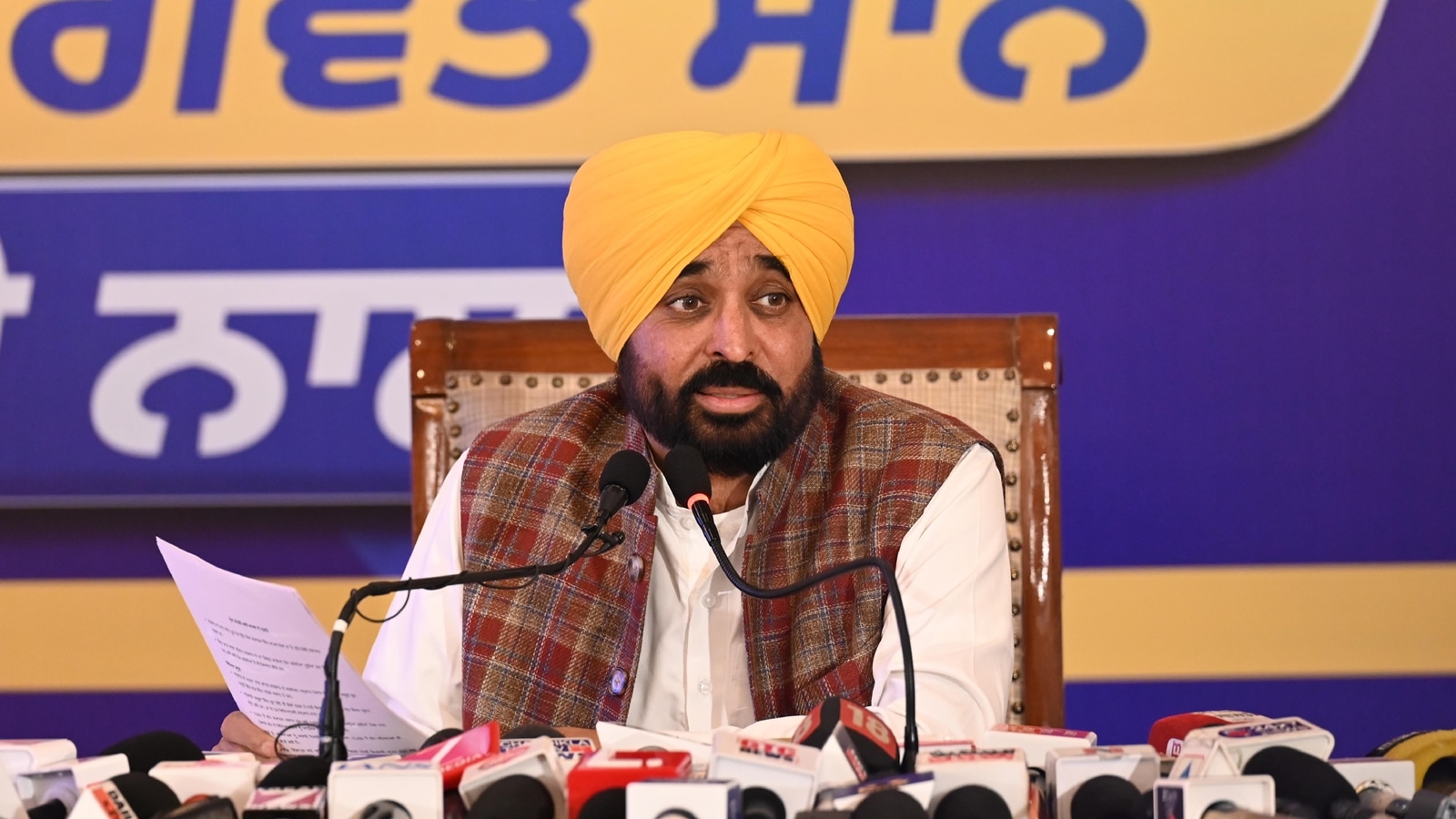
Weather ePaper Today’s Paper Journalism of Courage Home ePaper India Cities UPSC Premium Entertainment Politics Sports World Explained Opinion Business Lifestyle Tech Subscribe Sign In TrendingUPSC OfferIPL 2026US NewsPuzzles & GamesLegal NewsFresh TakeHealthResearch🎙️ Podcast Advertisement function checkAndLoadWindowSizeScript() { if (window.jQuery) { // jQuery is loaded, include your script jQuery(document).ready(function($) { // Your existing script for checking window width if (window.innerWidth) var page_w = window.innerWidth; else if (document.all) var page_w = document.body.clientWidth; if (page_w > 1024) { $(".add-left, .add-right").show(); } else { $(".add-left, .add-right").hide(); } }); } else { // jQuery is not loaded, check again after 0.2 seconds setTimeout(checkAndLoadWindowSizeScript, 200); } } // Initial call to the function checkAndLoadWindowSizeScript(); NewsCitiesChandigarhProvision of life term, Rs 25-lakh fine in Punjab Bill against sacrilege Provision of life term, Rs 25-lakh fine in Punjab Bill against sacrilege After the House passed the Bill, CM Bhagwant Mann said proposed legislation was "a historic correction of past regimes' failures”, as it plugs the loopholes left by previous governments. Written by: Kanchan Vasdev6 min readChandigarhApr 14, 2026 04:24 AM IST Punjab Chief Minister Bhagwant Mann. (File Photo) Make us preferred source on Google Whatsapp twitter Facebook Reddit PRINT The Punjab Vidhan Sabha on Monday unanimously passed a Bill proposing stricter punishment, including life imprisonment and fine up to Rs 25 lakh, exclusively for any act of ‘beadbi’ (sacrilege) against the Guru Granth Sahib, revered by the Sikh community as a living Guru. The Jaagat Jot Sri Guru Granth Sahib Satkar (Amendment) Bill, 2026, proposes a minimum imprisonment of seven years, extendable up to 20 years, along with a fine ranging from Rs 2 lakh to Rs 10 lakh for desecration, with stricter punishments, including life imprisonment and fines up to Rs 25 lakh, prescribed for sacrilege carried out as part of a conspiracy to disturb communal harmony. After the House passed the Bill, CM Bhagwant Mann said proposed legislation was “a historic correction of past regimes’ failures”, as it plugs the loopholes left by previous governments. The Bill, he added, signifies an end to the ‘beadbi’ of the holy text in the future, ensures swift investigations, and holds even those who assist in ‘beadbi’ equally accountable. While the Bill was passed unanimously, it was not without a heated debate with Congress members questioning the government about its intent and the report of a Vidhan Sabha committee constituted to consult religious heads and other stakeholders. Earlier, Mann tabled the Bill in the House in the special session called to coincide with the auspicious occasion of Baisakhi. In a highly symbolic move, the Bill was seconded by Education Minister Harjot Singh Bains, an MLA from the holy city of Anandpur Sahib. It was in Anandpur Sahib, on the festival of Baisakhi in 1699, that Guru Gobind Singh formally established the Khalsa Panth. The Bill defines sacrilege as any willful and deliberate act, committed with the intent of desecration by way of physical damaging, defacing, burning, tearing or theft of ‘Saroop(s)‘ the Guru Granth Sahib or part thereof, or by words, either spoken or written, or by signs or by visible representations or through electronic means or otherwise, which is of such a nature as to hurt the religious feelings of persons professing the Sikh faith. The investigation into the offence will be conducted by a police officer, not below the rank of deputy superintendent of police or assistant commissioner of police. In a key amendment, it proposes that the Shiromani Gurdwara Parbandhak Committee shall maintain a register of records pertaining to printing, storage, distribution, and supply of the ‘Saroops’. The register shall contain a unique identification number of each Saroop. Every custodian receiving a Saroop shall ensure safe custody, protection from damage, misuse, or loss in any manner and observance of ‘Sikh Rehat Maryada’ (Sikh code of conduct). The Bill received support from the Congress, Shiromani Akali Dal, Bharatiya Janata Party (BJP), Bahujan Samaj Party (BSP) and an independent member. During the debate, Leader of Opposition Partap Singh Bajwa insisted that the report of a select committee, which deliberated for nine months on a similar draft, must first be tabled and discussed threadbare in the House. The Opposition members also asked if the Bill will turn into an Act. The Opposition’s concern stemmed from the fact that previous SAD-BJP and Congress governments had tabled anti-sacrilege Bills during their terms. However, the Governor referred the Bills to the President of India and the assent is still pending. “The Bill will be sent to the governor. If there is a delay, I will personally urge the Governor to expedite the process. As this is a State Bill, presidential assent is not required,” Mann said. He said that that while the opposition often visits the Governor to lodge complaints against him, they could join him in supporting this noble cause as well. “If Sri Guru Granth Sahib is not safe in Punjab, then where else can it be?” Concluding the Debate, Mann said the previous governments did not have the intent to create a law. He said while the Akali-BJP combine and Congress sought votes in the name of ‘Guru Sahib,’ it is the AAP government that has taken concrete steps to uphold the sanctity of the Guru Granth Sahib. Without naming anyone, he said that those responsible for sacrilege had appeared before the Akal Takht and confessed their crimes publicly. “However, as it doesn’t suit their political ambitions, they took a U-turn and said that some people were playing into the hands of central agencies to defame them. The entire state knows the real face of these leaders who have always misled the people through their political gimmicks,” he said. Mann also noted that perpetrators of sacrilege often pretend to be mentally unstable, but the new legislation stipulates that the guardians of such individuals will be held accountable for this unpardonable crime. “The definition of ‘custodian’ has been introduced, making each custodian fully responsible for the safe custody, protection, and prevention of misuse or loss,” he said, adding that provisions have been made to ensure timely and efficient investigation of cases, and the offences under this law will be non-bailable and non-compoundable. Describing sacrilege as “a sin committed against humanity”, he said, “this legislation will ensure that anyone found guilty of this unpardonable offence will not be spared, and exemplary action will be taken against them as a deterrent for others”. Terming the Bill as a historic milestone in combating sacrilege, he said, “Sri Guru Granth Sahib Ji is a repository of universal brotherhood, secularism, and socialism that guides the destiny of mankind. The message and philosophy of Sri Guru Granth Sahib Ji is relevant across the globe and fosters harmony, oneness, peace, and compassion.” Quoting the Gurbani, the chief minister said, “Pawan Guru, Paani Pitaa, Mata Dharat Mahat.” He explained that the great Gurus equated air (pawan) with teacher, water (paani) with father, and land (dharat) with mother, teaching valuable life lessons that remain relevant today. Punjab has already seen two sacrilege bills tabled in 2016 and 2018. The 2016 proposal prescribed life imprisonment for desecration of the Guru Granth Sahib and 10 years for other religious texts. It was returned by the Centre, with objections that it created unequal punishments for similar offences across religions. In 2018, former chief minister Capt Amarinder Singh’s government revised the Bill to include all religions uniformly, but it has remained pending without Presidential assent for eight years. Kanchan Vasdev is a Senior Assistant Editor in The Indian Express’ Punjab bureau. She is a highly experienced journalist with 22 years of expertise covering high-stakes politics, governance, and social issues in Northern India. Professional Background Role: Primary reporter covering the Punjab Chief Minister’s Office (CMO), government policies, and the Aam Aadmi Party (AAP) leadership in the state. Experience: She previously worked with The Tribune and has played a key role in launching various city editions. Special Projects: Abandoned Brides: Authored a monograph on brides abandoned by NRIs as part of the Prabha Dutt Memorial Fellowship. Environment: Worked as a Centre for Science and Environment (CSE) fellow, focusing on the pollution levels in the Satluj river. Recent Notable Articles (Late 2025) Her recent reporting focuses on the legislative strategies and political maneuvers of the Bhagwant Mann-led Punjab government: 1. Legislative & Governance Standoffs "Punjab govt advances special Assembly session to pass resolution against VB-G RAM G Bill" (Dec 20, 2025): Reporting on the state's move to block the Centre's "Viksit Bharat" mission, which the state claims will undermine MGNREGA. "Punjab govt doubles down on special sessions, sixth in January" (Dec 19, 2025): Detailing the AAP government's use of special sessions as a legislative tool amid tensions with the Governor. "Punjab asks 'VIP teachers' working near Chandigarh to go back to border districts" (Dec 16, 2025): Reporting on CM Mann's move to end the practice of influential teachers avoiding postings in remote areas. 2. Political Analysis & Rural Polls "Punjab rural polls: Why Akalis are likened to dinosaurs in Punjab" (Dec 19, 2025): Analyzing CM Bhagwant Mann's rhetoric against the Shiromani Akali Dal (SAD) following local body elections. "AAP claims win in 78% Punjab zila parishads as counting continues" (Dec 18, 2025): Breaking down the results of the 2025 rural elections. "Rahul Gandhi and Sidhu alike, says Bhagwant Mann" (Dec 13, 2025): Covering the CM's critique of the Congress leadership. 3. Law Enforcement & Bureaucracy "Suspended Punjab IPS officer Ravjot Kaur Grewal awaits reinstatement" (Dec 10, 2025): Investigative reporting on the bureaucratic red tape involving the Election Commission and the state government. "Punjab declines to give parole to Amritpal Singh" (Nov 27, 2025): Detailing the state government's refusal to grant parole to the radical preacher and sitting MP. 4. Welfare & Economy "Punjab government's plan to add more freebies to 'atta-dal' scheme hits funds roadblock" (Dec 4, 2024): An analysis of the fiscal challenges facing the state's flagship food security program. "Mann leads Punjab delegation to Japan and South Korea for investor outreach" (Dec 2, 2025). Signature Beat Kanchan Vasdev is known for her insider access to Punjab's political executive. Her writing provides deep insights into how state policies are formulated and the friction points between the state government and central authorities. Her dual expertise in environment and law allows her to report on complex issues like the "Farmhouse Policy" (Dec 18, 2025) and river pollution with a unique policy-oriented lens. X (Twitter): @kanchan99 ... Read More Stay updated with the latest - Click here to follow us on Instagram
المصدر: Indian Express
| Source: Indian Express