Reaffirming its consistent policy, Pakistan has called for the abolition or severe restriction of the veto power and strongly opposed any expansion of permanent membership in the United Nations Security Council (UNSC).
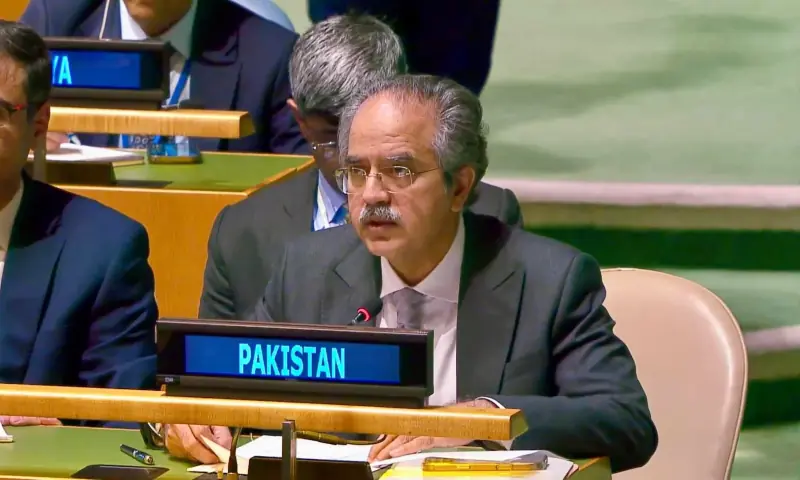
The stance was expressed by Pakistan’s Permanent Representative to the UN, Ambassador Asim Iftikhar Ahmad, at a resumed session of the long-running Intergovernmental Negotiations (IGN) aimed at reforming the 15-member UNSC.
“Pakistan’s policy position remains clear and consistent — veto should either be abolished or, at a minimum, its use by the current permanent members severely restricted,” Ambassador Ahmad stated.
He expressed Pakistan’s firm opposition to “any expansion of the veto or addition of new individual permanent members”, contending that more vetoes would only aggravate the problem.
“This is a position of principle,” he said, noting that Pakistan aligned itself with the statement delivered by the permanent representative of Italy on behalf of the Uniting for Consensus Group.
The UNSC comprises five permanent members — China, France, Russia, the United Kingdom, and the United States — and 10 non-permanent members elected for two-year terms by the General Assembly.
The UNSC often sees resolutions failing to pass due to the veto power being used by one or more of its permanent members.
This was particularly witnessed during Israel’s war on Gaza, when the US repeatedly vetoed resolutions calling for an immediate ceasefire.
In his remarks, Ambassador Ahmad said: “Together with a very large majority of member states, we firmly believe that the paralysis that we see often at the Security Council, leading to inaction on crucial matters related to international peace and security, stems from the misuse or abuse of the veto power by the permanent members.”
The envoy highlighted that this point of view was widely shared outside the UN in think tanks, academia, media and civil society.
“There is an overwhelming sentiment against the veto, and how actually this privilege is anachronistic today, along with the permanent membership. Yet, proposals to expand veto-wielding members persist,” he said.
“How can this dichotomy be defended? The problem cannot be the solution,” the ambassador remarked.
At the same time, he acknowledged that the power of veto remained a reality and the permanent members were “largely united in preserving this privilege, and would resist any dilution”.
Therefore, he said, Pakistan supported efforts to enhance accountability and transparency in the use of the veto.
The envoy underscored that UNSC reform “must be comprehensive and addressed as a single undertaking, including the question of veto, which is intricately linked to the other four clusters”.
Opposing deferring the issue or addressing it in isolation, Ahmad said the veto “runs counter to each one” of the principles of democracy, representation, accountability, effectiveness and transparency.
“We must seriously reflect on this contradiction. That is why we say if we want Reform for All, there should be Privilege for None,” he concluded.
Measures to ‘increase political cost’ of veto
During his address, Ambassador Ahmad noted that the frequency of vetoes has risen, reinforcing the need to “explore measures that can increase the political cost of the veto within and outside” the UNSC.
“Moreover, we all know that veto is primarily the power to block decisions of the Council. We need to address and balance this blocking power through more democratic means,” he emphasised.
Suggesting a series of measures, the envoy said the “most realistic way to raise the political cost of veto, and to counterbalance its blocking power” was by increasing the number of elected UNSC members.
“Increased number of elected members will tilt the balance away from the permanent members. This is the reality,” Ahmad asserted.
He explained, “In a reformed Council with more elected members, the burden of vetoing a resolution will increase markedly as it would be countering the wishes and position of an even higher number of members with affirmative votes in favour of a resolution.
“Keeping the current ratio, 16 affirmative votes would be required in a Council of say 26. We can agree on a higher ratio, say 17 or 18 affirmative votes required. This is how the veto’s blocking power can be balanced.”
Ambassador Ahmad noted, “When a permanent member blocks action that was backed by a broad majority, the veto becomes more isolated and harder to justify, increasing accountability and reputational costs.”
He further contended that “another concrete way of preserving collective interests is to reach an understanding as part of a reformed Council that would require concurrence of all members of a region, for adoption of any resolution relating to that region”.
According to Ahmad, this would not only raise the political cost of casting a veto but also “strengthen regional ownership in decision-making”.
“It could be of particular interest to regional groups such as Africa, that is increasingly asserting a regional perspective through its representatives on the Council,” he said, adding that such an arrangement can also apply to the Arab group.