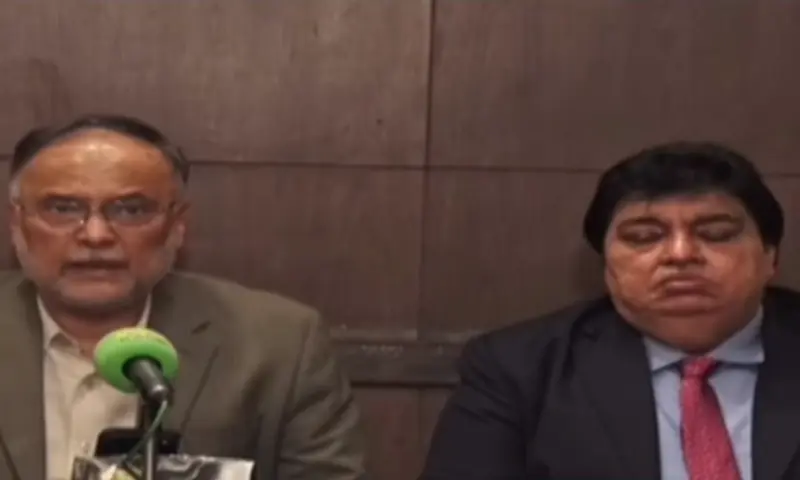
Planning Minister Ahsan Iqbal on Saturday advocated for the revision of market timings to cut down on oil usage by saving electricity, as the country faces rising import costs amid the global oil crisis.
Addressing a press conference in Lahore, Iqbal stressed the need to reduce energy spending to combat the economic difficulties arising from the ongoing war.
Pointing out that Pakistan generated electricity using imported fuel, the planning minister emphasised the need to “bring efficiency in the consumption of petrol and diesel”.
Iqbal observed that markets in Pakistan usually opened after 12pm and remained open till 2am, using “electricity generated from imported fuel”.
“If we use electricity at night now, this will be generated from furnace oil, which costs the public Rs60-80 per unit,” he explained, asking whether such “irresponsible conduct” suited a nation facing an enormous crisis.
“Crises are moments of behavioural change,” he said.
The planning minister noted that provinces have been asked to consult with traders and “seek a plan of action within a week so we can ensure the early closure of markets”.
Saying that such a move would save the government and the nation from the “unnecessary burden” of billions of rupees, Iqbal requested traders to decide “with empathy” on the matter.
He contended that people would eventually adjust to any changes in market timings.
The remarks come a day after Power Minister Awais Leghari said that Centre was consulting with provinces on changes to market timings and other conservation measures to reduce the potential rise in power tariffs driven by the high cost of gas and furnace oil.
In his remarks, Iqbal claimed that markets in “developed countries or successful economies” such as Japan, the United States, Malaysia, Indonesia and Turkiye did not remain open after 6pm or at most 8pm.
“If you go into neighbourhoods after 9pm or 10pm, there is complete calm. People have gone to sleep. Early to bed, early to rise,” he said, stressing that this was also the routine advised by Islamic teachings.
The minister further said the government had taken notice of unnecessary hikes introduced by transporters in fares, adding that provinces had been directed to discuss the prices with transporters to prevent profiteering.
“You can play your part in the country’s development and stability by preventing the unnecessary usage of a single drop of petrol or diesel,” he said, suggesting that the public adopt several fuel-saving measures.
“If you commute to the office alone, then try to carpool with colleagues from your residence or area to your office,” Iqbal said.
He further urged people not to use electricity when not needed so that the “country’s import bill can be reduced as much as possible”.
Noting that the ongoing conflict was impacting people in the Global South, Iqbal called for facing these challenges as a united nation without politicising them.
He urged the media not to report with “sensationalism”, recalling that publications were highlighting politicians’ old remarks against increases in fuel prices.
“You cannot compare apples and oranges,” he stated, contending that the past criticism was over price hikes caused by the government’s policies, whereas the current surges were not a result of the government’s performance.
‘All countries facing the same situation’
Separately, Information Minister Attaullah Tarar highlighted the government’s efforts to minimise the war’s toll on the economy and defended its decisions.
“This situation is not one of our doing. All countries are facing the same situation,” he said while addressing the media in Lahore alongside Climate Change Minister Musadik Malik.
Tarar recalled that when the conflict escalated, it required a “national response”, for which Prime Minister Shehbaz Sharif called a meeting of the national leadership, including all four chief ministers.
The information minister noted that PM Shehbaz had alerted all ministries and said that he would not tolerate the people of the country suffering due to a fuel shortage.
He said that the whole region faced a fuel shortage, pointing to neighbouring India. He recalled that the government had made arrangements so that such a situation could be avoided.
“Because the premier took a proactive approach … there was no shortage anywhere,” Tarar asserted. He said that the issue for Pakistan was that the war had affected supply lines and prices.
The minister said PM Shehbaz stayed up countless nights and that his team worked to bear a Rs129bn burden for weeks, highlighting that the government took a host of austerity measures.
Tarar asserted that the fuel subsidies announced would aid the common man. He added that the premier still did not “admit defeat”. As a result, Tarar said, PM Shehbaz partially reduced petrol prices after initially announcing an increase.
“Believe that whatever is humanly possible … the federal and provincial governments are doing for you,” he said. He added that efforts were also underway at a diplomatic level to secure peace in the Middle East.
Meanwhile, Malik said that it was also necessary to conserve fuel.
“You send your car somewhere three times a day. Please, stop. Turn off the lights when you leave the room. It is now your national duty,” he said.