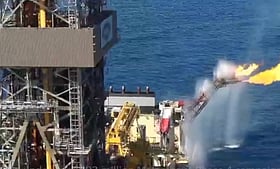
Manila: The Philippines has scored a major energy breakthrough after the successful drilling and testing of the Camago-3 well in the Malampaya gas field, a development expected to extend the country’s primary indigenous gas source and ease reliance on imported fuel.
President Ferdinand Marcos Jr. announced that the Camago-3 well —alongside the earlier Malampaya East-1 (MAE-1) discovery — will extend the life of the Malampaya field by an estimated six years, buying critical time for the country’s energy transition.
“The Camago-3 well has been successfully drilled and tested,” Marcos said, noting that the project marks a major milestone under the $893-million Malampaya Phase 4 campaign.
Bigger reserves, stronger output
Initial flow tests show Camago-3 can produce up to 60 million standard cubic feet of gas per day, significantly boosting the field’s remaining reserves.
The well is estimated to hold about 2.5 times more recoverable gas than the MAE-1 discovery, underscoring its strategic importance.
“Together, these two wells are projected to extend the life of the Malampaya gas field by an estimated six years,” Marcos said.
Power, prices, and energy security
For Filipino households and businesses, the implications are immediate: more stable and potentially cheaper electricity.
“What does this mean for you? It means more power. Steadier power. And cheaper power,” Marcos emphasized.
The President highlighted that electricity generated from Malampaya gas costs around ₱4.80 per kilowatt-hour — less than half the cost of imported liquefied natural gas, which can exceed ₱10 per kWh.
This cost advantage is especially critical as global fuel markets remain volatile due to geopolitical tensions, reinforcing the value of domestic energy sources.
Toward local gas delivery by 2026
The government is now pushing to bring new gas supplies online by 2026, with infrastructure such as subsea pipelines being developed to deliver fuel directly to power plants and industries.
The Malampaya project—long the backbone of Luzon’s power supply—has historically provided a significant share of the island’s electricity, reducing dependence on imported oil and coal while supporting cleaner energy generation.
Strategic boost amid energy transition
The Camago-3 success comes at a pivotal moment. Earlier projections warned that Malampaya could begin declining sharply within the decade, raising fears of supply gaps and rising electricity costs.
With Camago-3 and MAE-1 now confirmed, the Philippines gains a crucial buffer — potentially powering millions of homes while giving policymakers time to scale renewables, LNG infrastructure, and emerging energy technologies.
The milestone also highlights growing local capability in upstream energy development, with Marcos praising the collaboration between government and industry in advancing the project.
Breakthrough
The Camago-3 breakthrough is more than just a new well — it is a strategic lifeline, extending the Philippines’ energy security window and reinforcing the role of domestic gas as a bridge toward a more resilient, diversified power future.