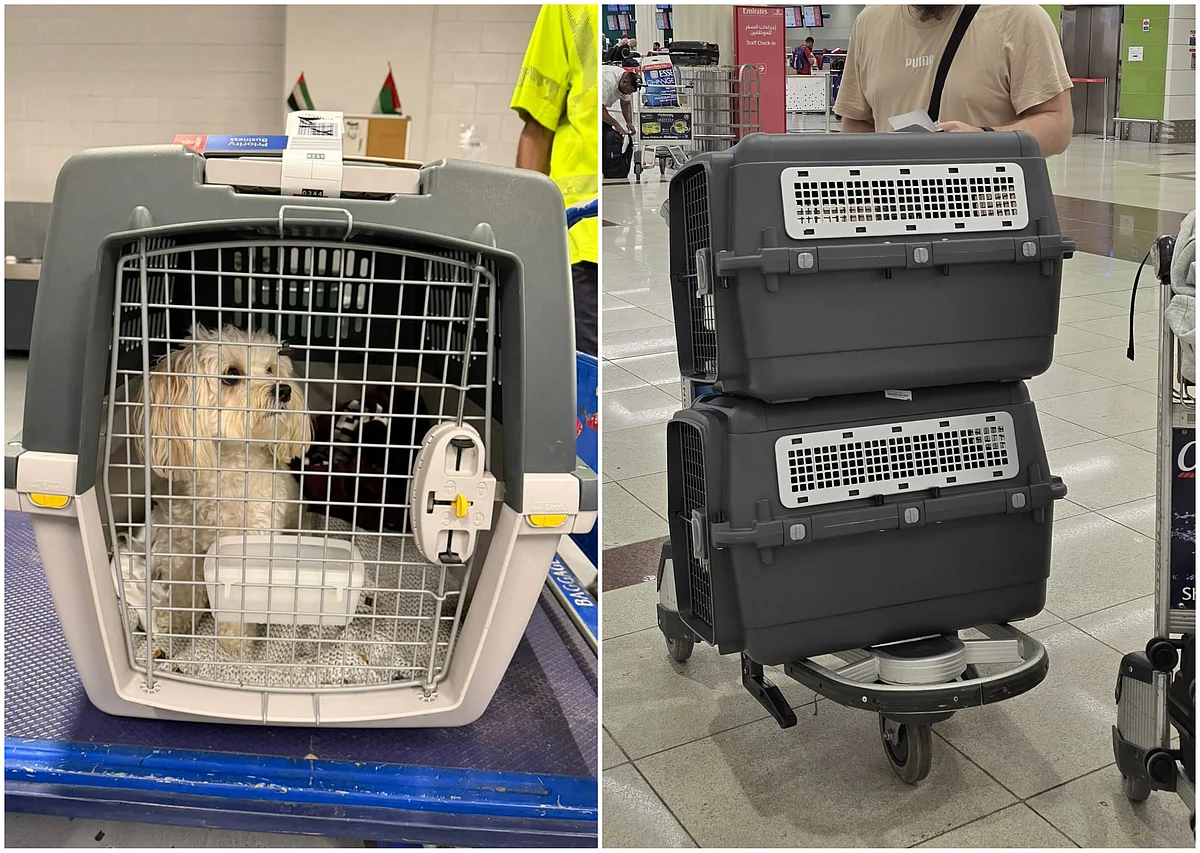
Pet relocation from UAE: How to travel to US, UK, Oman, Saudi Arabia with your fur baby
المصدر: Khaleej Times | Source: Khaleej TimesFor animal lovers, one of the most heartwarming scenes amid the US-Israel-Iran conflict was that of a flight full of pet parents with their dogs and cats landing at the Athens airport. Emotional scenes unfolded at the airport as small dogs leaped for joy after being let out of their special travel crates.
The Greek government-organised Aegean flight from Abu Dhabi carried 45 pets and 101 people amid air travel disruptions due to the war.
Not every pet parent has been as lucky as those on board that repatriation flight. Talk to any UAE resident who has tried to make travel arrangements for their four-legged companion since the war began and they'll tell you how difficult the process can be. Figuring out rules of air and road travel, and getting the vaccines and documents in order have proved to be a tedious task for many.
Stay up to date with the latest news. Follow KT on WhatsApp Channels.
While some pet parents have dealt with it on their own, others have enlisted the help of pet relocation agencies who helped them with the process, depending on the mode of transport and destination.
If you are a pet parent looking to travel out of the UAE, here's a detailed look at the process, permits and things you should know:
Pet passport to vaccines — all that you need
Every relocation is unique, but here is an overview of what the process typically involves, according to Karyna from Furry Travels, a Dubai-based pet relocation agency.
Review documents: The pet passport, vaccination booklets, microchip records, and more against the requirements of the destination country.
Vaccines: Rabies is the most commonly required vaccine, but depending on the destination, other vaccinations may also be mandatory.
Titer test: Some countries also require a rabies antibody titer test, which can take several weeks to process. This test checks for the presence of an antibody that neutralises rabies in your pet's blood.
Other treatments: Certain countries require documented anti-parasitic treatments administered within a specific window before travel.
Export permit: An official export permit must be obtained from MOCCAE, and the destination country's official health certificate must be completed and certified by the official veterinarian at MOCCAE.
Fit-to-fly certificate: Depending on which method of travel and choice of airline, a licensed vet must conduct a fit-to-fly check and issue a certificate.
Cabin or excess baggage: Whether your pet will travel in the aircraft cabin, as excess baggage, or cargo, depends on its size, temperament, and the airline's policies. Every pet must travel in an appropriate carrier, with in-cabin travel needing a soft carrier meeting the airline's specific dimensions, and hold or cargo pets requiring an IATA-approved hard crate sized precisely so it is neither too small for welfare reasons nor too large, which can increase airline costs.
Some agencies like Furry Travel also provide advice on how to prepare the pet emotionally and physically for the journey. They also offer pet taxi and shuttle services to get the family, pets, owners, and all luggage, to the airport comfortably.
"In some cases, we can also offer a door-to-door package, ensuring one of our partners arranges home delivery in the destination country," Karyna said.
Different countries, different rules
Each destination has its own rules, so the first step is always checking the import requirements and timeline for that specific country. Shannon Nulty from The Petshop breaks down the rules destination-wise.
Flying pets from the UAE to the UK
The UK has some of the strictest pet travel rules, which is why planning in advance is important, Nulty stressed.
Pets travelling to the UK must have:
A microchip
A valid rabies vaccination
An official export health certificate
Travel on an approved airline and route
Dogs also need a tapeworm treatment within the correct time window before travel. The UK does not allow pets to arrive in the passenger cabin, they normally travel as manifest cargo.
Costs vary depending on the size of the pet and the route taken. A more cost effective option is to travel to Mainland Europe and then into the UK via ferry or the Eurotunnel, Nulty advised.
Travelling to the United States
The US process is usually straightforward, particularly for cats and dogs coming from countries that are considered lower risk for rabies such as the UAE.
For dogs travelling from the UAE, the main requirements generally include:
A microchip
A rabies vaccination
A CDC import form
A health certificate from a veterinarian
UAE export permit
Airlines may also require additional documentation.
Costs are similar to other long-haul destinations and depend on the route and your pet's size and weight, Nulty says.
Travelling with pets by road to Oman
Pets can travel to Oman by road, but they do need proper veterinary paperwork and an import permit.
Typically this includes:
Microchip
Rabies vaccination
Import permit from Oman
Veterinary health certificate
Rabies antibody blood test
During the Iran war, Oman relaxed the rules slightly on the antibody test. If the test has been done, the pet can travel while waiting for the results.
By road to Saudi Arabia
Saudi Arabia has these requirements for importing pets:
Microchip identification
Vaccination records
Veterinary health certificate
Import permit issued by the Saudi authorities
UAE export permit
Using Oman or Saudi Arabia as transition points to another country
Nulty says that the most important thing is to remember that you must satisfy the rules of not just the transition country but the final destination as well. You will need to meet the following three things:
UAE export requirements
Entry rules for the transit country
Import rules for the final destination
Timing is also important because some documents, like health certificates, are only valid for a limited period. If you're not staying long, the health certificates for your final destination can be done in the UAE.
ملاحظة تحريرية | Editorial Note: نُشر هذا المقال في الأصل بواسطة Khaleej Times. خبر (Khabr) هي منصة إعلامية أردنية مرخّصة تعمل بالذكاء الاصطناعي. نضيف قيمة تحريرية من خلال: تحليل ذكي للأخبار، ملخصات تلقائية، رواية صوتية بالذكاء الاصطناعي، ترجمة متعددة اللغات، وتدقيق الحقائق. هدفنا جعل الأخبار أكثر وضوحاً وسهولةً للقارئ العربي.
This article was originally published by Khaleej Times. Khabr is a licensed Jordanian AI-powered news platform (Registration #82086). We add editorial value through: AI-powered news analysis, automated summaries, AI audio narration, multi-language translation (Arabic, English, French, Turkish), and AI fact-checking. Our mission is to make news more accessible and understandable for Arabic-speaking audiences worldwide.