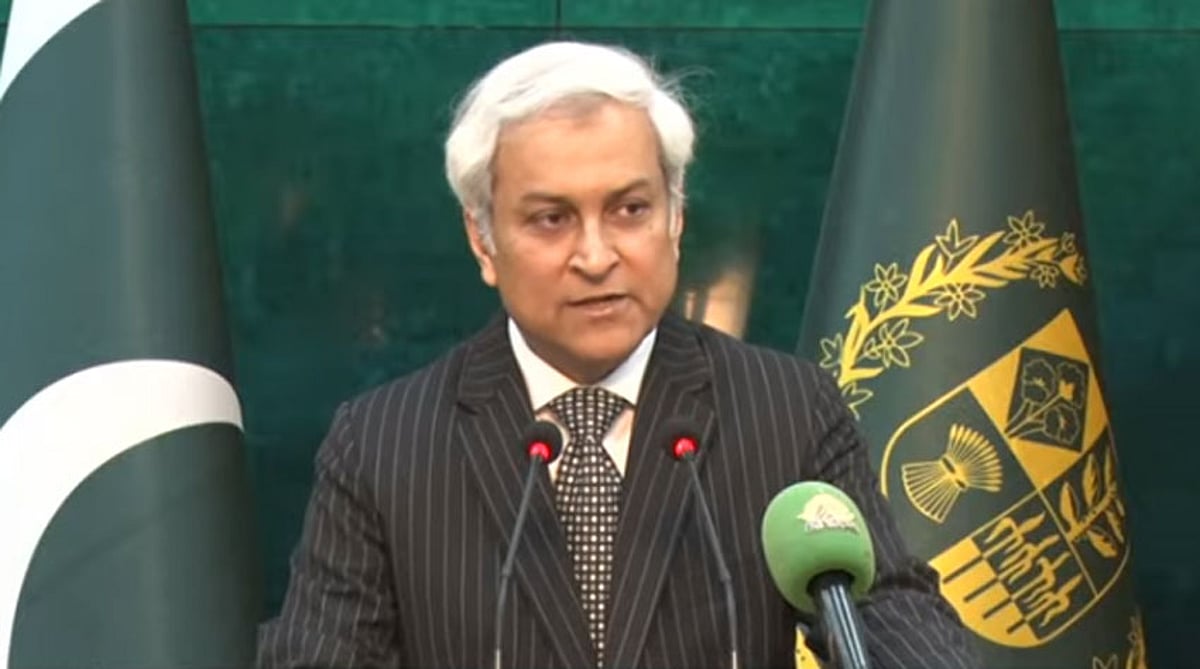
DUBAI 23°CGOLD/FOREXPRAYER TIMESNEWSLETTERSLOGIN GOLD/FOREXDUBAI 23°CPRAYER TIMES ASIAASIAINDIAPAKISTANPHILIPPINES World / Asia / PakistanPakistan intensifies diplomacy to ease US-Iran tensions, offers to host talksForeign Office says Islamabad in continuous contact with Washington, Tehran Dubai: Pakistan has stepped up high-level diplomatic engagement with the United States and regional stakeholders in a bid to de-escalate tensions in the Middle East, positioning itself as a key facilitator for dialogue amid a conflict that has rattled global energy markets and heightened geopolitical uncertainty. At a weekly press briefing on Thursday in Islamabad, Pakistan Foreign Office spokesperson Tahir Hussain Andrabi said Islamabad remains in “continuous diplomatic consultations” with US leadership and is working actively to create conditions conducive to negotiations between relevant parties, particularly Washington and Tehran. “Pakistan is actively working to create a conducive environment for de-escalation and dialogue,” Andrabi told reporters, adding that the next phase of engagement would focus on “meaningful negotiations” aimed at achieving a sustainable resolution. The diplomatic push comes against the backdrop of a more than monthlong conflict involving the United States, Israel and Iran, which began on February 28 and has since spilt across the wider Middle East. The crisis has disrupted critical shipping routes, with Iran effectively blocking oil and gas transit through the Strait of Hormuz, a development that has sent shock waves through global energy markets and strained economies worldwide. Pakistan, Andrabi said, has been in contact not only with the United States and Iran but also with European partners, as well as key multilateral blocs including the Organisation of Islamic Cooperation and the Gulf Cooperation Council. He noted that both Washington and Tehran have expressed confidence in Islamabad’s role and appreciated its ongoing facilitation efforts. Last week, Pakistan has hosted foreign ministers from Saudi Arabia, Turkiye and Egypt as part of a broader regional consultation process, relaying messages between the United States and Iran and building momentum for dialogue. Islamabad has also formally offered to host negotiations, underscoring its willingness to play a central mediating role. Despite speculation about evolving alliances, Andrabi cautioned against interpreting the emerging four-country consultative mechanism as a formal bloc, stressing that its purpose remains limited to enhancing coordination and promoting shared interests. “These consultations should not be prematurely seen as an alliance,” he said, adding that Pakistan’s approach is rooted in diplomacy rather than pressure. He reiterated that Iran, as a sovereign state, retains full authority over its policy decisions, and Pakistan’s efforts should not be misconstrued as coercive. Instead, Islamabad’s objective is to facilitate dialogue and reduce tensions through constructive engagement. A key pillar of Pakistan’s diplomatic outreach is a joint five-point peace initiative developed with China, which has received recognition at both regional and global levels. The plan, shared with the United States, Iran and other stakeholders, calls for an immediate ceasefire, humanitarian assistance, civilian protection, sustained dialogue and adherence to international law, including the UN Charter. According to the Foreign Office, the framework aligns with the outcomes of recent multilateral consultations in Islamabad and is increasingly being viewed as a viable road map toward de-escalation and long-term stability. Pakistan’s efforts have also drawn international support, with leaders from Europe and Southeast Asia endorsing Islamabad’s role in promoting peace. Andrabi said the President of the European Council and other global figures have acknowledged Pakistan’s diplomatic outreach, reflecting growing recognition of its constructive engagement. In a development seen as a positive signal for regional stability, Iran has allowed at least 20 Pakistan-flagged vessels to transit through the Strait of Hormuz, easing immediate concerns over maritime disruptions. Pakistani ships, the spokesperson confirmed, are continuing operations as scheduled. Alongside its Middle East diplomacy, Pakistan is also engaged in parallel efforts to address tensions with Afghanistan. A Pakistani delegation is currently in Urumqi, China, for what Andrabi described as “working-level talks” with Afghan officials, facilitated by Beijing. The discussions follow a recent visit by Deputy Prime Minister and Foreign Minister Ishaq Dar to China, where he met his counterpart Wang Yi and discussed regional security dynamics. While expressing hope for a “durable solution,” Andrabi said that the responsibility for meaningful progress in Pak-Afghan relations lies with Kabul. “The burden of real process lies with Afghanistan, which must demonstrate visible and verifiable actions against terrorist groups using its soil against Pakistan,” he said. Despite ongoing diplomatic engagement, Pakistan’s security operations along the Afghan border continue unabated. Andrabi confirmed that Operation Ghazab-lil-Haq remains in full effect, with recent actions carried out against militant groups. How Pakistan rises as key US-Iran war mediator Pakistan doubles down on talks to end regional tensions Pakistan doubles down on talks to end regional tensions PIA touches down in London after six-year hiatus How nations are pushing diplomacy to end the war How Pakistan rises as key US-Iran war mediator
المصدر: Gulf News
| Source: Gulf News
ملاحظة تحريرية | Editorial Note:
نُشر هذا المقال في الأصل بواسطة Gulf News.
خبر (Khabr) هي منصة إعلامية أردنية مرخّصة تعمل بالذكاء الاصطناعي.
نضيف قيمة تحريرية من خلال: تحليل ذكي للأخبار، ملخصات تلقائية، رواية صوتية بالذكاء الاصطناعي، ترجمة متعددة اللغات، وتدقيق الحقائق.
هدفنا جعل الأخبار أكثر وضوحاً وسهولةً للقارئ العربي.
This article was originally published by Gulf News.
Khabr is a licensed Jordanian AI-powered news platform (Registration #82086).
We add editorial value through: AI-powered news analysis, automated summaries, AI audio narration, multi-language translation (Arabic, English, French, Turkish), and AI fact-checking.
Our mission is to make news more accessible and understandable for Arabic-speaking audiences worldwide.