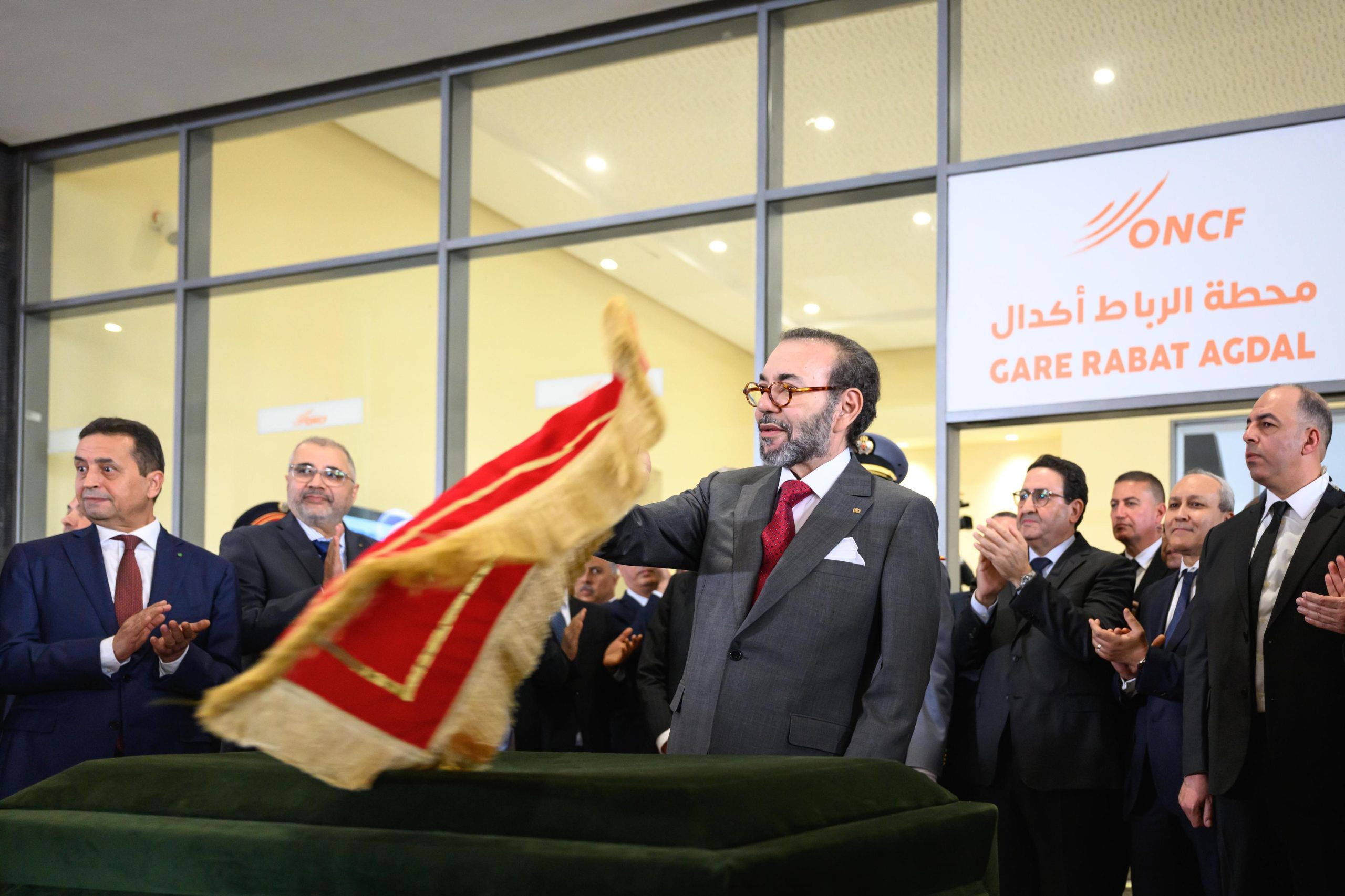
Marrakech – One year after King Mohammed VI launched construction of the Kenitra-Marrakech high-speed rail line, Morocco’s national railway operator says the project is on track.
In a communiqué released today, ONCF said it has recorded “major advances across all components of the program.” The statement described the MAD 96 billion ($9.6 billion) investment as a project of “unprecedented transformation and modernization” of the national rail system.
The numbers back that up. On the 430-kilometer Kenitra-Marrakech line alone, land acquisition is complete. Nearly all rights-of-way have been cleared. Some 20 million cubic meters of earthwork have been executed. Fifteen viaducts are under construction. Three covered trenches near Casablanca’s airport, Zenata, and Aïn Atiq stretch a combined 1.5 kilometers. Work on 92 rail and road bridges has also begun.
On the supply side, ONCF confirmed it has secured 2.5 million tons of ballast, 800,000 tons of sleepers, over 100,000 tons of rails, and 220 track switches. Track-laying is underway on several segments. Signaling systems are in the preparation phase.
The station design has been finalized, and a first batch of station construction was launched in early 2026. ONCF expects all stations to be underway by July.
The high-speed line carries an infrastructure budget of MAD 53 billion ($5.3 billion). A separate MAD 29 billion ($2.9 billion) is earmarked for 168 new-generation trainsets. And another MAD 14 billion ($1.4 billion) is set to go toward maintaining the existing network.
Around 150 companies are currently mobilized on the project. Nearly two-thirds are Moroccan firms.
Read also: ONCF: Marrakech Train Service Suspended for LGV Works
The progress update comes two weeks after ONCF reported record financial results for 2025.
At a Rabat board meeting chaired by Transport Minister Abdessamad Kayouh on April 9, ONCF said total revenue crossed MAD 5 billion ($500 million) for the first time. Passenger traffic hit 55.6 million travelers, generating MAD 2.9 billion ($290 million) in revenue – a 5% increase over 2024.
Al Boraq, Africa’s only high-speed rail service, carried 5.6 million passengers last year, up 3%. The service posted MAD 848 million ($84.8 million) in revenue in its seventh year of operation.
Freight volumes rose 6% to 9 million tons. Phosphate transport jumped over 12% to 14.2 million tons, bringing in MAD 1.245 billion ($124.5 million).
EBITDA climbed to MAD 2.173 billion ($217.3 million), up from MAD 1.949 billion ($194.9 million) in 2024. ONCF said it returned to a positive operating result, fully absorbing infrastructure depreciation charges. Net income, excluding infrastructure-related capital charges, reached approximately MAD 878 million ($87.8 million).
The operator also reported a 26% reduction in greenhouse gas emissions based on its 2024 carbon footprint assessment. It obtained ISO 37001 certification for anti-corruption management.
Morocco’s rail ambitions have drawn international attention. A CBS 60 Minutes segment aired on April 5 cited Al Boraq as a model of rail engineering. Reporter Jon Wertheim contrasted Morocco’s operational high-speed service with California’s stalled project, which voters approved in 2008 at $33 billion with a 2020 deadline. No trains run there. The estimated cost has ballooned to $126 billion.
When asked why over 20 countries, including Morocco, have high-speed rail and the US does not, Amtrak co-founder Lou Thompson offered a direct answer. “The simple answer is they’ve decided they want to do it and pay for it, and we haven’t,” he responded.
The post One Year After Launch, What Has ONCF Delivered on Its High-Speed Rail Program? appeared first on Morocco World News.