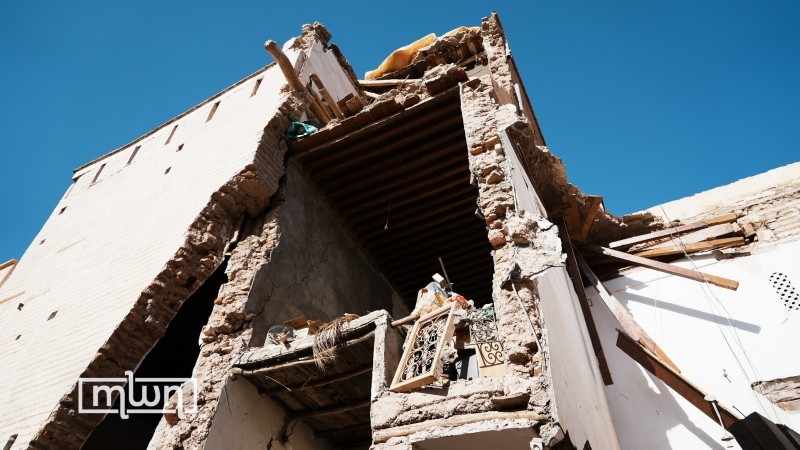
A new scientific study published in “Seismological Research Letters,” a journal of the Seismological Society of America, offers important new insight into the 2023 Al Haouz earthquake, one of the most devastating natural disasters in Morocco’s recent history. The paper, titled “The 2023 Mw 6.8 Al Haouz Lower Crustal Earthquake Buried in a Thick Crust Within a Thin Lithosphere Beneath the High Atlas Mountain Range (Morocco),” examines how and why this destructive earthquake occurred beneath the High Atlas Mountains.
The lead author is a PhD student at the Faculty of Sciences and Technics in Tangier. This work was carried out within the framework of a fellowship and was supported by the International Centre for Theoretical Physics (ICTP) and the International Atomic Energy Agency (IAEA) through the Sandwich Training Programme, which provided essential resources for this research.
This publication is the result of an international scientific collaboration between institutions in Morocco and abroad, reflecting the global scientific importance of understanding the Al Haouz earthquake and its tectonic causes.
One of the study’s most important findings is that the Al Haouz earthquake ruptured at least two-thirds of the thick crust beneath the High Atlas. The research shows that this happened in a region characterized by an unusually thin lithospheric mantle, about 30 kilometers thick, near the edge of the western African craton.
Read also: Earthquake in Morocco: An Intimate Tragedy Meets Timeless Resiliency
According to the study, this suggests that the slow deformation of the region is likely controlled by a combination of oblique crustal convergence and localized asthenospheric uplift. The authors interpret this uplift as possibly related to the lateral flow of the Canary Plume interacting with the western African craton. In other words, the earthquake was not only the result of shallow tectonic processes near the surface, but was also influenced by deeper geodynamic mechanisms within the Earth.
To reach these conclusions, the study combined several advanced geophysical approaches, including satellite-based deformation measurements, aftershock analysis, Coulomb stress modeling, ambient-noise seismic tomography, and P-wave coda autocorrelation. Together, these methods provided a clearer image of the earthquake source and the deep structure beneath the High Atlas.
These findings are important because they go beyond describing the earthquake itself. They help explain the deeper tectonic conditions that made such a destructive event possible in a region where surface deformation is relatively slow. This improves scientific understanding of seismic hazard in Morocco and provides useful knowledge for future research on earthquake processes in the region.
The study has also attracted significant international attention and is currently ranked first on the journal’s “Most Read” list in “Seismological Research Letters.”
At a time when Morocco continues to reflect on the human and structural impact of the Al Haouz tragedy, such scientific research plays an important role in improving our understanding of the forces shaping the country’s seismic risk.
The post New Study Sheds Light on the Deep Cause of Morocco’s Al Haouz Earthquake appeared first on Morocco World News.