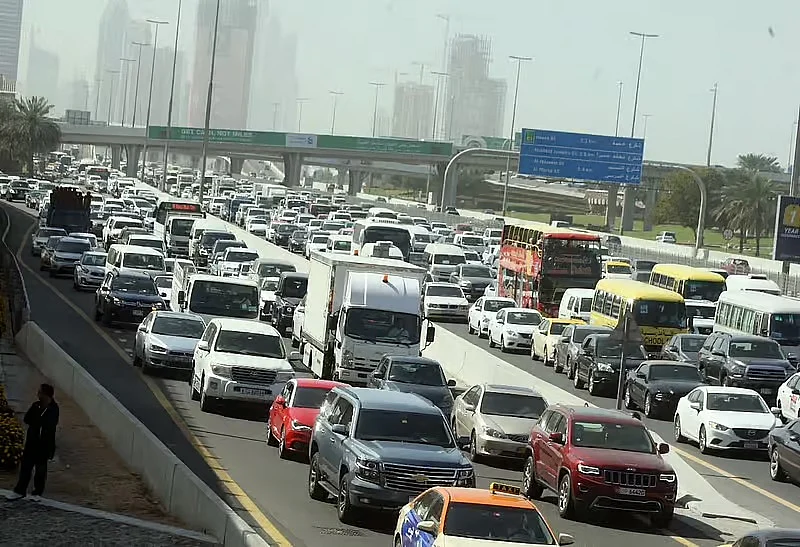
'Mostly stop-and-go': Dubai–Sharjah traffic builds up again, residents say
•Not long ago, the drive between Dubai and Sharjah felt smoother, with cars moving steadily for most of the journey.
•Now, brakes are back in frequent use.
•Traffic is building up again, and during peak hours, large stretches of key routes are once again turning red on navigation maps.Motorists said that levels of traffic between the two emirates are pick...
هذا الخبر من Khaleej Times. خبر يقدم أدوات ذكاء اصطناعي للتلخيص والترجمة والاستماع.
المصدر: Khaleej Times | Source: Khaleej TimesNot long ago, the drive between Dubai and Sharjah felt smoother, with cars moving steadily for most of the journey. Now, brakes are back in frequent use. Traffic is building up again, and during peak hours, large stretches of key routes are once again turning red on navigation maps.
Motorists said that levels of traffic between the two emirates are picking up again, with daily drive times gradually stretching at the same hour in some areas. They noted that traffic is building up across key routes including Sheikh Mohammed bin Zayed Road and Al Ittihad Road, as well as internal roads that connect to major highways.
By 7.30am, long stretches of major roads are already slowing down, with drivers stating that journeys which earlier took around 30 minutes are now taking closer to an hour. “I travel from Al Nahda in Sharjah to Al Quoz every day, usually taking the Airport Tunnel route. A few weeks ago, I could leave at around 7.30am and reach in about 30 to 35 minutes. Now, at the same time, it is taking closer to an hour,” said Shareef M, a marketing executive at an automotive firm in Dubai.
Stay up to date with the latest news. Follow KT on WhatsApp Channels.
Traffic begins to slow down right from Shareef's house in Al Nahda, Sharjah and continues along the stretch until Al Mulla Plaza on Itiihad road. “Earlier, the roads were clear, but now it stays slower for longer. You keep moving, but it’s mostly stop-and-go,” he says.
Driving for over an hour
Syed Abbas, another resident who drives daily using a combination of Al Khail Road, Oud Metha and the Infinity Bridge, said the situation has changed in recent weeks.
“My route is usually Al Khail Road from my office, then I cut through Oud Metha and take the Infinity Bridge towards Sharjah. It used to be a smooth drive, around 30 minutes,” said Abbas, a media professional.
“Now it feels different. The same route is taking over an hour on some days, especially if there is congestion near Oud Metha as widening of the road is ongoing and the regular Infinity bridge traffic is back. Also, with the widening of the road project towards Al Mamzar, it feels like traffic is building up across multiple roads, not just one stretch,” he added.
Traffic increase is visible
Drivers who spend long hours on the road said that the increase is visible across different parts of the day. “I drive across Dubai and Sharjah the whole day, using Sheikh Mohammed bin Zayed Road or Al Ittihad road. A few weeks ago, trips were faster and I could complete more rides in the same time,” said Abdullah, a taxi driver who works with a taxi company in Dubai.
“Now traffic has increased again in recent days. What used to take 30 to 40 minutes is now going beyond an hour during peak periods. Even between trips, you spend more time moving through slower traffic,” he said.
Car-lift drivers, who follow fixed routes and timings, also said that the impact has also been noticeable.
“I start from Jebel Ali and pick up passengers from different areas, including business hubs in Dubai, before heading to Al Nahda in Sharjah,” Abdul Latif, a car-lift driver operating between Jabel Ali, JLT, and Business Bay, said.
“Earlier, I could complete the full trip in around one and a half hours. Now it is taking more than two and a half hours on most days,” he said, adding that delays tend to build up with each pickup point. “By the time we reach near the Sharjah border, traffic is already heavier.”
Some motorists view that ongoing roadworks and lane diversions in parts of the UAE are also contributing to slower traffic flow, with merging points and reduced lanes adding to delays during busy hours.
ملاحظة تحريرية | Editorial Note: نُشر هذا المقال في الأصل بواسطة Khaleej Times. خبر (Khabr) هي منصة إعلامية أردنية مرخّصة تعمل بالذكاء الاصطناعي. نضيف قيمة تحريرية من خلال: تحليل ذكي للأخبار، ملخصات تلقائية، رواية صوتية بالذكاء الاصطناعي، ترجمة متعددة اللغات، وتدقيق الحقائق. هدفنا جعل الأخبار أكثر وضوحاً وسهولةً للقارئ العربي.
This article was originally published by Khaleej Times. Khabr is a licensed Jordanian AI-powered news platform (Registration #82086). We add editorial value through: AI-powered news analysis, automated summaries, AI audio narration, multi-language translation (Arabic, English, French, Turkish), and AI fact-checking. Our mission is to make news more accessible and understandable for Arabic-speaking audiences worldwide.