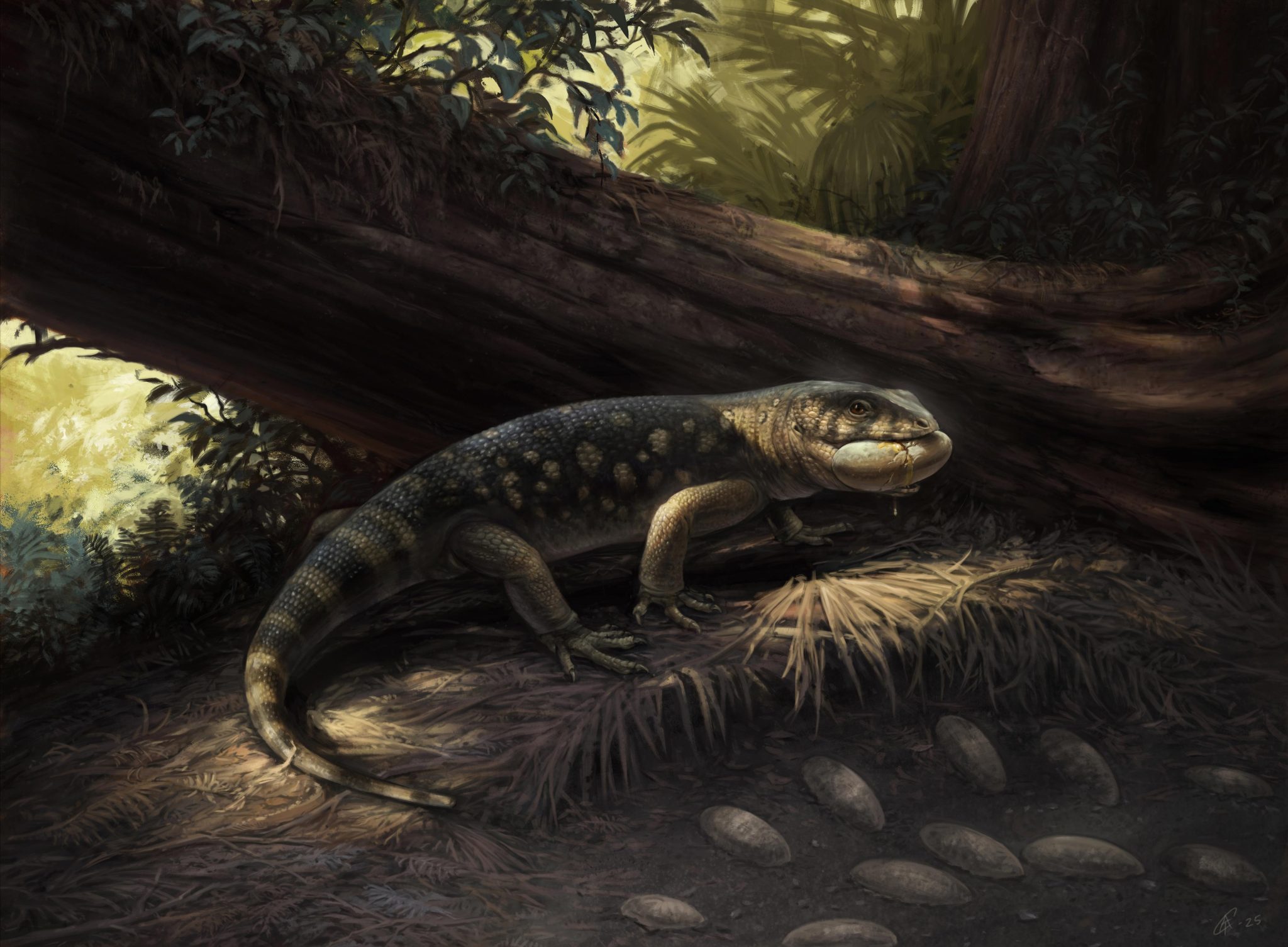
Marrakech – A team of Moroccan researchers has identified the first lizard-like fossil tracks ever recorded from Jurassic-era rocks on the African continent. The discovery, published April 20 in the journal Historical Biology, comes from the Guettioua Formation in the Msemrir syncline of Morocco’s Central High Atlas.
The find represents only the third known occurrence of Jurassic lacertoid tracks worldwide. The two previous records came from the Early Jurassic of the United States and the Late Jurassic of northern Spain. No such tracks had ever been documented in Gondwana, the ancient southern supercontinent that included Africa.
Omar Ait Haddou of Sidi Mohamed Ben Abdellah University in Fez led the study alongside eight co-authors from six Moroccan universities. The team analyzed a sandstone slab containing 12 tracks, including both pes (foot) and manus (hand) imprints. The slab measures roughly 30 cm in length and 25 cm in width.
Most of the imprints are poorly preserved. One left manus track, catalogued as AAHMC24-M, stands out as well-preserved and complete. The researchers described it as pentadactyl, ectaxonic, highly asymmetrical, and plantigrade. Digit IV is the longest, while digits I and II are nearly equal and slightly shorter than digits III and IV.
The manus measures 20 mm in length and 19.8 mm in width, giving it a length-to-width ratio of 1. The interdigital angles range from 18° between digits II and III to 48° between digits I and II. The general morphology suggests a lacertoid-type track comparable to those of a modern lizard.
Read also: Moroccan Researcher Discovers New Ant in Chtouka Ait Baha, Names it After His Wife
A 2024 prospecting campaign near the village of Msemrir led to the discovery. The tracks were found in the lower part of the Guettioua Formation, dated to the Bathonian-Callovian stages of the Middle to Late Jurassic, roughly 164 to 168 million years ago. The specimens are now housed at the palaeontological collection of the Faculty of Sciences Dhar El Mehraz in Fez.
The team used photogrammetric techniques to analyze the slab. Three-dimensional models were generated using Agisoft PhotoScan Metashape, while depth-color maps were produced with Paraview software.
The researchers compared the tracks to several known ichnotaxa. The specimen shows morphological affinities with Rhynchosauroides, the only lizard ichnogenus generally accepted for the entire Jurassic. However, key differences exist. In Rhynchosauroides, the manus is laterally overstepped by the pes. In the Msemrir specimen, the manus is positioned anterior to the pes and inward rotated.
The team also ruled out small crocodylomorph ichnotaxa including Batrachopus, Crocodylopodus, and Hatcherichnus based on differences in digit proportions, size, and interdigital angles. Due to the poor preservation, the authors cautiously referred the tracks to lacertoid without proposing a more precise identification.
The Guettioua Formation has already yielded dinosaur, crocodyliform, bird-like, and invertebrate traces. The addition of lacertoid tracks points to a transitional environment integrating both terrestrial and aquatic habitats. The researchers interpreted the depositional setting as a fluvial system with dynamic alluvial plains and an anastomosing channel network.
The coexistence of lizard-like reptiles and theropods in the same environment suggests possible ecological interactions, including a predator-prey relationship where small reptiles may have been hunted by carnivorous theropods.
The discovery confirms the presence of lacertoids along the southern margin of the Tethys Ocean during the Middle to Late Jurassic. It also aligns with the osteological record of squamates from the Anoual syncline in eastern Morocco, supporting evidence of faunal exchange between North Africa and the Iberian Peninsula during the Middle Mesozoic.
The authors recommended systematic fossil prospecting in the Msemrir region, noting the Guettioua Formation possibly contains traces of yet unknown Jurassic vertebrates.
The post Morocco Yields First Jurassic Lizard Tracks in Africa appeared first on Morocco World News.