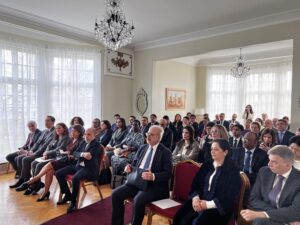
Rabat – The Residence of Morocco in Stockholm hosted a high-level conference on Thursday to discuss the future of multilateralism in a shifting global order. The event brought together more than 50 ambassadors and senior diplomats.
Titled “Between the Multilateral and Multipolar World: The New Roles of Europe and the Global South,” the conference was organized at the invitation of Morocco’s Ambassador to Sweden, Karim Medrek, who also chairs the Stockholm-based Group of Friends of Multilateralism.
In his opening remarks, Medrek said Morocco under the leadership of King Mohammed VI remains committed to multilateral cooperation based on “active solidarity, inclusion and shared responsibility.” He warned that the international system is undergoing major changes, with new global powers gaining influence while traditional forms of cooperation face growing pressure.
Medrek called for stronger collective engagement and updated approaches to global governance. He said Europe, with its experience in regional integration, and countries of the Global South could play an important role in shaping a more balanced international system.
He also noted the need for joint action on key global issues, including peace and security, trade, climate change, sustainable development, and health security.
The keynote speaker, former Latvian President Egils Levits, described today’s international environment as increasingly unpredictable. He pointed to a “crisis of trust” between countries and a rise in conflicts driven by territorial and political ambitions.
Levits said multilateral cooperation is weakening as geopolitical tensions grow. He warned that smaller and medium-sized countries are more exposed to economic inequality in this context. In addition, he noted that fast developments in technology are also changing global power dynamics.
Despite these challenges, Levits said multilateralism can still continue if it adapts. He suggested that stronger regional cooperation between countries with shared interests could help maintain stability.
He added that institutions such as the United Nations are essential for addressing global challenges, even if they need reform.
During the discussions, participants discussed the importance of respecting international law as a key factor for stability in a more divided world. They also noted Europe’s role and called for more balanced partnerships with countries of the Global South.
Levits noted the need to protect the principles of the UN Charter while recognizing that the current system must evolve to reflect new global realities.
The Group of Friends of Multilateralism in Stockholm, created in 2023, includes ambassadors from several countries, including Argentina, the United Arab Emirates, Greece, Indonesia, Mexico, New Zealand, Sri Lanka, Switzerland, and Morocco, which launched the initiative.
The conference comes at a time when global cooperation is under pressure due to ongoing conflicts, economic competition, and climate challenges.
According to the Global Peace Index 2025, there are 59 active state-based conflicts worldwide, the highest number since World War I.
Economic cooperation is weakening, with recent reports indicating a decline in global development aid of between 9% and 17% in 2025, with major donor countries reducing funding.
The post Morocco Hosts Conference in Stockholm on Multilateralism, a Changing World Order appeared first on Morocco World News.