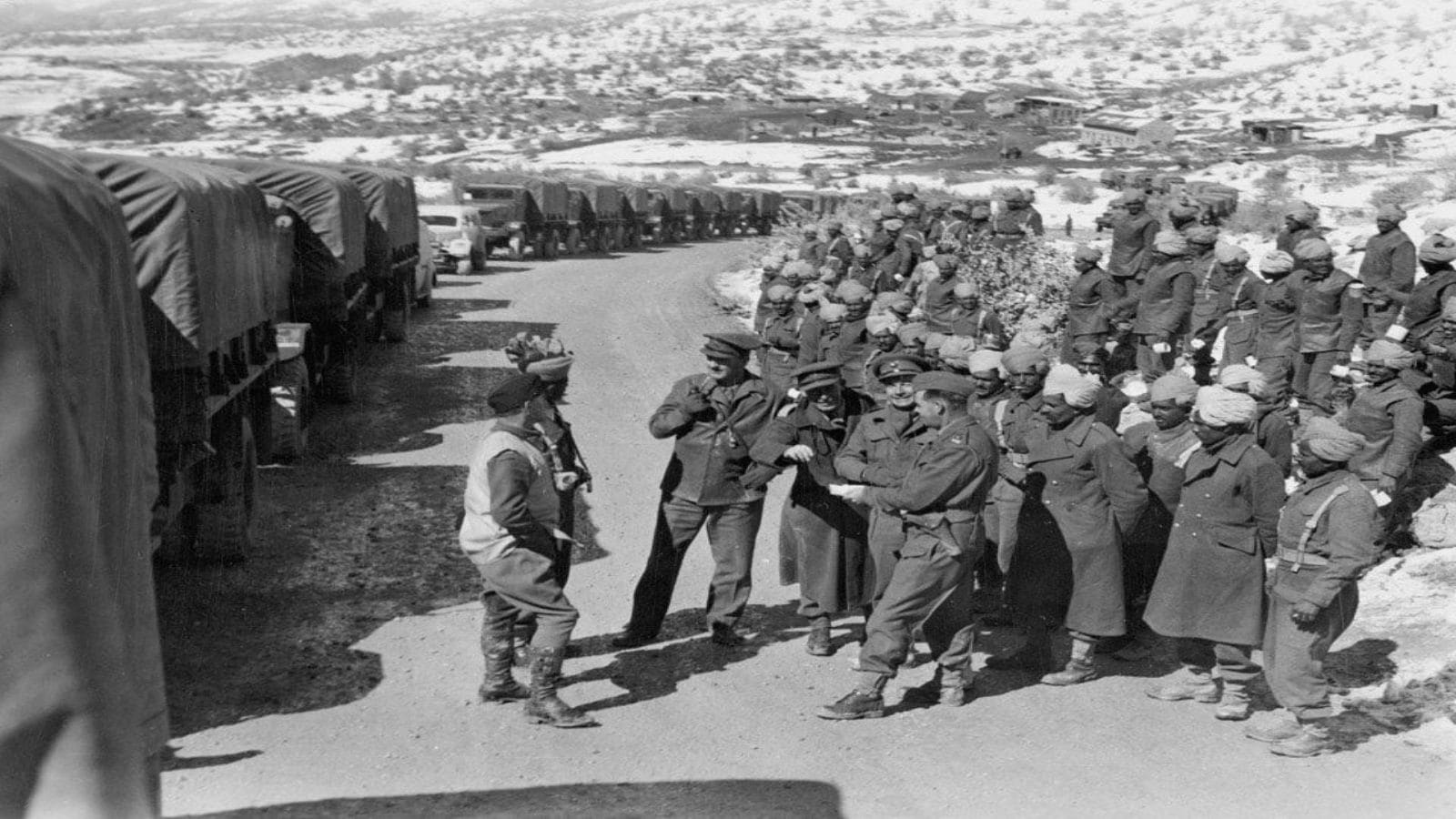
Weather ePaper Today’s Paper Journalism of Courage Home ePaper Politics Explained Opinion India Business Premium Cities UPSC Entertainment Sports World Lifestyle Tech Subscribe Sign In TrendingUPSC OfferIPL 2026US NewsPuzzles & GamesLegal NewsFresh TakeHealthResearch🎙️ Podcast Advertisement function checkAndLoadWindowSizeScript() { if (window.jQuery) { // jQuery is loaded, include your script jQuery(document).ready(function($) { // Your existing script for checking window width if (window.innerWidth) var page_w = window.innerWidth; else if (document.all) var page_w = document.body.clientWidth; if (page_w > 1024) { $(".add-left, .add-right").show(); } else { $(".add-left, .add-right").hide(); } }); } else { // jQuery is not loaded, check again after 0.2 seconds setTimeout(checkAndLoadWindowSizeScript, 200); } } // Initial call to the function checkAndLoadWindowSizeScript(); NewsCitiesChandigarhMilitary Digest | A look at Indian Army’s role in Persia in the 2 World Wars Military Digest | A look at Indian Army’s role in Persia in the 2 World Wars Indian troops in Persia played a crucial role in World War I and World War II, protecting oilfields, supply lines, and countering German influence in strategic regions. Written by: Man Aman Singh Chhina6 min readChandigarhApr 19, 2026 03:07 PM IST A supply convoy en route to the Soviet Union passing Indian Army soldiers in Iran in 1944. (Photo National Army Museum, UK) Make us preferred source on Google Whatsapp twitter Facebook Reddit PRINT The Persian invasion of India is taught in school in great detail, starting from Darius’s forays into the country in the sixth century to Nader Shah’s battles in the 18th century. However, little is known about the Indian troops who remained stationed in Persia (now Iran) during World War I as well as World War II to protect lines of communication and oilfields. Today, when the world awaits whether the war in Iran will finally end, we take a look at the participation of Indian troops in military operations in Persia in the two world wars. Siestan Force and South Persia Rifles in WW I During the First World War, Persia wished to remain a neutral country. However, this was not to happen, and it was eventually occupied by Turkish, Russian and British troops, including those from the Indian Army. The Russians and British were allies and had divided Persia into spheres of influence: the British in the south and the Russians in the north. Infamous General Dyer commanded Siestan Force The Seistan Force, also referred to as East Persia Cordon, was despatched to Persia to prevent infiltration by German and Ottoman elements into Persia and then onto Afghanistan and Balochistan. Brig General Reginald Dyer, who later conducted the massacre at Jallianwala Bagh in 1919, was commanding this force, for which he received a mention in despatches and was made a Companion of the Order of the Bath. British military history at the National Army Museum notes that in 1916, the British were engaged against the Turks in neighbouring Mesopotamia (now Iraq) and were keen to secure their military ascendancy over the Persian Gulf trade and communication routes and to protect their Anglo-Persian oil supplies. When German agents and Persian nationalists started carrying out espionage and mobilising the southern tribes against the British, Brigadier-General Sir Percy Sykes was despatched to Persia. Arriving in Kerman in June, Sykes set about recruiting for the South Persia Rifles. This unit was commanded by British officers and eventually consisted of around 8,000 Persian, Arab, and Baluchi men in regular cavalry, infantry and artillery units alongside irregular tribal levies. It also included an attached force of 600 Indian Army sepoys. Persia and Iraq Force (Paiforce) in WW II In the Second World War, the Indian Army again played a major role in Persia. A detailed account of the force has been given in the book Paiforce: The Official Story of the Persia and Iraq Command, 1941-1946. Paiforce had an unconventional general at its helm who had an eye for the minutest details of the units under his command and who was persistently afflicted with high blood pressure until it forced his retirement from the Army. This was Lieutenant-General E P Quinan. “General Quinan had an intense dislike of the trappings of office. He refused to have a flag on his car, he much preferred to travel without an A.D.C., in church he liked to sit next to sepoys,” reads an account about him in the book. The oilfields at Naft-i-Shah and Masjid-i-Sulaiman were, at the time, outside the US, the largest source of petrol supply in the world. The book notes that, “Throughout the Middle East, and to a great extent in other theatres as well, the motive power for allied arms at sea, on land and in the air came from that source. Persia, in short, was a country where the Germans could win the war outright”. The Germans had begun to exert considerable influence on Persia, and in Tehran, the capital, there were a large number of German businessmen who were in reality propagating Nazi ideology. “Trade is followed by the flag. Inspiring pictures of the Hitler Youth began to appear mysteriously in the little shops of Tabriz and Hamadan. Persians were insidiously taught to regard German goods and German methods as unquestionably superior to those of any other country; from there they were led towards thinking that German views were the only ones that counted,” the book says. Well-known Indian military historian Ravi Rikhye has also written about Paiforce, quoting the Indian Armed Forces in World War II, Historical Section India and Pakistan, Bisheshwar Prasad, Editor, 1957. Rikhye writes that Paiforce was intended to protect northern Iran from a German thrust through the Caucasus. “The Indian troops, all volunteer long-service professionals, were first class in matters of training and discipline. But armor and motorized transport were conspicuous by their absence…..With 8th Army fighting for its very life against Rommel, German U-boats ascendant at sea, America not even a year in the war, and the British-Indian armies in the east retreating against a relentless Japanese advance, the supply position for the Middle East was desperate,” he wrote. Rikhye notes that given the lack of transport infrastructure in the theatre, the huge area, the long lines of communication, and the shortage of troops to be protected, Paiforce had slim chances of deflecting an attack by the 7-8 German divisions believed to constitute the threat. “Had it come to war, the British and Indian troops would probably have found themselves staging another long and undoubtedly famous retreat back to their Persian Gulf ports,” he wrote. Eventually, German reverses in Stalingrad and Northern Africa changed the operational situation dramatically in favour of the allies. “If Hitler and the German General Staff had given Rommel the four additional divisions he wanted, who knows what he might have achieved,” wrote Rikhye. Stay updated with the latest - Click here to follow us on Instagram
المصدر: Indian Express
| Source: Indian Express
ملاحظة تحريرية | Editorial Note:
نُشر هذا المقال في الأصل بواسطة Indian Express.
خبر (Khabr) هي منصة إعلامية أردنية مرخّصة تعمل بالذكاء الاصطناعي.
نضيف قيمة تحريرية من خلال: تحليل ذكي للأخبار، ملخصات تلقائية، رواية صوتية بالذكاء الاصطناعي، ترجمة متعددة اللغات، وتدقيق الحقائق.
هدفنا جعل الأخبار أكثر وضوحاً وسهولةً للقارئ العربي.
This article was originally published by Indian Express.
Khabr is a licensed Jordanian AI-powered news platform (Registration #82086).
We add editorial value through: AI-powered news analysis, automated summaries, AI audio narration, multi-language translation (Arabic, English, French, Turkish), and AI fact-checking.
Our mission is to make news more accessible and understandable for Arabic-speaking audiences worldwide.