Since the beginning of the US-Israel war with Iran on February 28, global oil prices have risen by a factor of around 50 per cent. In Pakistan, this increase was reflected in the government’s decision to raise the regulated price of petroleum products by 20pc or Rs55 per litre, sending ripple effects across the country from higher transport fares to rising food prices.
With no letup in the Middle East conflict, there remains great uncertainty about when and where the global markets will settle.
It is being suggested that the government will try to protect the public from price surges and volatility. At the same time, discussions are also underway regarding the adoption of austerity measures such as fuel rationing and retail price differentials for vehicle types, notably between two- and four-wheelers.
The discussion assumes that four-wheelers are owned by the rich, while two-wheelers are used by everyone else.
Let’s see what the data says.
In its most recent round for 2024-2025, the Household Income and Expenditure Survey (HIES) — which gathers information on household consumption expenditure (used as a proxy for income) and household assets (such as land, cattle, and forms of motor transport) — found that under 9pc of Pakistan’s households own a four-wheeler, while around 58pc own a two-wheeler.
There is some overlap, too. Around 6pc of all households own both a four-wheeler and a two-wheeler.
But who are these vehicle-owning households in terms of poverty status? Economists sort households in a sample by income or per capita consumption expenditure in Pakistan, then divide them into five equal parts called quintiles. Comparing between quintiles is a simple way of seeing differences in the sample — and in the country by extension — by income level.
The data shows that the ownership of a four-wheeler is indeed concentrated in the richest households. Nearly three-quarters or 72pc of all households that report ownership of four-wheeler vehicles are in the top 20pc in terms of income.
So, if the government is thinking of not shielding four-wheeler owners/users from world oil price shocks, it is a reasonable position. They constitute under 9pc of all households, and an overwhelming majority are in the richest quintile.
The situation with two-wheelers, on the other hand, is more complex.
Around 58pc of households own a two-wheeler, and this ownership is more evenly distributed across income groups. It is concentrated, nevertheless, in the top three income quintiles — richest, upper middle, and middle — who account for around three-quarters of all households that own a two-wheeler.
In the poorest quintile, two-wheeler ownership is just 27pc, i.e. 73pc of the households in that group do not own a two-wheeler. The lowest two income segments — poorest and lower middle — account for around 25pc of all households that own two-wheelers. This shows that while lower-income groups do rely on motorcycles, ownership is still skewed towards better-off households.
If public policy aims to protect the poor from high and volatile world fuel prices, not shielding four-wheeler owners while protecting two-wheeler owners is somewhat justifiable.
But if the policy goal is to protect the poorest, such a measure protects mobility for the better-off while leaving the poorest untouched.
Instead, the aim should be to find mechanisms for protecting users of public transport, or those who have no regular access to transportation at all.
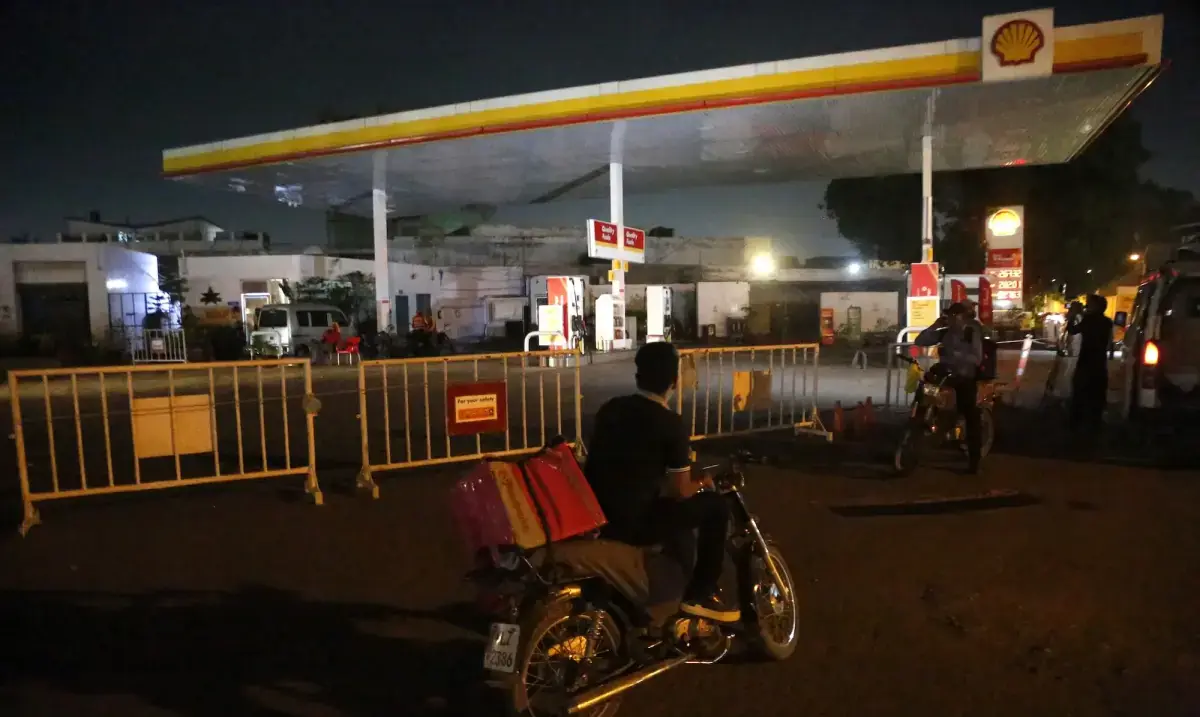
Header image: A petrol station at Karachi’s Lucky Star is shut ahead of the government’s announcement to increase fuel prices. — Shakeel Adil/ White Star