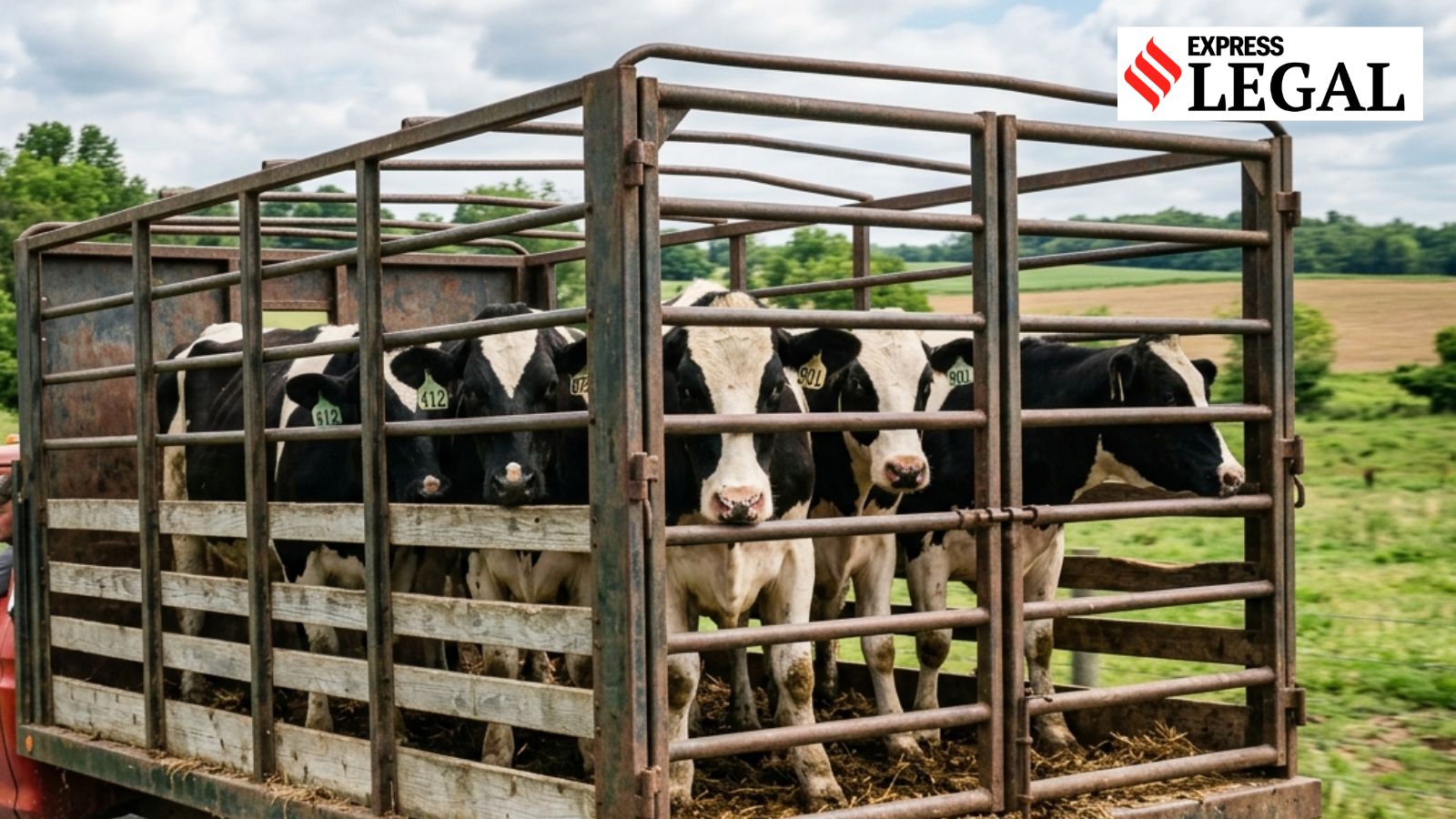
Weather ePaper Today’s Paper Journalism of Courage Home ePaper Politics Explained Opinion India Business Premium Cities UPSC Entertainment Sports World Lifestyle Tech Subscribe Sign In TrendingUPSC OfferIPL 2026US NewsPuzzles & GamesLegal NewsFresh TakeHealthResearch🎙️ Podcast Advertisement function checkAndLoadWindowSizeScript() { if (window.jQuery) { // jQuery is loaded, include your script jQuery(document).ready(function($) { // Your existing script for checking window width if (window.innerWidth) var page_w = window.innerWidth; else if (document.all) var page_w = document.body.clientWidth; if (page_w > 1024) { $(".add-left, .add-right").show(); } else { $(".add-left, .add-right").hide(); } }); } else { // jQuery is not loaded, check again after 0.2 seconds setTimeout(checkAndLoadWindowSizeScript, 200); } } // Initial call to the function checkAndLoadWindowSizeScript(); NewsLegalMere transportation of cows, its progeny not offence: Allahabad High Court Mere transportation of cows, its progeny not offence: Allahabad High Court The high court noted that admittedly no beef was found inside the vehicle and there was nothing on record to show that the cows were being smuggled for slaughtering. Written by: Ashish Shaji4 min readNew DelhiApr 18, 2026 07:00 AM IST Allahabad High Court ordered the release of petitioner's vehicle. (Image generated using AI) Make us preferred source on Google Whatsapp twitter Facebook Reddit PRINT The Allahabad High Court recently ordered the release of a truck seized in connection with an alleged illegal transportation of cattle, observing that mere transport of cows or its progeny within the state is not an offence under the UP Prevention of Cow Slaughter Act. Justice Vivek Kumar Singh noted that admittedly no beef was found inside the vehicle and there was nothing on record to show that the cows or its progeny were being smuggled for slaughtering. “Mere transportation of the cows or its progeny within the State cannot be said to be an offence,” the court noted in its order dated April 15. An FIR was lodged against the petitioner in March 2024 under provisions of the UP Prevention of Cow Slaughter Act, the Prevention of Cruelty to Animals Act, Indian Penal Code, and the Arms Act. The prosecution alleged that the petitioner’s driver was transporting cows in the truck. The vehicle, registered in the petitioner’s name, was subsequently seized and confiscated. Feeling aggrieved by the confiscation of his vehicle, he approached the high court. The petitioner argued that no beef was recovered from the vehicle and there was no allegation of slaughter. He further contended that prolonged seizure of the truck had deprived him of his livelihood. It was also submitted that by keeping the vehicle at the police station for a long time, it could diminish its value and ultimately become junk. Opposing the plea, the additional government advocate challenged the maintainability of the plea. He further submitted that there was no illegality in the order to confiscate the vehicle under sub-section (7) of Section 5-A of the UP Prevention of Cow Slaughter (Amendment) Act, 2020. Section 5 A(7) says- The vehicle by which the beef or cow and its progeny is transported in violation of the provisions of this Act and the relevant rules, shall be confiscated and seized by the law enforcement officers. The concerned district magistrate/commissioner of police will do proceedings of the confiscation and released, as the case may be. At the outset the court noted that the petitioner was granted pre-arrest bail by the high court. Relying on a precedent, the court also reiterated that keeping seized vehicles in police custody for long periods serves no purpose and leads to their deterioration. “It is for the Magistrate to pass appropriate orders immediately by taking appropriate bond and guarantee as well as security for return of the said vehicles, if required at any point of time. This can be done pending hearing of applications for return of such vehicles,” the court said. On the issue of maintainability, the court rejected the state’s objection, noting that the availability of an alternative remedy does not bar the high court’s jurisdiction under Article 226. “The alternate remedy is no bar to invoke power under Article 226/227 of the Constitution or 482 of CrPC or 528 BNSS, thus, the objection of the learned AGA fails,” the court observed. It allowed the plea for release of the petitioner’s vehicle relying on another judgment and considering that the vehicle was stationed since the last two years in the open premises of the police station and was becoming junk. Accordingly, the court directed that the truck be released to the petitioner upon furnishing a personal bond and sureties, subject to conditions that it shall not be sold or altered and must be produced before the court as required. Ashish Shaji is a Senior Sub-Editor at The Indian Express, where he specializes in legal journalism. Combining a formal education in law with years of editorial experience, Ashish provides authoritative coverage and nuanced analysis of court developments and landmark judicial decisions for a national audience. Expertise Legal Core Competency: Ashish is a law graduate (BA LLB) from IME Law College, CCSU. This academic foundation allows him to move beyond surface-level reporting, offering readers a deep-dive into the technicalities of statutes, case law, and legal precedents. Specialized Legal Reporting: His work at The Indian Express focuses on translating the often-dense proceedings of India's top courts into clear, actionable news. His expertise includes: Judicial Analysis: Breaking down complex orders from the Supreme Court and various High Courts. Legal Developments: Monitoring legislative changes and their practical implications for the public and the legal fraternity. Industry Experience: With over 5 years in the field, Ashish has contributed to several niche legal and professional platforms, honing his ability to communicate complex information. His previous experience includes: Lawsikho: Gaining insights into legal education and practical law. Verdictum: Focusing on high-quality legal news and court updates. Enterslice: Working at the intersection of legal, financial, and advisory services. ... Read More
المصدر: Indian Express
| Source: Indian Express
ملاحظة تحريرية | Editorial Note:
نُشر هذا المقال في الأصل بواسطة Indian Express.
خبر (Khabr) هي منصة إعلامية أردنية مرخّصة تعمل بالذكاء الاصطناعي.
نضيف قيمة تحريرية من خلال: تحليل ذكي للأخبار، ملخصات تلقائية، رواية صوتية بالذكاء الاصطناعي، ترجمة متعددة اللغات، وتدقيق الحقائق.
هدفنا جعل الأخبار أكثر وضوحاً وسهولةً للقارئ العربي.
This article was originally published by Indian Express.
Khabr is a licensed Jordanian AI-powered news platform (Registration #82086).
We add editorial value through: AI-powered news analysis, automated summaries, AI audio narration, multi-language translation (Arabic, English, French, Turkish), and AI fact-checking.
Our mission is to make news more accessible and understandable for Arabic-speaking audiences worldwide.