⚡ عاجل: كريستيانو رونالدو يُتوّج كأفضل لاعب كرة قدم في العالم●⚡ أخبار عاجلة تتابعونها لحظة بلحظة على خبر●⚡ تابعوا آخر المستجدات والأحداث من حول العالم●
AI اقتراحات ذكية
AI مباشر|--مشاهد مباشر
928,464مقال401مصدر نشط228قناة مباشرة4,705خبر اليوم
آخر تحديث:منذ 4 ثواني
March 2026 to 'change everything': Tipping point for global EV adoption
•March 2026 could change everything for the electric vehicle (EV) industry, marking the "tipping point" for global adoption, according to an industry expert.The internal-combustion engine (ICE) era is...
•Every popular pick-up and SUV on the ICE list — Ford Ranger, Toyota HiLux, Isuzu D-Max, etc.
•— costs between 16.7 ¢ and 25.6 ¢ per km.
هذا الخبر من Gulf News. خبر يقدم أدوات ذكاء اصطناعي للتلخيص والترجمة والاستماع.
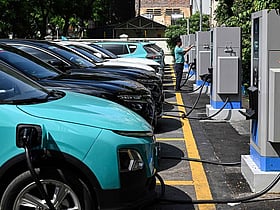
March 2026 could change everything for the electric vehicle (EV) industry, marking the "tipping point" for global adoption, according to an industry expert.
The internal-combustion engine (ICE) era is not ending through gradual replacement by battery electric vehicles (BEVs) alone.
Instead, a rapid “system break” around 2026–2027 will trigger an accelerated collapse, several data points show.
Collapse in EV running cost
EV running costs have collapsed because electricity is now dramatically cheaper than petrol on a per-km basis.
For example, a real-time app (petrol-vs-electric.vercel.app) built by Simonahac compares the energy cost per km for Australia’s actual top-10 best-selling internal combustion engine (ICE) vehicles against the top-10 EVs.
It uses live Melbourne petrol/diesel prices and the average Amber Electric smart-charging rate over the previous 24 hours (just 12.1 ¢/kWh).
EVs are 10 times cheaper to run
The numbers are eye-watering.
Every popular pick-up and SUV on the ICE list — Ford Ranger, Toyota HiLux, Isuzu D-Max, etc. — costs between 16.7 ¢ and 25.6 ¢ per km. The entire EV list (Tesla Model Y, BYD Sealions, Kia EV5, BYD Atto 3, etc.) sits between 1.5 ¢ and 2.2 ¢ per km.
That’s roughly 10 times cheaper to run.
Many owners report real-world figures below 1 ¢/km using rooftop solar. Battery prices have fallen ~90 % since 2010, range has doubled, and high fuel prices amplify the advantage.
This little app by @simonahac compares the cost per km of the top 10 selling ICE vehicles with the top 10 selling EVs, using current petrol prices and the average charging rate over the past 24 hours.
Futurist Chris Meder now predicts that March 2026 will mark the "tipping point" for EVs vs ICE, thanks in part to the global fuel supply crunch induced by the tanker squeeze in Hormuz Strait, sending prices up.
In a widely shared chart, Meder points to a dramatic “system demand shock” in the auto industry.
He projects that EVs — including battery-electric vehicles (BEVs) and plug-in hybrids (PHEVs) — will surge from roughly 23% of global sales in 2025 to about 80% by 2030 and 99.2% by 2035.
March 2026 changes everything.
My updated System Demand Shock (Best Case) shows EVs (BEV+PHEV) hitting ~80% of global sales by 2030 & ~99.2% by 2035.
He cited that PHEV removes two major barriers — range anxiety and high upfront costs — allowing the immediate replacement of traditional ICE vehicles without waiting for the optimum or "perfect" charging infrastructure.
'Tipping point'
Several state-level sales data show a "tipping point" trend: Most cars now sold in Singapore, Nepal and Norway, among others, are now electric.
And it's no longer just passenger cars; its also trucks, earth movers and boats, say industry trackers.
The key accelerator to land transport transition: plug-in hybrid electric vehicles (PHEVs), which act as a critical bridge.
Unlike pure battery BEVs that require widespread charging infrastructure, PHEVs let drivers use electric power for daily commuting while retaining a gasoline engine for longer trips.
This removes two major barriers — range anxiety and high upfront costs: This is the “bridge phase”: PHEV sales rise sharply in the late 2020s before BEVs dominate.
Result: Immediate "displacement" of traditional ICE vehicles, without waiting for perfect infrastructure.
By 2035, ICE sales are projected to shrink to "near zero", with BEVs accounting for the vast majority of the roughly 114 million annual global car sales.
Nepal nears 80% EV in 2025!
Incredible.
Developing countries cannot afford the huge cost of oil imports.
The economics of EVs versus oil burning autos is why EVs are skyrocketing in many developing countries.
Back then, EVs were still niche: charging networks were limited, used-car options scarce, and price points high.
In 2026, scale has arrived. Battery costs have fallen, second-hand EV markets are maturing, and consumers have affordable choices across segments.
PHEVs further compress the transition timeline by delivering immediate ICE displacement even in regions with patchy chargers.
Replacement 'under pressure'
This is not smooth, linear growth but “replacement under pressure.”
Once the "feedback loop" starts — shrinking ICE sales erode economies of scale, dealer networks, and consumer familiarity — the old system unravels quickly.
Historical oil shocks (1973, 1979, 2008) reinforced gasoline dominance because no viable alternative existed.
This time, solar, batteries, and EVs provide a clear exit ramp.
Critics may question the aggressive timeline, but Meder’s model draws from data by IEA, OICA, and others.
✨Beyond passenger EVs, China is widely promoting new energy heavy-duty trucks. pic.twitter.com/f0ZxZial67
More than people movers, electric heavy-duty vehicles are no longer experimental — they are now operating across industries where diesel once dominated.
What’s changed is simple: economics, emissions pressure, and rapid advances in battery tech are converging to push electrification into the toughest sectors of transport.
Based on latest industry data, these are some of the examples below:
Volvo Trucks – dominant in Europe and North America with ~47% market share in heavy electric trucks
Daimler Truck – scaling electric Freightliner and Mercedes-Benz trucks
BYD – strong in buses and commercial EV fleets
Tesla – pushing long-range electric semis
Geely (Farizon brand) – expanding electric truck lineup
Caterpillar – developing electric mining trucks and dynamic charging systems
Liebherr – leading in electric excavators
NEWS: Tesla says that there are currently a few hundred Tesla Semis out in the real world that have traveled a combined 13.5 million miles, with one truck that has traveled 440,000 miles. Fleet has 95% uptime: "80% of breakdowns if you have one, are returned back to the customer… pic.twitter.com/JwW0P1EKZB
Whether the exact numbers hold, the chart underscores a pivotal insight: 2026 isn’t just another year of EV sales skyrocketing — it’s the year the old auto system breaks and the electrified future locks in.
The fleet, not just annual sales, will soon tell the story of which wins.
And it's not even about "winning" anymore, it's about what makes more sense.
ملاحظة تحريرية | Editorial Note:
نُشر هذا المقال في الأصل بواسطة Gulf News.
خبر (Khabr) هي منصة إعلامية أردنية مرخّصة تعمل بالذكاء الاصطناعي.
نضيف قيمة تحريرية من خلال: تحليل ذكي للأخبار، ملخصات تلقائية، رواية صوتية بالذكاء الاصطناعي، ترجمة متعددة اللغات، وتدقيق الحقائق.
هدفنا جعل الأخبار أكثر وضوحاً وسهولةً للقارئ العربي.
This article was originally published by Gulf News.
Khabr is a licensed Jordanian AI-powered news platform (Registration #82086).
We add editorial value through: AI-powered news analysis, automated summaries, AI audio narration, multi-language translation (Arabic, English, French, Turkish), and AI fact-checking.
Our mission is to make news more accessible and understandable for Arabic-speaking audiences worldwide.
هذا الخبر ضمن تغطية خبر لقسم تكنولوجيا.
نقدّم لك تحليلات ذكية وملخصات يومية لأهم الأخبار من مصادر موثوقة متعددة.
المصدر: Gulf News.
يوجد 6 مقالات مرتبطة بهذا الموضوع.
This article is part of Khabr's coverage of Technology.
We provide AI-powered analysis, summaries, and multi-source aggregation to keep you informed.
Source: Gulf News.
Tags: EV adoption, global, 2026.
🍪 نستخدم ملفات تعريف الارتباط لتحسين تجربتك وعرض الإعلانات المخصصة. باستخدامك للموقع، فإنك توافق على سياسة ملفات تعريف الارتباط وسياسة الخصوصية.
We use cookies to enhance your experience and show personalized ads. By using this site, you agree to our Cookie Policy and Privacy Policy.
🔍
FREEFree 1GB Internet + Free International Calls
$1 trial — eSIM in 190+ countries — No roaming charges