Legal eagles help bridge gap on Nikahnama reform
•ISLAMABAD: Disagreements between the judiciary and the government over the scope of legal reforms were amicably resolved through the efforts of the legal community, as the Lahore High Court (LHC) pus...
•The issue surfaced during proceedings before Justice Jawad Hassan at the Rawalpindi bench of the Lahore High Court, who declared the matter one of “public importance”.
•The court pointed out discrepancies between the Urdu and English versions of columns 13 and 16 of the Nikahnama — provisions dealing with dower (haq mehr) and dowry details — observing that vague and...
هذا الخبر من Dawn. خبر يقدم أدوات ذكاء اصطناعي للتلخيص والترجمة والاستماع.
المصدر: Dawn | Source: DawnISLAMABAD: Disagreements between the judiciary and the government over the scope of legal reforms were amicably resolved through the efforts of the legal community, as the Lahore High Court (LHC) pushed for legislative clarity on the Nikahnama while the Ministry of Law and Justice emphasised the role of constitutional forums in the lawmaking process.
The issue surfaced during proceedings before Justice Jawad Hassan at the Rawalpindi bench of the Lahore High Court, who declared the matter one of “public importance”.
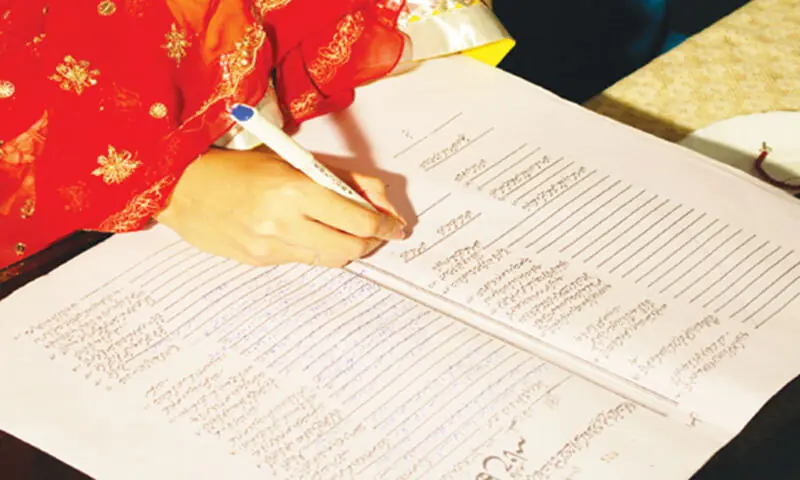
The court pointed out discrepancies between the Urdu and English versions of columns 13 and 16 of the Nikahnama — provisions dealing with dower (haq mehr) and dowry details — observing that vague and inconsistent translations had caused confusion, prolonged litigation, and hardship for female litigants.
The LHC, in its observations, stressed the need to “settle this once and for all” through legislative clarity. It also tasked an eight-member committee with reviewing amendments to the Muslim Family Laws Ordinance, 1961, particularly focusing on Section 10A concerning matrimonial property rights.
Discrepancies in Urdu and English versions caused confusion and litigation, particularly for women
However, the law ministry expressed reservations regarding judicial intervention in legislative processes, cautioning that pre-legislative review might undermine democratic mechanisms. It maintained that constitutional forums, including parliament and the CII, are the appropriate bodies to ensure compliance with Islamic injunctions and constitutional provisions.
Despite this institutional disagreement, the reform process has gained momentum under the court’s doctrine of continuing mandamus.
Legal observers note that the bar’s active participation has not only highlighted systemic deficiencies but also contributed meaningfully to policy formulation aimed at protecting women’s property rights and reducing litigation arising from ambiguous marital contracts.
With further deliberations and legislative input expected, stakeholders remain optimistic that a standardised, bilingual Nikahnama will soon be introduced, ensuring clarity, enforceability, and legal protection for parties entering into marriage contracts across Pakistan.
Acting on the court’s directives, the law ministry initiated a consultative process and constituted a technical committee, which held multiple sessions to examine transcription errors and broader legal implications.
It recommended that the updated English version be formally translated into Urdu through the National Language Authority, in coordination with the Ministry of Religious Affairs and district administrations.
Legal practitioners played a central role in these deliberations. Additional Attorney General Haseeb Paracha, along with the petitioners’ counsels, worked closely with government officials to streamline proposals.
Published in Dawn, May 6th, 2026
ملاحظة تحريرية | Editorial Note: نُشر هذا المقال في الأصل بواسطة Dawn. خبر (Khabr) هي منصة إعلامية أردنية مرخّصة تعمل بالذكاء الاصطناعي. نضيف قيمة تحريرية من خلال: تحليل ذكي للأخبار، ملخصات تلقائية، رواية صوتية بالذكاء الاصطناعي، ترجمة متعددة اللغات، وتدقيق الحقائق. هدفنا جعل الأخبار أكثر وضوحاً وسهولةً للقارئ العربي.
This article was originally published by Dawn. Khabr is a licensed Jordanian AI-powered news platform (Registration #82086). We add editorial value through: AI-powered news analysis, automated summaries, AI audio narration, multi-language translation (Arabic, English, French, Turkish), and AI fact-checking. Our mission is to make news more accessible and understandable for Arabic-speaking audiences worldwide.