Kashmiri, Kavita, Krishna, Sunita, Sonu, Sakshi: A roll call of change in Haryana panchayats
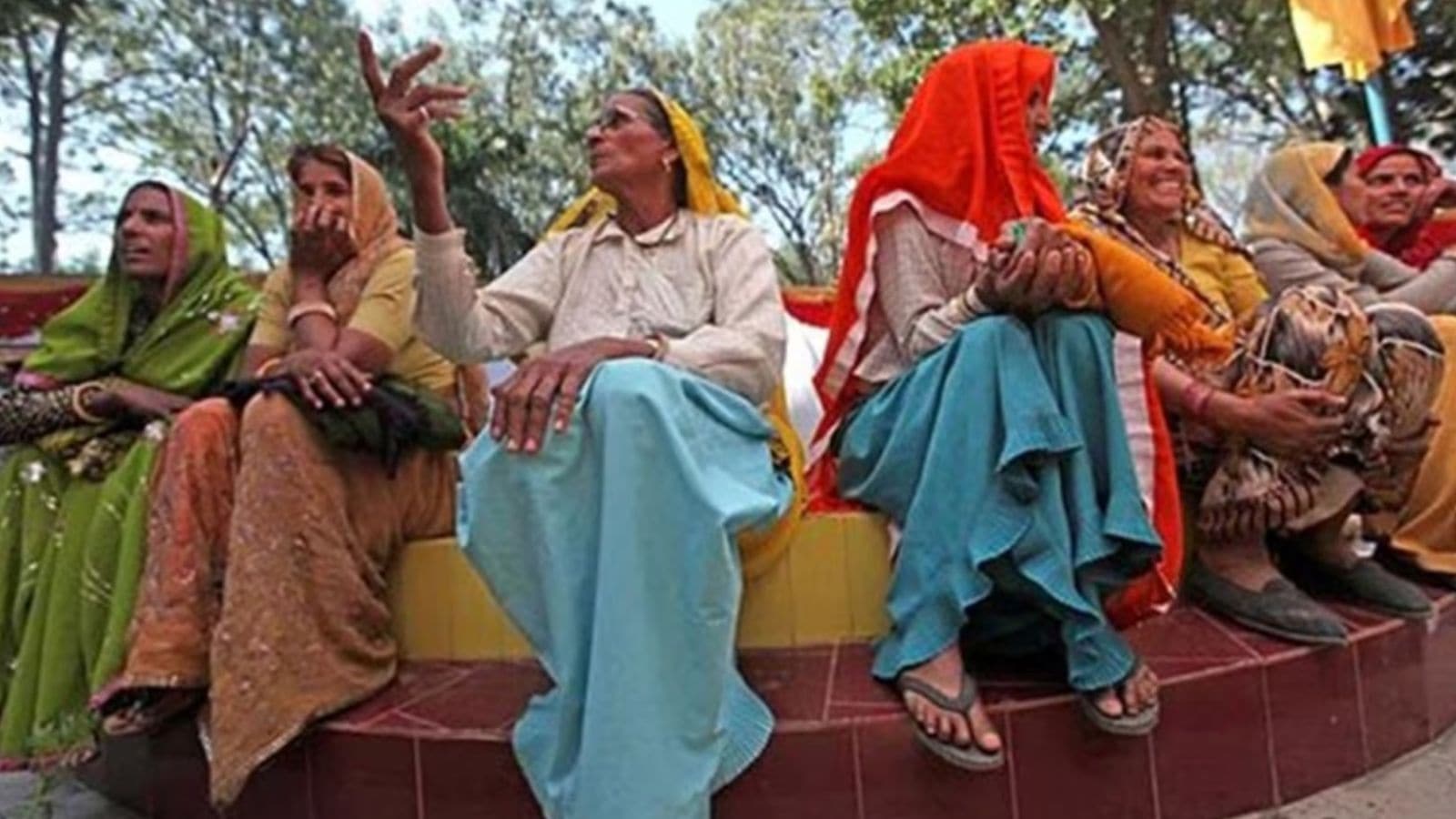
Weather ePaper Today’s Paper Journalism of Courage Home ePaper Politics Explained Opinion India Business Premium Cities UPSC Entertainment Sports World Lifestyle Tech Subscribe Sign In TrendingUPSC OfferIPL 2026US NewsPuzzles & GamesLegal NewsFresh TakeHealthResearch🎙️ Podcast Advertisement function checkAndLoadWindowSizeScript() { if (window.jQuery) { // jQuery is loaded, include your script jQuery(document).ready(function($) { // Your existing script for checking window width if (window.innerWidth) var page_w = window.innerWidth; else if (document.all) var page_w = document.body.clientWidth; if (page_w > 1024) { $(".add-left, .add-right").show(); } else { $(".add-left, .add-right").hide(); } }); } else { // jQuery is not loaded, check again after 0.2 seconds setTimeout(checkAndLoadWindowSizeScript, 200); } } // Initial call to the function checkAndLoadWindowSizeScript(); NewsLong ReadsKashmiri, Kavita, Krishna, Sunita, Sonu, Sakshi: A roll call of change in Haryana panchayats Premium Kashmiri, Kavita, Krishna, Sunita, Sonu, Sakshi: A roll call of change in Haryana panchayats When Lok Sabha debated the 33% quota for women in Parliament and Assemblies, it was attempting to catch up with a transformation that was sparked decades ago in India’s villages, when seats were set aside for women in panchayats Written by: Uma Vishnu16 min readRohtakUpdated: Apr 18, 2026 07:42 AM IST Like Kashmiri, almost every woman here, all in ghunghats and with chores waiting at home to be attended, have at some point tested the boundaries laid out for them. (File Photo) Make us preferred source on Google Whatsapp twitter Facebook Reddit PRINT In 2022, when Kashmiri was elected sarpanch of Lahli village in Haryana’s Rohtak district, her brother offered to buy her a gift. “I said I want a suit and formal trousers. Hamesha se bada man tha mera (I always wanted one),” says the 38-year-old. The suit stayed in her almirah until it came of use in December 2025, when she had to travel to Delhi for an awards ceremony. “That’s the first time I wore it. Bada proud feel hua (I felt proud). People came up to me and said, you don’t look like you are from a village,” she says, sitting in the living room of the house that she shares with a large joint family of her husband’s three brothers and their families. The photograph of Kashmiri in her suit, legs crossed in poise, sunglasses pushed up her head and in black pencil heels, is now her profile picture on WhatsApp. It’s an image that at once shatters some of the most hardened stereotypes about rural Haryana, a state that has traditionally fared poorly on most gender indices. When Lok Sabha debated the 33% reservation for women in Parliament and Assemblies, sparring over how much to yield, it was attempting to catch up with a transformation that was sparked decades ago in India’s villages when the 73rd Constitutional amendment of 1993 mandated 33% reservation for women in panchayats. Since then, most states, including Haryana, have raised the quota to 50% across all tiers of the panchayati raj system: gram panchayats (panches and sarpanches), panchayat samitis in the block and district-level zilla parishads. Much of the distance that Lahli and other villages have covered in these decades can be measured in the small, slow gains – in classrooms where girls eagerly occupy the front rows; on the village ground, where girls in closely cropped hair come to play in jerseys and shorts; and in the way Kashmiri navigates her political and personal space in a household where she came as a child bride when in Class 11, went on to do her PhD and now introduces herself as “Dr Kashmiri”. “I always respect what my father-in-law told me. He said, ‘You can dress whichever way you like, but make sure you wear your veil when you step outside’. But the day I was elected sarpanch, I took my oath without wearing the veil. Because how can you be a public representative and not show your face to people? He wasn’t around to see me that day – he died some years earlier – but I am sure he would have understood,” says Kashmiri, who was elected on a seat reserved for women and Dalits. The ghunghat (veil) comes off and on, depending on the space she is negotiating. On when she travels, “MLA style”, in her car, a secretary in tow; off when she and her three daughters pose in identical sleeveless gowns she designed and stitched; on when she holds her panchayat meetings where she has “banned” hookahs; off when she is the “dabang”, evicting people from the common village land. Like for most women, it’s the kind of negotiation that is constant, unrelenting. Her husband Krishan Kumar is a school teacher in Rohtak, two of his brothers work in the police and their wives run the household and a ‘boutique’, a tailoring set-up that’s part of the house. She says her husband pushed her to contest. “Since I was educated, my name came up. I was initially reluctant, even scared. I would sometimes cry, most recently when someone filed an RTI accusing me of corruption in a village project. It’s tough, especially handling male egos, but if you stand your ground, they eventually give in.” She says she is almost never made aware of her caste. “In fact, the Brahmins and Jats supported my candidature. But sometimes, outside the village, when I don’t get selected for awards even after my work gets noticed, I wonder if there is more to it.” She credits her in-laws, and her larger family, for backing her. “They encouraged me, supported me, pushed me to study, go out and work. I am what I am because of them. But what I become from here on will be because of me,” says Kashmiri. She is clear of where that path leads. “I have been to Delhi a couple of times for sarpanch workshops, stayed in big hotels. We also went to Parliament. When I came back, I told my family, ‘Main Parliament mein apna seat book kar ke aayi hoon (I have booked my seats in Parliament)’,” she laughs. As she says that once more for the camera, uninhibited about her ambition, her neighbour Krishna, 60, claps heartily, chanting, “MLA, MLA…” She and the other women who have gathered at Kashmiri’s house say having a woman sarpanch helps. “We can come here whenever we want to, we can be open about our problems,” she says. Like Kashmiri, almost every woman here, all in ghunghats and with chores waiting at home to be attended, have at some point tested the boundaries laid out for them. Krishna has her own delightful story of an afternoon, when, as a 20-something mother of two, she was lying down next to her radio tuned to Rohtak station. “On radio, they were talking of nasbandi (sterilisation) and that you shouldn’t have more than two children. My husband was away at work (a peon in a bank), so I got up, took the bus to the Rohtak civil hospital, got the procedure done and came back home in the evening. When my husband came back and found out, he took the radio and flung it to the ground. Luckily, the radio survived,” she says, her eyes crinkling in delight at her own audacity all those years ago. “Galat kiya (She did wrong),” says her grandson Deepender, a diploma student of electric engineering, listening to a retelling of Krishna’s story. “She should have discussed it with people at home.” While Krishna stopped at two children, she goaded her son and daughter-in-law to have more, “in the greed for more grandsons”. She doesn’t regret her call, though. “She is lucky for me,” Krishna says of her youngest granddaughter Nancy, who is waiting for her Class 10 results. “I gave her that name. I found it in the papers. She studies hard, takes care of me. You won’t find anyone like her. There was a time when no one wanted girls. That’s changing.” Metres away, Sonia, a multipurpose health worker at the health sub-centre in Lahli village, says she desperately hopes that’s the case. While Haryana’s sex ratio stood at 923 girls for every 1,000 boys in 2025, the highest in five years, Lahli’s stood at 800. “We were pulled up. Officials ask why the sex ratio is down, to which we have no answers. We are doing everything we can, going door to door, raising awareness. There are incentives for pregnant women for deliveries carried out in government institutions and the crackdown on sex-determination clinics is severe. So when the sex ratio falls despite all this, we just hope it’s natural. Every time we hear a girl is born, we cheer silently, as much for the child as for us,” laughs Sonia, who is in charge of handling the ASHA workers in the village. In adjoining Sample village, the board pointing to sarpanch Kavita’s house makes it a point to mention that she is the wife of Ravindra Kumar, “former sarpanch”. As her husband directs Kavita to make tea, he talks of how he supports his wife and accompanies her to official events. “I am just helping her. This is her training. Agli baar training ki zaroorat nahin padegi (She won’t need any more training),” he says. As Kumar leaves to supervise arrangements for a family wedding, Kavita settles down, dupatta in place on her head. She says she has studied till Class 12 and that her husband does all the panchayat work. The women come to her, though, with their complaints and she takes them up with her husband. Kashmiri interrupts her, saying, “Kaho, main sarpanch hoon. Main apna nirnay khud leti hoon (Say, I am the sarpanch. I take all decisions myself). At a training I attended, we were told to repeat this to ourselves.” A mother of two, an engineer son based in Bengaluru and a daughter who is studying for her MSc in mathematics from Amity University, Kavita says, “When I came home after winning the sarpanch election, my daughter said, ‘Mummy, at least take off your ghunghat now.’ But it’s not that easy to change.” As she steps out briefly, Kavita ensures her veil is pulled further down to her chest. “I can’t talk now, not when tau ji is around,” she whispers nervously, pointing to a village elder. A few men from the village sit on plastic chairs in the porch of an adjoining building, eager to weigh in on how reservation for women, at any level, is all “bakwaas (nonsense)”. While there is near unanimity in Parliament on reservation for women, even if parties differ on the modalities, the idea remains a deeply unpopular one on the ground given that social change, especially among men, hasn’t kept pace with institutional reforms. “Auraton ki soch doordarshi nahin hoti (Women can’t think ahead). I am a teacher. I see it in my school too. They can’t take others along; they only see what is in it for them,” says one of them. Someone in the group talks of having to get up for women in buses while they themselves don’t budge once they have settled in with their children and luggage; another talks of a day when they’ll have to make rotis if the women go out; yet another says he would at best give women “5%, chalo 11%, not more”. “That way, at least 89% men won’t have to make rotis,” he says, and the group roars with laughter at the ‘joke’. “Indira Gandhi was a woman, she ran the country; so is Mayawati,” says the teacher in a brief moment of clarity. “But they fall in that 11%; the others don’t know how to work.” Don’t tell Sunita Devi that. In 1995, she was elected sarpanch of her Bhali Anant village, one of the 1,994 women village heads who came to power in the state in the first elections after the 73rd Amendment came into force. “Until I stood for elections, I had never voted. The first time I voted was for myself. After that, I never wasted my vote,” she says. Now at 54, she is fiercely independent, earns around Rs 14,000 from her work at three anganwadi kendras, tends to her three buffaloes, listens to news on YouTube channels, and navigates her smartphone, a hand-me-down from her DJ son, with ease. And she has an opinion. “Did they say women don’t work? The men can’t dream of doing what we do. Times have changed. Now men are scared of their wives,” she says. Her 32-year-old son hasn’t found a bride yet – “they run away when I say he is a DJ” – while her daughter married at 19, but continued her education to do a BEd and Master’s, and is now a mathematics guest teacher at a government school in Nangloi, Delhi. Sunita, who herself studied till Class 10 and got married while in college in Class 11, admits her husband did most of the work when she was sarpanch, though she was no rubber stamp herself. “I always read through what I had to sign,” she says, talking about some of the work she got done during her term. Jogender Kumar, the current sarpanch, admits Sunita Devi was an outlier for her times, considering many women sarpanches continue to be dominated by their husbands. But he worries more for the men. “Women are far ahead. They study, work at home and outside, do small businesses on the side… beauty parlours, boutiques, they are part of self-help groups. But the men sit around. There are no jobs, land holdings are shrinking, and the younger ones do drugs and drive around on their motorcycles,” he says. It’s the kind of crisis that Reena Deswal, PGT English teacher at the Government Senior Secondary School in Lahli, has noticed in her classroom. “I really don’t know what to do with the boys. They don’t listen to us. The biggest headache are the devices students got from the government during the pandemic. They spend all their time on these tablets. At least the girls are sincere; they want to do well. It’s just that they have few opportunities to shine,” she says. In a room where the senior classes have assembled for a meet-up with The Indian Express, the boys stay on the back benches, diffident, unsure, while the girls pull a few desks and line up in front. Lahli village’s Sonu Kanta graduated from the school some years ago. A final year Master’s student of Geography from the state-run Maharshi Dayanand University, Sonu is among the 20 girls in her class of 30. She hopes to attempt the civil services exams while also preparing for the NET-JRF and applying for teaching jobs. Sonu talks of a two-month residential programme, Gunvatta Gurukul, that she attended in Delhi, which exposed her to people and places beyond her village. “I learnt a lot. I can now make PowerPoint presentations and do calculations on Excel sheets much better than others in my class. Now I am certain about one thing. I don’t plan to stay on in the village. I want to work outside, and then maybe come back when I am around 40 and do something for people here,” she says. Dr Rajesh Tandon, co-founder of PRIA, a New Delhi-based civil society organisation that has worked extensively in Haryana panchayats, says it’s hard to make generalisations on the societal impact of women’s reservation. “For instance, Rohtak and Sonepat, given their proximity to Delhi and presence of educational institutions, have very different social realities from, say, Jind. I am not saying women panchayats are more effective. There are many factors that enable or constrain that. But 20 years ago, you would not have seen those girls and women you saw in Haryana. The large part of it is because they saw senior women sitting in panchayats, undertaking panchayat-related activities, and beginning to gain respect. It doesn’t mean caste will go away, it doesn’t mean religion will go away. Those are larger and more difficult boundaries to cross. But the woman’s place in the public sphere has progressively increased as a result of reservation.” Between classes, a group of friends, all postgraduate students from nearby villages, hang out on the shaded lawns of Tagore auditorium at Maharshi Dayanand University. On women’s reservation, the boys, Sahil and Naresh, who offer only their first names, are quick with their opinion. “Auratein kaam nahin kar payengi (Women won’t be able to work). Definitely not at the sarpanch level. Their husbands do all the work,” says one. “Karte hi nahin hain (They don’t do any work),” the other pitches in. In the way they hold forth on what women can and can’t do, in the casualness with which they dismiss women’s need for representation, are echoes from Sample village, where the men joked about having to make rotis if the wives stepped out. “It’s not that women can’t work, they are not encouraged or allowed to,” says their classmate Sakshi. The boys playfully rib Sakshi about the jeans and crop top she is wearing, and how she would have to be in a ghunghat (veil) if she got married and ended up as sarpanch. Their friend Paramjeet Kaur, the only one in the group who is married, joins the banter, saying the boys need to change their mindset if they are to find true love. “There’s almost nothing women can’t do. It’s just about your soch (mindset). That needs to change,” she says.المصدر: Indian Express | Source: Indian Express
ملاحظة تحريرية | Editorial Note: نُشر هذا المقال في الأصل بواسطة Indian Express. خبر (Khabr) هي منصة إعلامية أردنية مرخّصة تعمل بالذكاء الاصطناعي. نضيف قيمة تحريرية من خلال: تحليل ذكي للأخبار، ملخصات تلقائية، رواية صوتية بالذكاء الاصطناعي، ترجمة متعددة اللغات، وتدقيق الحقائق. هدفنا جعل الأخبار أكثر وضوحاً وسهولةً للقارئ العربي.
This article was originally published by Indian Express. Khabr is a licensed Jordanian AI-powered news platform (Registration #82086). We add editorial value through: AI-powered news analysis, automated summaries, AI audio narration, multi-language translation (Arabic, English, French, Turkish), and AI fact-checking. Our mission is to make news more accessible and understandable for Arabic-speaking audiences worldwide.