Israel and Lebanon hold their first direct talks in more than 30 YEARS - and they were 'positive'
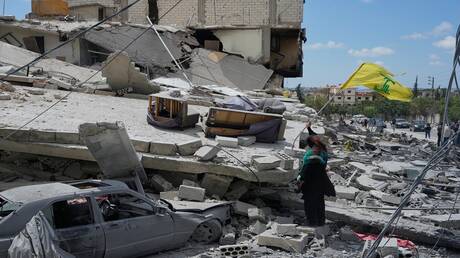
By ANDREW JEHRING, CHIEF FOREIGN CORRESPONDENT Published: 23:40, 14 April 2026 | Updated: 23:40, 14 April 2026 Israel and Lebanon on Tuesday held their first direct diplomatic talks in over three decades, with the Jewish State hailing the meeting as 'a victory for sanity'. Ambassadors from the Middle Eastern nations met for a summit in Washington hosted by US Secretary of State Marco Rubio. Israel agreed to talks after the Lebanese government told its army to disarm Iranian proxy Hezbollah, who have repeatedly fought against Israel, including in the latest conflict with Iran. Speaking after the two-and-a-half-hour talks, Israel's ambassador to the US, Yechiel Leiter, said: 'We discovered today that we're on the same side of the equation, and that's the most positive thing we could have come away with.' He added the talks focused on a 'clearly delineated border' between Israel and Lebanon. 'The security of our civilians is not up for negotiation. This was a victory for sanity, for responsibility and for peace,' Mr Leiter said. Lebanon's ambassador Nada Hamadeh Moawad said the talks were 'productive'. Israel and Lebanon agreed to hold direct negotiations after 'productive discussions' between the two sides in Washington, the United States said on Tuesday. 'The participants held productive discussions on steps toward launching direct negotiations between Israel and Lebanon,' State Department spokesman Tommy Pigott said in a statement. 'All sides agreed to launch direct negotiations at a mutually agreed time and venue.' US Secretary of State Marco Rubio (pictured centre) Lebanon's Ambassador to the US Nada Hamadeh Moawad (far right) and Israeli Ambassador to the US Yechiel Leiter (far left) Smoke billows above the skies of southern Lebanon on Tuesday after an Isreali strike It was the first direct talks between the two countries since 1993. The discussions aimed at bringing the fighting between Israel and the Iranian-backed group Hezbollah also saw Lebanon call for a 'ceasefire' to 'alleviate [the country's] severe humanitarian crisis', Mr Pigott added. However, the US also voiced its support for 'Israel's right to defend itself' from attacks launched by the militant group, he said. Meanwhile, Mr Rubio said the discussions were a 'process', but that they 'believe it is worth the endeavour.' He added: 'It's a historic gathering that we hope to build on.' Lebanese President Joseph Aoun said he hoped the discussions signalled 'the beginning of the end of the suffering of the Lebanese people in general, and those in the south in particular'. He added that 'stability will not return to the south if Israel continues to occupy its lands.' 'The only solution lies in the Lebanese army re-deploying up to the internationally recognised border, and so being solely responsible for the security of the area and the safety of its residents, without the partnership of any other party,' he said. However, the capacity of Lebanon's government to go against Hezbollah is limited. And before the talks between Israel and Lebanon, a senior member of the militant group told AP news agency that it would not accept any agreement made in the US. 'We are not bound by what they agreed to,' Wafiq Safa, a member of Hezbollah's political council, told the BBC. Meanwhile, Iranian negotiators maintained that Lebanon be included in any ceasefire in separate discussions between Iran and the US in Islamabad. However, the US and Israel maintained that it would not. A US state department official said talks between Israel and Lebanon were organised a month ago, before discussions in Islamabad between the US and Iran were solidified. The comments below have not been moderated. The views expressed in the contents above are those of our users and do not necessarily reflect the views of MailOnline. By posting your comment you agree to our house rules. Do you want to automatically post your MailOnline comments to your Facebook Timeline? Your comment will be posted to MailOnline as usual. Do you want to automatically post your MailOnline comments to your Facebook Timeline? Your comment will be posted to MailOnline as usual We will automatically post your comment and a link to the news story to your Facebook timeline at the same time it is posted on MailOnline. To do this we will link your MailOnline account with your Facebook account. We’ll ask you to confirm this for your first post to Facebook. You can choose on each post whether you would like it to be posted to Facebook. Your details from Facebook will be used to provide you with tailored content, marketing and ads in line with our Privacy Policy.المصدر: Daily Mail | Source: Daily Mail
ملاحظة تحريرية | Editorial Note: نُشر هذا المقال في الأصل بواسطة Daily Mail. خبر (Khabr) هي منصة إعلامية أردنية مرخّصة تعمل بالذكاء الاصطناعي. نضيف قيمة تحريرية من خلال: تحليل ذكي للأخبار، ملخصات تلقائية، رواية صوتية بالذكاء الاصطناعي، ترجمة متعددة اللغات، وتدقيق الحقائق. هدفنا جعل الأخبار أكثر وضوحاً وسهولةً للقارئ العربي.
This article was originally published by Daily Mail. Khabr is a licensed Jordanian AI-powered news platform (Registration #82086). We add editorial value through: AI-powered news analysis, automated summaries, AI audio narration, multi-language translation (Arabic, English, French, Turkish), and AI fact-checking. Our mission is to make news more accessible and understandable for Arabic-speaking audiences worldwide.