Diplomacy does its best work when no one is looking. In calls that stretch for hours, in proposals dismissed publicly but refined privately, in capitals that deny mediation even as they pass messages.
Over the past two weeks, as missiles crossed the Gulf and ultimatums replaced rhetoric, Pakistan tactfully slipped into that space: not loud enough to claim the stage, but persistent enough to keep the curtains from closing.
After nearly two weeks of sustained, largely unseen engagement, those quiet efforts culminated in a breakthrough Pakistan could no longer keep in the background.
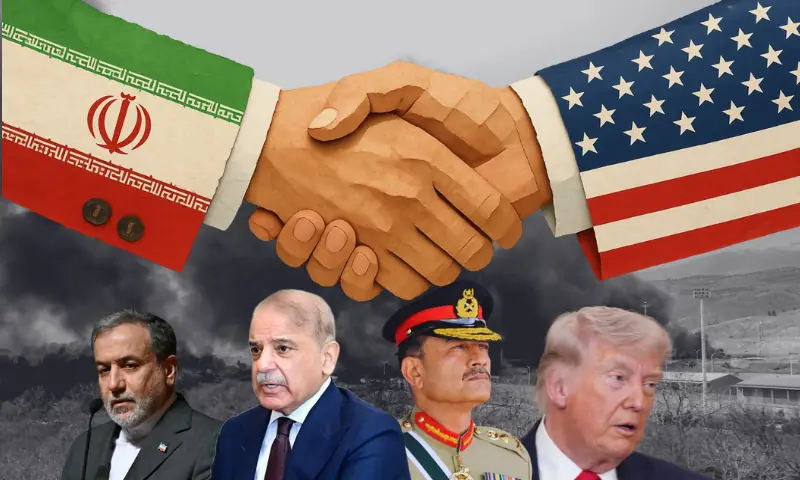
Prime Minister Shehbaz Sharif announced, early on Wednesday morning, that Pakistan had helped secure an “immediate ceasefire” between Iran and the United States, alongside their respective allies across the region, including in Lebanon, bringing a sudden halt to a conflict that had edged dangerously close to wider war.
The agreement, shaped through a series of proposals, relayed positions, and last-minute interventions, reflected Pakistan’s role not as a front-facing broker but as a steady intermediary. It practised diplomacy in its classic form. There was condemnation without foreclosure and mediation without the vanity of naming it. Calls were made, time was bought, and just enough ambiguity preserved to keep every side in the room.
Queen’s gambit: The opening move
Islamabad could have reached for spectacle. Instead, it chose something far more old-fashioned and durable: dialogue.
Even as the missiles flew and death toll rose, Pakistan offered solidarity to Tehran and pressed restraint to Washington. To Gulf capitals, it framed the war as an economic and security risk spiralling beyond anyone’s control. Each outreach looked modest in isolation. By the time a ceasefire window appeared, diplomacy had seamlessly threaded itself through the conflict.
This is a story of those threads.
It began on March 24 when Prime Minister Shehbaz Sharif expressed readiness to “facilitate” comprehensive talks for settlement between the countries at war. On March 28, when US-Israeli strikes on Iranian targets triggered the latest escalation, Pakistan, almost immediately, held a parallel round of diplomacy. Within hours, PM Shehbaz spoke with Iranian President Masoud Pezeshkian, condemning the strikes, expressing solidarity, and outlining outreach to Washington and regional capitals — the first visible sign of a mediation effort that would soon expand far beyond a single call.
Iranian President extended his gratitude to Prime Minister Shehbaz Sharif, acknowledging Pakistan’s sincere efforts to advance peace by engaging the United States, Gulf states, and other Islamic countries to facilitate dialogue.
The following day, Deputy Prime Minister and Foreign Minister Ishaq Dar met with the foreign ministers of Egypt, Turkey, and Saudi Arabia, exploring pathways for de-escalation and shaping a framework to initiate US-Iran talks.
On March 31, Dar undertook a one-day visit to Beijing at the invitation of China’s Foreign Minister Wang Yi. That same day, Pakistan unveiled a five-point initiative, marking the first structured multilateral framework aimed at restoring peace and stability in the Gulf and the Middle East amid the US-Israeli-Iran tensions. The plan called for the immediate cessation of hostilities and the prompt commencement of peace talks, underlining Islamabad’s commitment to translating diplomatic engagement into action.
On April 2, US and Israel attacked a century-old medical research centre in Tehran, a bridge near the capital and steel plants, after President Donald Trump threatened to bomb Iran back to “the Stone Ages”. As the war escalated with Iran downing multiple US aircraft, Trump’s threats escalated as well. He warned of “hell” and gave a 48-hour ultimatum to Iran to “open up” Striat of Hormuz.
Pakistan, though, continued working on the backend.
Endless calls were made to foreign ministers of countries like Turkey, Egypt, Indonesia, Jordan, Qatar, Saudi Arabia, the Gulf Countries, Iran and the US, promoting the Pak-China five-point initiative to encourage dialogue and resolve conflict.
When immediate talks did not materialise, one expected Islamabad to give up, but according to diplomatic sources, however, it intensified its outreach rather than scaling it back.
Two days later, Iranian Foreign Minister Seyed Abbas Araghchi reassured Iran’s willingness to visit Islamabad for negotiation talks and expressed gratitude for Pakistan for its efforts.
On April 6, Iran and the US received a proposal to end hostilities as a structured plan transmitted through Pakistan. The deal, dubbed the “Islamabad Accord,” would include a regional framework for the strait, with final in-person talks in Islamabad.
The document outlined a two-tier approach. First, an immediate ceasefire tied to the reopening of the Strait of Hormuz. Second, a 15-20 day window to negotiate a broader settlement. The sequencing was deliberate. De-escalation would come first; the harder political compromises would follow once the pressure of imminent conflict had eased.
Islamabad became the sole conduit through which revisions, clarifications and assurances moved between Washington and Tehran.
As the proposal circulated, Chief of Defence Forces (CDF) Field Marshal Asim Munir remained in continuous contact through the night — speaking with US Vice President JD Vance, special envoy Steve Witkoff, and Iranian Foreign Minister Abbas Araqchi — effectively managing the back-and-forth required to keep both sides aligned on timing and language.
The mechanics mattered as much as the substance. The initial understanding was designed to be formalised as a memorandum of understanding, finalised electronically through Pakistan. That allowed both sides to commit simultaneously without the optics of direct negotiation which was a critical consideration for two governments still publicly locked in confrontation.
“A whole civilisation will (not) die tonight”
By the eve of the ceasefire, the groundwork had already shaped the pressure points: each side knew what could be gained, or lost, if the window lapsed.
With less than two hours left before his 8pm (EST) deadline, Donald Trump — who had spent the previous day warning that “a whole civilisation will die tonight” — abruptly shifted tone. The bombing, he said, could be suspended for two weeks, but only if Iran reopened the Strait of Hormuz.
That conditional pause did not emerge in a vacuum. It followed a direct diplomatic push from Islamabad. As the clock ticked down, Prime Minister Shehbaz Sharif publicly urged Trump to extend the deadline, framing the request as an opportunity: give diplomacy two weeks, and a pathway could still be salvaged. Simultaneously, Pakistan relayed a parallel appeal to Tehran — reopen the Strait for the same period as a goodwill gesture, and halt defensive operations if attacks stop.
Within hours, the pieces began aligning. Iran signalled that if strikes ceased, it would pause its military response and allow safe passage through Hormuz for two weeks. Trump’s conditional suspension suddenly had a reciprocal answer.
The sequencing mattered. Washington demanded movement from Tehran; Tehran demanded relief from bombardment; neither wanted to move first. Pakistan’s intervention effectively split the deadlock — asking both sides to act simultaneously, under the same two-week window. The proposal transformed unilateral demands into mirrored commitments.
The result was a narrow diplomatic corridor created at the last possible moment: Trump extended the timeline, Iran offered conditional de-escalation, and the Strait (through which roughly a fifth of global energy supplies flow) was put back on the table as leverage for calm.
All eyes on Islamabad
In a crisis driven by threats and deadlines, Pakistan’s intervention did something deceptively simple. It gave both sides a way to step back without appearing to retreat.
So far, Pakistan has structured a clear pathway for peace: an immediate lull in hostilities, a scheduled window for negotiations, and eventual face-to-face talks in Islamabad on April 10. And though the outcome remains uncertain, its role as a mediator has already reshaped the possibilities for de-escalation.