Rabat – Mentions of North Africa tend to conjure up a specific mental picture in the minds of Western tourists – a picture replete with camels, Islam, and desert robes. Though Morocco is more than this, it does, indeed, have all these things. And unlike other parts of the Arab world currently gripped by conflict or dealing with the aftermath of war throughout the early 21st century, Morocco is largely stable.
Perhaps this is why the tourism industry has near-exploded in Morocco. It is not only the most-visited country in all of Africa, with tourism up 35% from pre-pandemic levels, but its tourism industry is booming compared to other Middle Eastern and North African countries – especially considering Morocco’s size relative to business titans like Saudi Arabia.
Many of these tourists come expecting to find their mental picture of North Africa. And what they wish to see, they can find. They need not go deeper into what makes Morocco, Morocco, if they do not care to do so.
And doing so may take a lot of effort. It may mean leaving behind the major cities, where English, French, and formal Arabic are spoken. It may take venturing into Morocco’s more rural towns, farms, fields, and mountains, where it is necessary to speak Darija with the locals.
Darija is Morocco’s hidden-in-plain-sight language. Though it is the language they speak on a daily basis, more than any other tongue, the government designates French and Arabic as official languages. Menus and news broadcasts are in French and Arabic as well. But Darija is the language of taxi drivers, doctors, lawyers, college students, farmers, villagers – the language of Moroccan life.
But for decades, barriers have obstructed tourists from learning Darija. In years past there were no resources for them to learn outside of tutorship from Moroccans themselves. Lately, though language translators abound online, Darija is not usually among them; though Google Translate offers 243 languages, Darija is not one of them, despite Morocco’s rapidly-increasing profile.
But things are changing. They have, inch by inch, for over a decade. The COVID-19 pandemic proved a special turning point. Then, the world locked down, and something unexpected ruptured: the gates of Darija swung Morocco open to the world.
Language into industry – the YouTube revolution
One of that gate’s hinge points was driver-turned-educator Muhammad Moukasse. He spent years chatting with tourists who wished they could understand the language around them. He saw demand for learning Darija, but no supply of teachers.
So around the time that the world shut down, he registered a new YouTube channel, flipped open a camera, and began explaining the language he had grown up speaking.
To everyone’s surprise – including his own – his channel took off.
What began as a handful of videos swiftly ballooned into a global classroom. His subscriber count climbed from dozens to over ten thousand. Registration at his online school recently counted 52 students. North Americans, Europeans, Gulf residents, heritage speakers, Peace Corps alumni, and curious polyglots dropped comments. Many had Moroccan partners or in-laws. Some hoped to move to Morocco, while others simply wanted to understand the conversations swirling around them on their travels.
Moukasse’s channel was not alone. Others like Tea Time Darija, Daily Darija, Moroccan Arabic with KAWTAR, English to Darija, and Assia West have collectively accrued millions of views. Most started around 2020 or started posting Darija-related videos later as the trend took off. Each feature easy, accessible livestreams explaining useful phrases; short videos of simple Darija structures meant for everyday situations; or even more in-depth lessons, though creators like Moukasse reserve the real teaching for subscribers to their official courses.
Moukasse notes that many more serious students are interested in working or living in Morocco; much of the time these students plan on marrying a Moroccan.
In an interview with Morocco World News (MWN), Moukasse recognized that “[Many of my students] don’t learn Darija for tourism… Most learn it to speak with their family – mother-in-law, father-in-law, cousins, neighbors.”
One of Moukasse’s students, a woman from Jacksonville, Florida, spent six months studying Darija so she could speak with her Moroccan partner’s parents in Beni Mellal. When she finally did, “she touched their hearts,” Moukasse recounted. They invited her to their wedding celebration. Moukasse attended too. Today, she and her husband live in Florida with their two children.
“I don’t know how to explain how proud that makes me,” Moukasse said. “Language builds bridges… At first, families might struggle to accept someone because they can’t communicate. But when students speak Darija, everything changes. They become part of the family.”
Understanding a language built from bits and pieces
Growth like the kind Moukasse is experiencing is notable simply because it has never happened before when it comes to Darija. Morocco’s colonial past and Islamic heritage push French and Arabic to the foreground, especially in major cities and tourist hotspots.
So foreigners rarely learn Darija; even long-term visitors to Morocco are more likely to choose learning French over Darija. Arabs tourists often do not understand Darija. Many Moroccans will speak Levantine or Egyptian Arabic with other Arabs before they try Darija.
Others typically avoid learning Darija, so Moroccans have adapted and learned how to speak to accommodate them. This is in part because Darija is not comprehensive – it does not have its own words for certain concepts, especially in topics related to technology. Instead, it borrows words from other languages, like French and English.
But whatever Moroccans learn from other languages, they carry back into Darija. The result is a beautiful taped-together mass of language, fashioned from colonial influence, history, modern progress, and even TikTok and Instagram.
Youness Guarmouti, a 30-year-old Moroccan who has spent much of his life teaching Darija, told MWN: “Some people who are not language-oriented will say, like, ‘this is nonsense’… But the beauty of this language is you have this mix of words from France, from Spain, from Portugal, from England. From different countries, different words. And then you have the structure of the Amazigh language, not even classical Arabic.”
Guarmouti sees this as a positive.
“When you combine all of those things and you create a language with it, it is just something that I admire,” he said. “[It] has a beauty that does not exist in other languages.”
Because Darija is not as standardized or widely taught as other languages, its rules are not well-understood. That being said – Guarmouti understands better than most. He had not yet graduated college when the Peace Corps hired him to teach Darija to its volunteers. Though his family and friends were shocked, disbelieving that Darija was even teachable, he and several other young Moroccan teachers built a curriculum from scratch.
Over the years, he watched volunteers use Darija to integrate deeply into rural communities. Some of his students even loved Morocco so much that they decided to relocate permanently.
Guarmouti eventually left the Peace Corps, but he did not leave his work teaching Darija. In the course of his time as an educator he has played a role in several key developing sectors – as an administrator at Darija teaching institutions, a private tutor, a budding podcaster, and most recently, as an author.
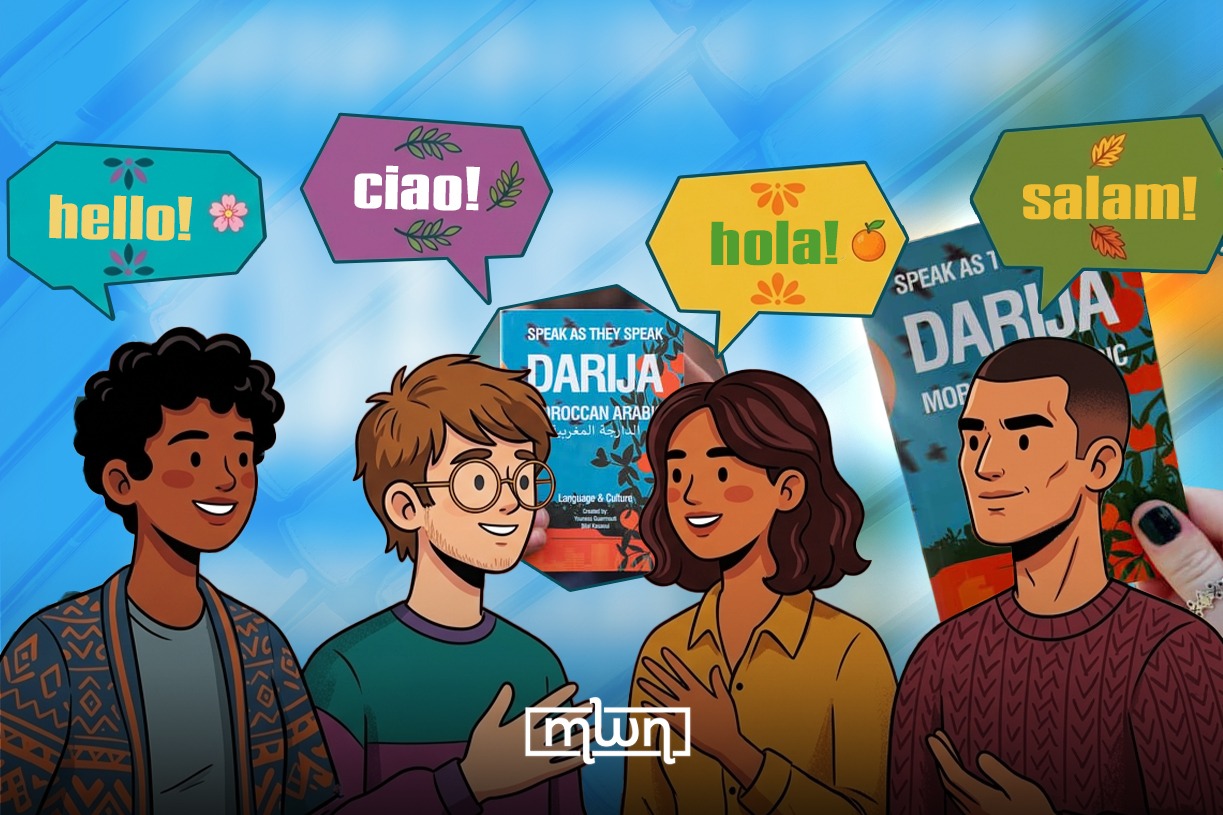
His recent book is among the first of its kind. Written for visitors and translated into multiple languages, “Speak As They Speak: Darija” is meant to serve as a kind of cheatsheet to Moroccan culture and language. It has been distributed to stores and museums in major cities across the country.
Prior to “Speak As They Speak: Darija,” only several Darija teaching courses existed on paper, including the old Peace Corps manual – which Guarmouti, early in his career in the Peace Corps, quickly rendered obsolete – and several other books.
But Guarmouti’s travel guide is unique for its size and accessibility.
“The book was the idea of a tool [with which] every single human… can reach out,” said Guarmouti. “So not just people who really want to study because they want to learn Darija, but [also] people visiting Morocco for ten days or something, and they want to throw words in here and there and create a really beautiful, enthusiastic atmosphere… like an authentic atmosphere living here.”
Nevertheless, efforts like those of Guarmouti’s and Moukasse’s have lately centered on improving tourist experiences. What about those who really wish to master Darija – not just to speak as Moroccans speak, but to understand how and why?
To this latter group belongs the academic world, which is increasingly setting its eyes on Morocco.
Resources for understanding the whole of Morocco
Every year, foreign students travel to the Middle East and North Africa, more specifically the Levant, to study Arabic on site. Morocco’s share of these students has increased as genocide and wars in the Levant make university lawyers wary of the Levant’s liability risks.
One of these students is Rachel Gammon. A 22-year-old American, she was originally planning on traveling to Jordan with her university last year to study MSA and Levantine Arabic, which is traditionally far more versatile than Darija across the Arab world.
But with conflict and the genocide in Gaza raging close to Jordan’s borders, university lawyers abruptly changed plans on Gammon’s school group and sent them to Morocco instead. And though Gammon’s school, Brigham Young University, offers one of the most robust American undergraduate programs for Arabic learning, it had no resources on Darija last year. Consequently, Gammon, her fellow students, and her professor arrived in Morocco with little to zero Darija under their belts. They learned mostly from YouTube videos and conversations in the streets.
As Gammon’s Darija grew over the course of the semester, Morocco seemed to open up for her – and her new perspective made her fall in love with the country.
“[Last year,] I started to be really self-conscious of the way I spoke Arabic… I could get my needs across, but I felt like I was in this hoity-toity British accent [when I spoke MSA],” said Gammon in an interview with MWN. “I couldn’t actually communicate in the register of language that everyone else was… It affected my relationships because I couldn’t connect on a friendship level, only on a professional level.”
When she returned to America, she and her fellow students returned to a university program short of expertise in Darija. Therefore, when she became the teaching assistant for the Arabic students who were set to travel abroad this year, she became the de-factor Darija expert.
Now she is back in Rabat with the same students and a professor who has studied Darija for far less time than she has.
“Coming back this year was really exciting for me,” said Gammon. She compared her group’s visit to a village in the Atlas Mountains last year with this year’s visit to the same village. In that village were two girls about her age who only spoke Tamazight and Darija. Last year, she could communicate with them just slightly; this year, she was able to get to know them, what she called a “beautiful experience in the beginning of our friendship.”
Yet, Darija remains riddled with complications for students actually seeking fluency. Outside of YouTube academies like Moukasse’s and private appointments with teachers like Guarmouti, foreign students, especially those following traditional Western collegiate paths, have no direct route to fluency in Arabic – especially not through their universities.
Gammon ran into this difficulty at her own university when she stepped into the role of teaching assistant. Before returning to Morocco this year, she devoured the few existing textbooks on Darija – the Peace Corps manual and a textbook published by Al Akhawayn University in Ifrane – but found that they did not necessarily work for the students she was trying to teach, who had spent time on MSA and had a basic level of Darija but were seeking to grow.
“I basically scoured the Internet for Darija teaching resources, like all of YouTube, Reddit, just Google searches, Facebook groups. I looked everywhere. There’s a lot of really beginner Darija and there’s a lot of Moroccan people talking Darija, but there’s not a lot of anything in the middle,” said Gammon. “I still have… things that I want to understand more.”
Meet Darija’s future: AI, social media, and people who care
For years, Darija has languished as what academics call a “low-resource language.” Like Gammon said, few academic courses exist, either online or in universities. And computational linguistics have not recognized Darija in the past.
Research is blooming, especially as Darija turns trendy. Though Google Translate still fails to understand Darija, ChatGPT can, enabled by a large and growing body of research and technological innovation.
There is also Atlas-Chat, which introduced large language models trained on Darija that could act as chatbots or virtual tutors; DODa (Darija Open Dataset), which compiled over 100,000 entries of uses of Darija; and Dialect2SQL, which allows databases to interpret queries written in Moroccan Arabic.
These tools started emerging in just the last few years. They were motivated by increasing awareness. Native Moroccans like Moukasse and Guarmouti have popularized Darija education via YouTube, short, accessible books, and podcasts. Then, Moroccan influencers are increasingly stepping into the limelight; some TikTok and Instagram accounts produce skits spoken in Darija, while others post helpful Darija phrases or make jokes about Darija’s still-ambiguous nature.
And all these things are working. Darija YouTubers’ subscriber counts continue to rise. Foreigners are catching the Darija fever. And as Guarmouti has said, more and more institutions where Darija is taught are popping up across Morocco.
James Allen is one of those foreign students studying at a Darija-teaching institution this fall. He is also one of Gammon’s students – this is his first time in Morocco. Though he says he likes MSA, he prefers Darija and “the accent, the words, the context, the jokes, the expressions” that come with it.
“I’m learning [Darija] to connect with people,” he said to MWN. He added that Darija has helped him build friendships that he otherwise would not have. “[Moroccans] see that I’ve cared enough to learn their language, and then they care enough to keep talking to me.”
Allen started Instagram and TikTok accounts dedicated to Morocco when he was just a few weeks into his semester in Rabat. “james_lmaghribi” shows Allen testing out Darija with his Moroccan friends. Though he didn’t set out for virality, he quickly garnered over 650,000 views on some of his videos.
Americans have been among those viewing and commenting on Allen’s posts. But it has mostly been Moroccans, many of whom, Allen says, have been shocked and delighted to see him learning Darija.
“For somebody to have taken the time to learn [Darija, Moroccans are] so intrigued. They always ask me, ‘why?’” said Allen. “Then it just creates a mutual appreciation.”
The Moroccans’ surprise is in part fueled by how few foreigners have ever really tried to get to know Morocco before. Darija is difficult for even other Arabs to learn; why would non-Arabs bother? The process has instead traditionally worked the other way, with Moroccans learning foreign tongues. That is why, after all, Darija is as unique as it is.
And social media has capitalized on this flexibility. As Morocco increasingly globalizes and its young people adopt the Internet as their second home along with the rest of Generation Z, English increasingly leaks into Darija, changing its course yet again.
“The interaction of these cultures… helps grow the language,” said Guarmouti. “Like, I can speak Darija, and I will learn like two words from Americans and I will use them in my language, I will use them in Darija.”
Even as Darija evolves, those passionate about the language and its speakers run to catch up. Darija YouTube videos continue to proliferate; AI scans vast amounts of Darija data and spits it back out for learners; students pack up their bags for semesters abroad. Travelers turn to a growing array of learning resources, and as their interest grows, so does awareness – which in turn pushes the growth of learning resources even more.
At the heart of this phenomenon is a growing global love for Morocco.
“We often don’t like people because we don’t know them. That is essentially the case for so many Americans towards the [Arab world],” Allen tells MWN.
“But when you connect on a one-to-one basis, you realize that we’re all humans, we’re all brothers and sisters… When you connect in that way, and they can get a look into your life and you can get a look into theirs… [you can] get to know an individual, which builds bridges.”
The post How the Darija Teaching Industry Has Opened Morocco’s Culture in a New Way appeared first on Morocco World News.