What began as an aggressive drive for productivity, automation and competitive advantage, is now opening a dangerous new front in cyber risk. In 2026, AI (artificial intelligence) is no longer simply helping enterprises move faster, it is also helping attackers do the same – even allowing them to move faster than tech defenders can respond.
Threats have emerged leading to a precarious landscape where AI has become both the target and weapon, cybersecurity analysts warned. “This is no longer a gap. It is a collapse of control,” Rayad Kamal Ayub, managing director of Dubai-based Rayad Group, told Khaleej Times over the weekend.
“AI has introduced machine speed risk into systems that still depend on human speed defenses,” he added, noting IBM X Force, for instance, has recently reported a 44 per cent surge in attacks against public facing applications, while CrowdStrike’s 2026 Global Threat Report revealed breakout times inside compromised networks are collapsing to roughly 29 minutes.
“The threat is not theoretical – it is active, immediate and already being exploited,” Ayub pointed out, citing the recent attacks against open-source AI platform Flowise.
Stay up to date with the latest news. Follow KT on WhatsApp Channels.
“VulnCheck researchers have confirmed live exploitation of CVE 2025 59528 in Flowise. The flaw enabled remote code execution, giving attackers a path to arbitrary command execution and full system takeover,” said Ayub.
Flowise is not a fringe tool. It is widely used to orchestrate large language model workflows. Cybersecurity experts said a compromise at that layer is not contained; it cascades. Meaning, one poisoned orchestration node can expose credentials, data and operational infrastructure across interconnected environments within minutes.
“When orchestration layers fall, everything downstream is exposed. Attackers are stepping into systems through trusted automation,” said Ayub, underscoring: “The most dangerous threat is authorised misuse at machine speed, simply because security tools struggle to distinguish legitimate AI tasks from active exploitation.”
Palo Alto Networks also recently identified AI agents being weaponised from within. The problem is not simply code but the entire architecture granting AI agents access beyond what they actually need.
“This is what makes the threat so dangerous,” noted Ayub, explain: “These actions often look like ordinary platform behavior – Tthey are executed by valid agents, using valid permissions, inside valid workflows. Traditional security systems are built to detect intrusion. They are far less effective when the abuse is carried out through trusted automation.”
29 million credentials leaked in 1 year
According to GitGuardian, data leaks have risen 152 per cent since 2021. Last year, more than 1.27 million AI-related secrets were exposed, an 81 per cent year-on-year increase. Across the broader ecosystem, more than 29 million credentials were exposed in a single year.
Cybersecurity analysts like Ayub pointed out: “Attackers are not breaking in anymore. They are logging in with exposed identities.”
“The concentration of those leaks is especially alarming. The biggest spikes are appearing precisely where enterprises are scaling AI infrastructure the fastest. Each new integration creates another machine identity. Each machine identity relies on tokens, keys or service accounts. Each exposed credential becomes a ready made doorway into production systems,” he added.
How easy it has become to weaponise AI
This is perhaps the most unsettling reality in the 2026 cyber threat landscape: The barrier to entry is collapsing.
Research from CrowdStrike and academic studies published in 2026 indicates that modern AI systems can autonomously conduct reconnaissance, generate exploit paths and support multi step attack execution with minimal human input.
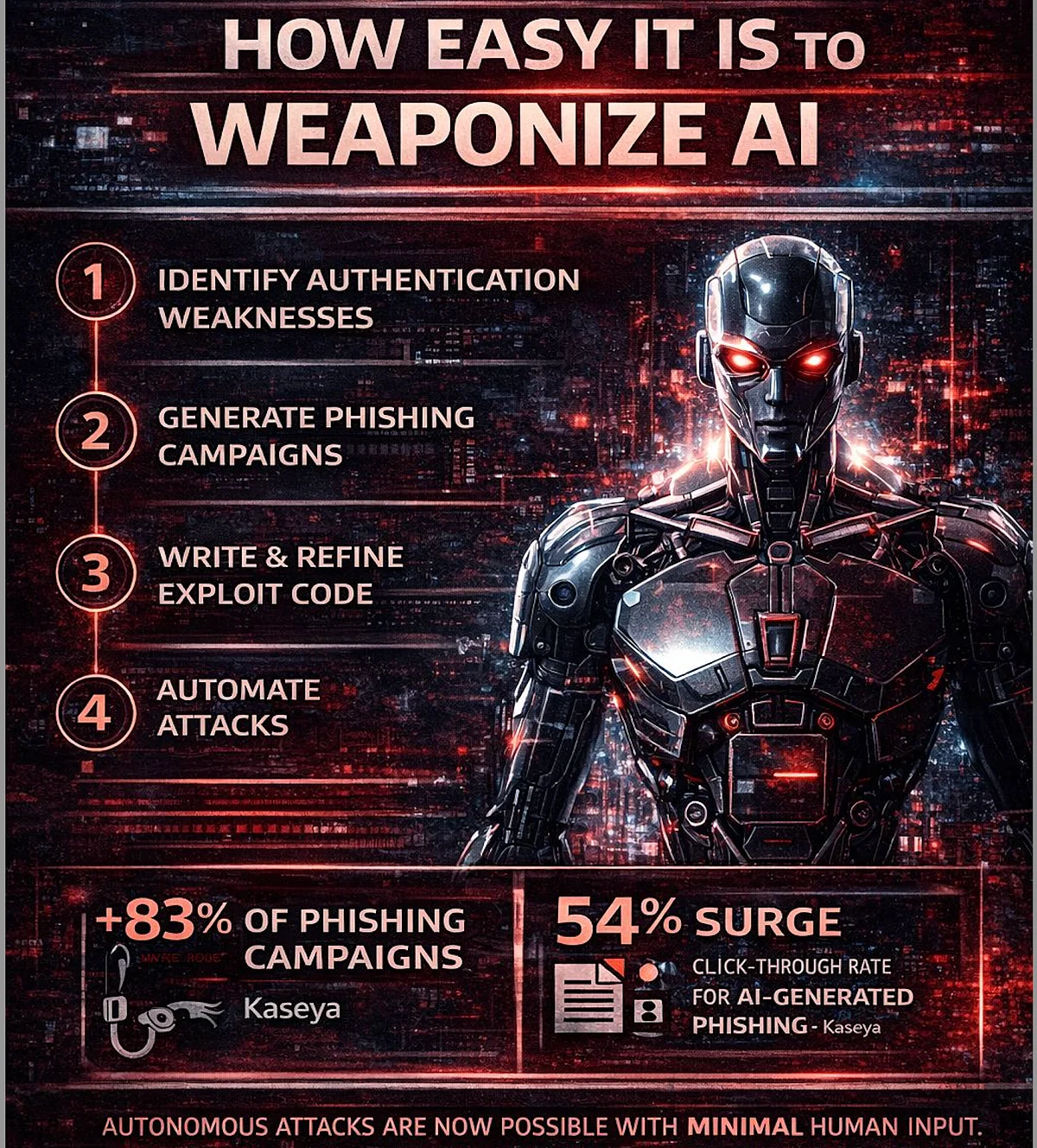
Miami-based information technology company Kaseya recently reported that 83 per cent of phishing campaigns now use AI-generated content, with click through or engagement rates far above traditional campaigns.
Because of AI, messages are no longer generic spam but personalised, contextualised, grammatically polished, and produced in minutes.
“This means a single operator can now do what previously demanded a coordinated team. AI can scan thousands of potential targets, identify weak authentication points, generate plausible lures, refine exploit code, automate lateral movement and adapt in real time as defenders respond,” Ayub explained.
‘Enterprises must fight back’
Conventional defenses are proving inadequate; attackers are accelerating while tech defenders remain dependent on models of detection built for an earlier era.
“The result is a widening asymmetry. The security model is being outpaced. We are still applying human speed defenses to machine speed threats,” cautioned Ayub, underscoring: “Businesses must act now to close the security gap.”
“Security teams should expect heavier targeting of AI orchestration layers, machine identity systems and cloud permission models. Attack chains are likely to become quieter, more adaptive and more difficult to detect as attackers increasingly rely on valid credentials, trusted workflows and automated agent behavior,” he added.
Ayub underscored: “Organisations should not only adopt AI to transform their operations but also ensure their level of cybersecurity is up to date – meaning, it must be made an integral pat of their digital future, not something added afterwards.”
“Critical vulnerabilities are already under exploitation; AI is being weaponised and credential leaks are accelerating. This is not a passing phase in enterprise security. It is a structural shift. Those who fail to act decisively will lose control, but those who act now can close the security gap and ensure innovation."