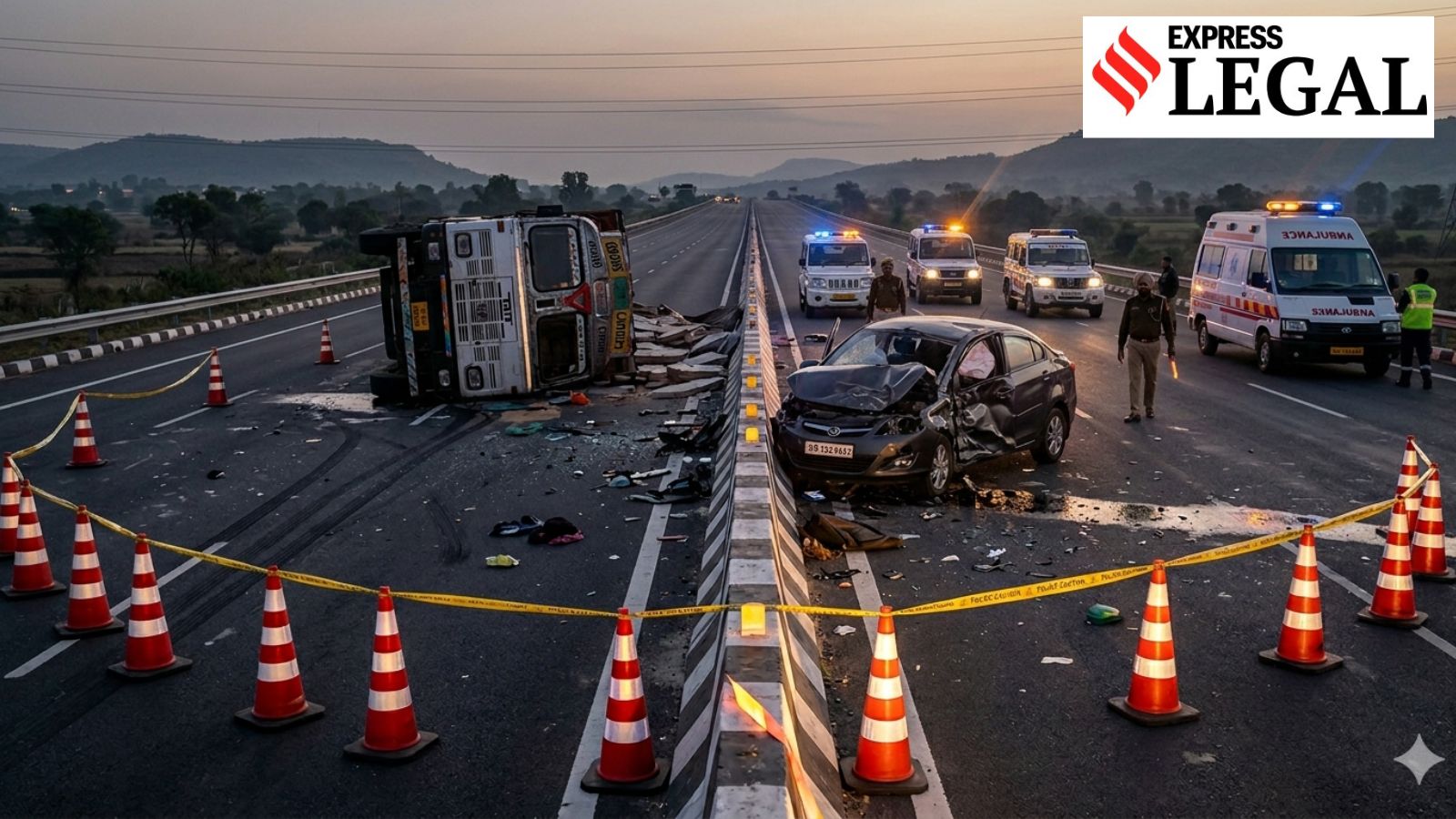
Weather ePaper Today’s Paper Journalism of Courage Home ePaper Politics Explained Opinion India Business Premium Cities UPSC Entertainment Sports World Lifestyle Tech Subscribe Sign In TrendingUPSC OfferIPL 2026US NewsPuzzles & GamesLegal NewsFresh TakeHealthResearch🎙️ Podcast Advertisement function checkAndLoadWindowSizeScript() { if (window.jQuery) { // jQuery is loaded, include your script jQuery(document).ready(function($) { // Your existing script for checking window width if (window.innerWidth) var page_w = window.innerWidth; else if (document.all) var page_w = document.body.clientWidth; if (page_w > 1024) { $(".add-left, .add-right").show(); } else { $(".add-left, .add-right").hide(); } }); } else { // jQuery is not loaded, check again after 0.2 seconds setTimeout(checkAndLoadWindowSizeScript, 200); } } // Initial call to the function checkAndLoadWindowSizeScript(); NewsLegalHighways must not become ‘corridors of peril’: Supreme Court flags safety gaps, issues nationwide directions Highways must not become ‘corridors of peril’: Supreme Court flags safety gaps, issues nationwide directions The Supreme Court was hearing a suo motu writ petition arising out of two fatal accidents in November 2025 in Rajasthan and Telangana, which together claimed 34 lives. Written by: Vineet Upadhyay5 min readNew DelhiApr 19, 2026 06:00 AM IST It is seen that National Highways constitute approximately 2 per cent of India’s total road length but account for nearly 30 per cent of all road fatalities, said the Supreme Court. (Image generated using AI) Make us preferred source on Google Whatsapp twitter Facebook Reddit PRINT Supreme Court news: Flagging data that national highways constitute only about 2 per cent of India’s total road length but account for nearly 30 per cent of all road fatalities, the Supreme Court said that a high-speed roadway “must not become a corridor of peril” due to administrative lapses or infrastructural gaps, stressing that the right to life includes a safe commuting environment. A bench of Justices J K Maheshwari and Atul S Chandurkar was hearing a suo motu writ petition arising out of two fatal accidents in November 2025 in Rajasthan’s Phalodi and Telangana’s Rangareddy districts, which together claimed 34 lives, and examined systemic lapses in highway management and enforcement. “A road, particularly a high-speed Expressway, must not become a corridor of peril due to administrative lethargy or infrastructural gaps. The loss of even a single life to avoidable hazards like illegal parking or blackspots etc., represents a failure of the State’s protective umbrella,’ the court said on April 13. Acting on joint suggestions from the solicitor general and the amicus curiae, the Supreme Court issued a detailed set of time-bound directions. No heavy or commercial vehicle shall park/stop on any national highway carriageway or paved shoulder except at a designated bay, lay-bye or wayside amenity. Enforcement to be through ATMS real-time alerts, GPS-timestamped photographic evidence and integrated e-challan generation, with SOPs and compliance within 60 days, said the Supreme Court. Highway authorities shall, within 30 days, file a consolidated report on inspection teams, encroachments and compliance status, fully operationalise the Rajmargyatra complaint module, helpline 1033, and conduct drone-based surveys with periodic reporting. No construction or operation of any new dhaba, eatery or commercial structure within the Right of Way, all unauthorised structures to be removed within 60 days as per law and SOP, ordered the Supreme Court. No licence, NOC or trade approval shall be granted or renewed within highway safety zones without prior clearance; existing licences to be reviewed within 30 days, said the Supreme Court. Each district to constitute a task force within stipulated time, comprising administration, police and highway authorities, joint responsibility for enforcement, regular meetings, and land-use restrictions near highways to be notified, ordered the Supreme Court. Dedicated surveillance teams to be set up within 30 days for regular highway patrolling, supported by vehicle tracking systems and continuous monitoring. Full activation of Advanced Traffic Management Systems across highways, including cameras, speed detectors, message boards and emergency call boxes, with compliance affidavit within 60 days. Deployment of ambulances and recovery cranes at intervals not exceeding 75 km to ensure timely emergency response, in line with Article 21 obligations. Ensure construction of truck lay-bys at regular intervals and operationalisation of wayside amenities with basic facilities like rest areas, food, washrooms and signage. Authorities may provide additional lay-bys wherever necessary to allow drivers adequate rest. Identify and publish accident blackspots within 45 days, install lighting, speed cameras and warning systems within prescribed timelines. Set up an inter-state coordination mechanism to standardise enforcement protocols, surveillance and penalties across states. All agencies to ensure compliance within timelines and submit consolidated reports before the court within 75 days. These directions, issued under the court’s constitutional powers, form a structured, time-bound framework for improving highway safety nationwide. TheSupreme Court directed all implementing agencies, including NHAI and state authorities, to submit compliance reports within 75 days. Copies of the order have been circulated to chief secretaries and police chiefs across states and union territories to ensure nationwide implementation. With the matter scheduled for further hearing after two months, the Supreme Court’s intervention signals a strong push towards systemic reform in highway safety, placing responsibility squarely on authorities to prevent avoidable tragedies on India’s roads. Vineet Upadhyay is an Assistant Editor with The Indian Express, where he leads specialized coverage of the Indian judicial system. Expertise Specialized Legal Authority: Vineet has spent the better part of his career analyzing the intricacies of the law. His expertise lies in "demystifying" judgments from the Supreme Court of India, various High Courts, and District Courts. His reporting covers a vast spectrum of legal issues, including: Constitutional & Civil Rights: Reporting on landmark rulings regarding privacy, equality, and state accountability. Criminal Justice & Enforcement: Detailed coverage of high-profile cases involving the Enforcement Directorate (ED), NIA, and POCSO matters. Consumer Rights & Environmental Law: Authoritative pieces on medical negligence compensation, environmental protection (such as the "living person" status of rivers), and labor rights. Over a Decade of Professional Experience: Prior to joining The Indian Express, he served as a Principal Correspondent/Legal Reporter for The Times of India and held significant roles at The New Indian Express. His tenure has seen him report from critical legal hubs, including Delhi and Uttarakhand. ... Read More
المصدر: Indian Express
| Source: Indian Express
ملاحظة تحريرية | Editorial Note:
نُشر هذا المقال في الأصل بواسطة Indian Express.
خبر (Khabr) هي منصة إعلامية أردنية مرخّصة تعمل بالذكاء الاصطناعي.
نضيف قيمة تحريرية من خلال: تحليل ذكي للأخبار، ملخصات تلقائية، رواية صوتية بالذكاء الاصطناعي، ترجمة متعددة اللغات، وتدقيق الحقائق.
هدفنا جعل الأخبار أكثر وضوحاً وسهولةً للقارئ العربي.
This article was originally published by Indian Express.
Khabr is a licensed Jordanian AI-powered news platform (Registration #82086).
We add editorial value through: AI-powered news analysis, automated summaries, AI audio narration, multi-language translation (Arabic, English, French, Turkish), and AI fact-checking.
Our mission is to make news more accessible and understandable for Arabic-speaking audiences worldwide.