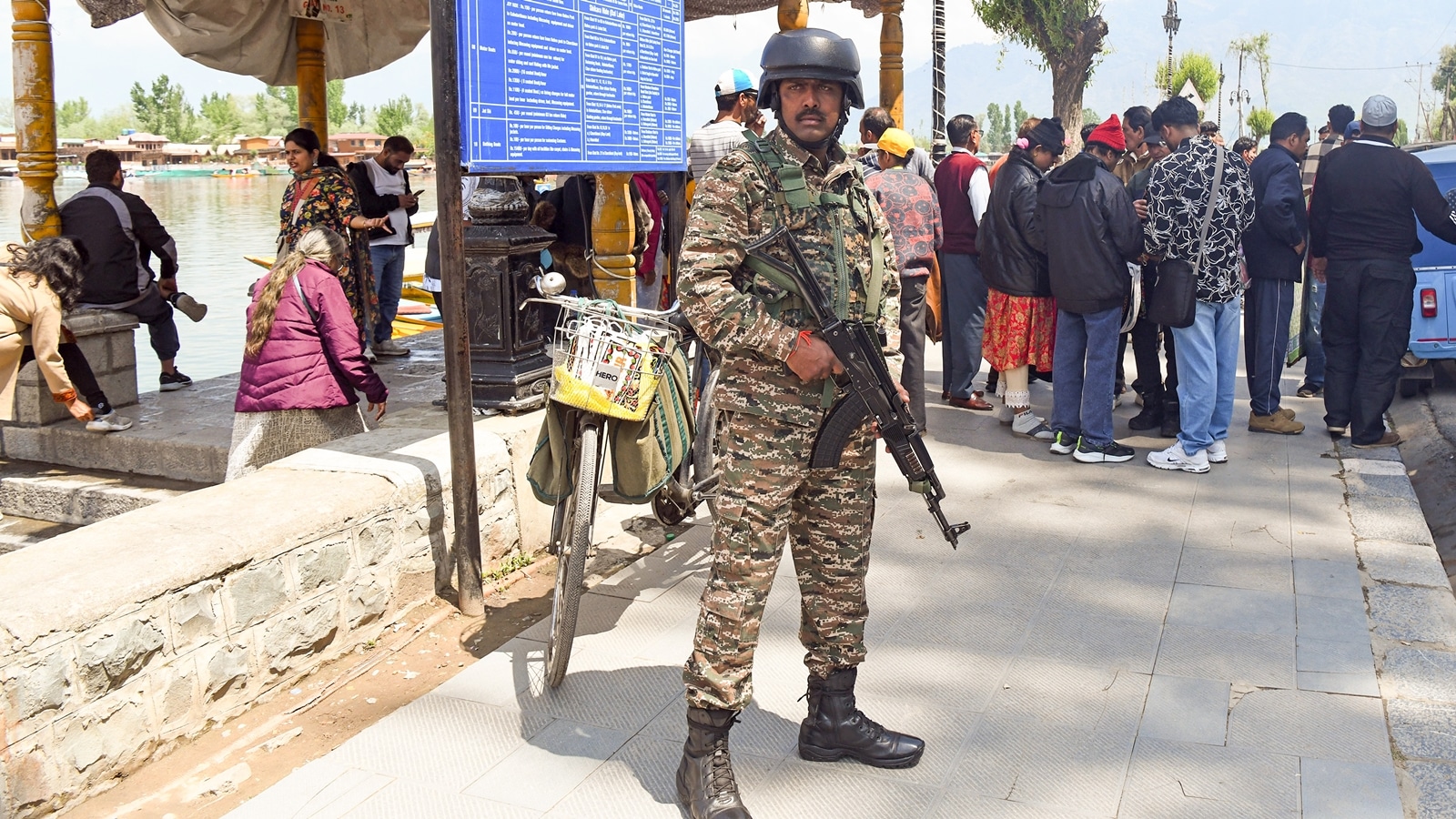
Weather ePaper Today’s Paper Journalism of Courage Home ePaper Politics Explained Opinion India Business Premium Cities UPSC Entertainment Sports World Lifestyle Tech Subscribe Sign In TrendingMumbai NewsDelhi NewsChandigarh NewsBangalore NewsLucknow News Advertisement function checkAndLoadWindowSizeScript() { if (window.jQuery) { // jQuery is loaded, include your script jQuery(document).ready(function($) { // Your existing script for checking window width if (window.innerWidth) var page_w = window.innerWidth; else if (document.all) var page_w = document.body.clientWidth; if (page_w > 1024) { $(".add-left, .add-right").show(); } else { $(".add-left, .add-right").hide(); } }); } else { // jQuery is not loaded, check again after 0.2 seconds setTimeout(checkAndLoadWindowSizeScript, 200); } } // Initial call to the function checkAndLoadWindowSizeScript(); NewsIndia‘Hard reset’: A year since Pahalgam, J&K’s security landscape looks vastly different Premium ‘Hard reset’: A year since Pahalgam, J&K’s security landscape looks vastly different Strategy changes from defence to preemption and offence. While many gunfights take place in dense forests, Pahalgam was last big militant attack in J-K. Written by: Bashaarat Masood, Mahender Singh Manral5 min readNew Delhi, SrinagarApr 21, 2026 06:46 AM IST Security personnel stand guard on the banks of Dal Lake. (ANI) Make us preferred source on Google Whatsapp twitter Facebook Reddit PRINT In the year since the Pahalgam terror attack, the security apparatus in Kashmir and Jammu has witnessed what many call a “hard reset” – from the Army scouring the dense forests more aggressively to the J&K police setting up ‘Snow Leopards’ and ‘Markhor’, two elite counterinsurgency units trained in high altitude and jungle warfare, officials in the security establishment The Indian Express spoke to say. The strategy, which has changed from defence to preemption and offence, has meant that while many gunfights continue to take place in the dense forests, Pahalgam was the last big militant attack in Jammu and Kashmir. “For almost three decades, we were largely used to urban warfare. It was relatively easy – target a house where terrorists are trapped, and the game is over,” explained a senior police officer. “But the jungle warfare was new to us. It took us some time to adapt, but we are there now.” After the Pahalgam attack, J&K Police established two new elite units within its Special Operations Group (SOG) to strengthen operations in challenging terrain. The twin units have drawn their names from high-altitude wild animals found in the Valley known for their strength, resilience, precision and speed. While the Snow Leopards unit is trained for high-altitude warfare in rough terrain, Markhors are trained for gunfights in dense forests. The twin units have undergone specialised training with different elite forces in the country. While these units are always in a ready-to-deploy position, the Army, too, has strengthened its security apparatus, especially in mountainous areas, with its elite paratrooper units deployed at high altitudes. It was one such unit that killed Pahalgam attackers Suleiman alias Faisal Jatt, Afghan and Jibran on July 28 last year, in the Dachigam forest area on the outskirts of Srinagar. Then, in December last year, the Army launched a major anti-militancy operation on both sides of the Pir Panjal mountains that connect the Kashmir valley to Poonch and Rajouri on one side and Kishtwar and Doda on the other. The Army managed to eliminate the Saifullah group of Jaish-e-Mohammad after a year-long pursuit, and also disrupted the larger terror network emanating from Pakistan, destroying their hideouts and forcing them to shift their bases. “There was a total shift of strategy. Earlier, they (terrorists) were hunting for us, and now we were hunting for them,” said a senior officer. “The results are obvious. They have been on the run and have not been able to plan an attack since Pahalgam.” The security agencies in Jammu and Kashmir have also adopted better coordination between different forces operating on the ground and the intelligence agencies. The security grid, under the banner of the Joint Control Centre, meets every week to get “instant operation and intelligence feedback” and for better coordination between the security apparatus deployed in the Kashmir and Jammu regions. “Over the last few years, the contour of insurgency has changed. Insurgents shifted their bases from urban areas of the valley to the mountains bordering the Kashmir and Jammu regions. These border regions have jurisdictional overlap and are often overlooked. It is these areas that they (the terrorists) used as their sanctuary,” said another police officer. “To effectively deal with this new threat, coordination between the regions on both sides of the Pir Panjal mountains was essential. It is now showing results.” What the probe has found so far According to the National Investigation Agency, two months ago, a Letter Rogatory was sent to the competent judicial authority in China seeking exact details of the supply chain and end-user details of an electronic device linked to the attack. According to officials, the NIA has yet to hear back and is likely to send a fresh reminder in the coming days. Last month, the NIA Deputy Inspector General Sandeep Choudhary, in an application before a Special NIA Court in Jammu, said that various material and electronic devices connected with the conspiracy and execution of the terrorist attack had been seized. “One such crucial electronic device was a GoPro camera, which was relevant for establishing pre-attack reconnaissance, movement and operational preparation of the terrorist module involved in the Pahalgam attack,” it said. The NIA has also found that three terrorists were using two phones of Chinese origin. “The NIA has got confirmation from the Chinese company that the phones concerned were sold in Pakistan,” an official said. The NIA has found in its probe that the attack was planned by Sajid Jatt and the terrorist outfit Lashkar-e-Taiba (LeT)/The Resistance Front (TRF). “All movements of the attackers, drone drops of arms and targeting tourists were coordinated by Pak-based handle Sajid. During the investigation, the NIA examined 1,113 persons, including 543 dhok inhabitants, 117 ponywallahs, 67 animal owners, 52 local food vendors, 19 shopkeepers, 42 photographers, 36 persons working in ticket counters and ziplines, 31 shawl hawkers, 25 taxi drivers and 23 other suspects.” Bashaarat Masood is a Special Correspondent with The Indian Express. He has been covering Jammu and Kashmir, especially the conflict-ridden Kashmir valley, for two decades. Bashaarat joined The Indian Express after completing his Masters in Mass Communication and Journalism from the University in Kashmir. He has been writing on politics, conflict and development. Bashaarat was awarded with the Ramnath Goenka Excellence in Journalism Awards in 2012 for his stories on the Pathribal fake encounter. Expertise and Experience Two Decades of Frontline Reporting: Bashaarat has spent 20 years documenting the evolution of Kashmir, from high-intensity conflict and political shifts to socio-economic development. Award-Winning Investigative Journalism: He is a recipient of the prestigious Ramnath Goenka Excellence in Journalism Award (2012). This honor was bestowed for his reporting on the Pathribal fake encounter, a series of stories that highlighted his ability to handle sensitive human rights and security issues with investigative rigor. Specialized Beats: His authoritative coverage spans: Political Transitions: Tracking the shift from statehood to Union Territory, electoral dynamics, and the pulse of local governance. Security & Conflict: Providing nuanced reporting on counter-insurgency, civil liberties, and the impact of the conflict on the civilian population. Development: Documenting the infrastructure, healthcare, and educational landscape within the Valley. Academic Background: He holds a Masters in Mass Communication and Journalism from the University of Kashmir, providing him with a localized academic and professional foundation that is rare in regional reporting. ... Read More Mahender Singh Manral is an Assistant Editor with the national bureau of The Indian Express. He is known for his impactful and breaking stories. He covers the Ministry of Home Affairs, Investigative Agencies, National Investigative Agency, Central Bureau of Investigation, Law Enforcement Agencies, Paramilitary Forces, and internal security. Prior to this, Manral had extensively reported on city-based crime stories along with that he also covered the anti-corruption branch of the Delhi government for a decade. He is known for his knack for News and a detailed understanding of stories. He also worked with Mail Today as a senior correspondent for eleven months. He has also worked with The Pioneer for two years where he was exclusively covering crime beat. During his initial days of the career he also worked with The Statesman newspaper in the national capital, where he was entrusted with beats like crime, education, and the Delhi Jal Board. A graduate in Mass Communication, Manral is always in search of stories that impact lives. ... Read More Stay updated with the latest - Click here to follow us on Instagram
المصدر: Indian Express
| Source: Indian Express