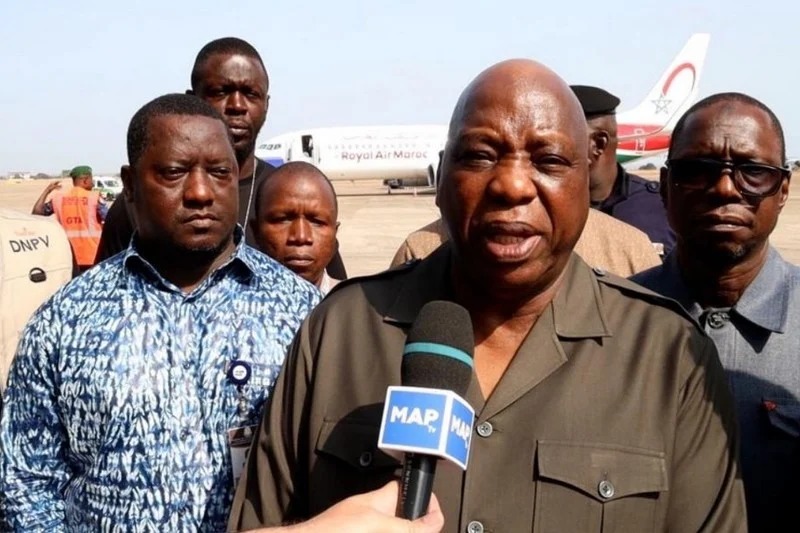
Marrakech – Guinea’s Foreign Minister Morissanda Kouyaté on Sunday thanked King Mohammed VI for a humanitarian operation that returned dozens of Guinean nationals to their home country after a shipwreck off Morocco’s coast.
Kouyaté made the remarks at Conakry’s international airport as the first group of Guinean citizens arrived aboard a Royal Air Maroc (RAM) flight from Dakhla, Morocco’s state-owned news agency MAP reported.
The repatriated nationals were survivors of a shipwreck in Moroccan territorial waters. Moroccan authorities provided them with medical and psychological support before their departure.
“Guinea will always remember this action, which complements other efforts carried out by Morocco,” Kouyaté said. He also stressed the broader commitment of both heads of state to strengthening bilateral ties.
More repatriation flights are expected in the coming days. Once completed, the operation will bring the total number of returned Guinean nationals to 360. All chose voluntarily to return to their families, according to the agency.
The operation reflects Morocco’s broader approach to migration management, which combines strict border enforcement with humanitarian measures.
In 2025, the country intercepted 73,640 irregular migration attempts, a 6.4% decline from the previous year, and dismantled over 300 smuggling networks. At the same time, Moroccan authorities rescued 13,595 migrants at sea, while 4,372 participated in voluntary return programs.
Guinea itself has emerged as a major departure point along the Atlantic migration route to Spain’s Canary Islands. Thousands of young Guineans now set sail from coastal towns like Kamsar, driven by economic hardship and political instability under the country’s military government. Guinean authorities have described the growing exodus as a “hemorrhage.”
The shift toward Guinea is partly a consequence of tighter migration controls further north. Bilateral agreements between Spain and countries like Mauritania and Senegal have pushed departures southward to less monitored coastlines.
The crossing from Guinea spans over 2,200 kilometers and can take up to ten days, substantially increasing the risk of shipwrecks and death at sea.
UNHCR data shows Guineans accounted for 11.7% of those reaching Spain via the Canary Islands in 2025, behind Mali and Senegal. The International Organization for Migration (IOM) has noted that increased surveillance in Mauritania and Senegal is directly lengthening and worsening migrant journeys by pushing departure points further south.
The human toll on these routes remains severe. The NGO Caminando Fronteras documented 3,090 deaths among those attempting to reach Spain in 2025, including 192 women and 437 minors.
Guinea and Morocco maintain close diplomatic relations. Conakry opened a consulate general in Dakhla in January 2020, and the two countries held their seventh joint commission session in July 2023 in the same city. Kouyaté has described the bilateral relationship as built on deep historical ties.
The repatriation also comes as Guinea manages a wider migration challenge involving its nationals stranded across North and West Africa. Earlier this month, Kouyaté visited Mauritania to arrange the return of Guinean migrants blocked there, announcing an airlift to bring them home.
The post Guinea Thanks King Mohammed VI for Humanitarian Repatriation of Shipwreck Survivors appeared first on Morocco World News.