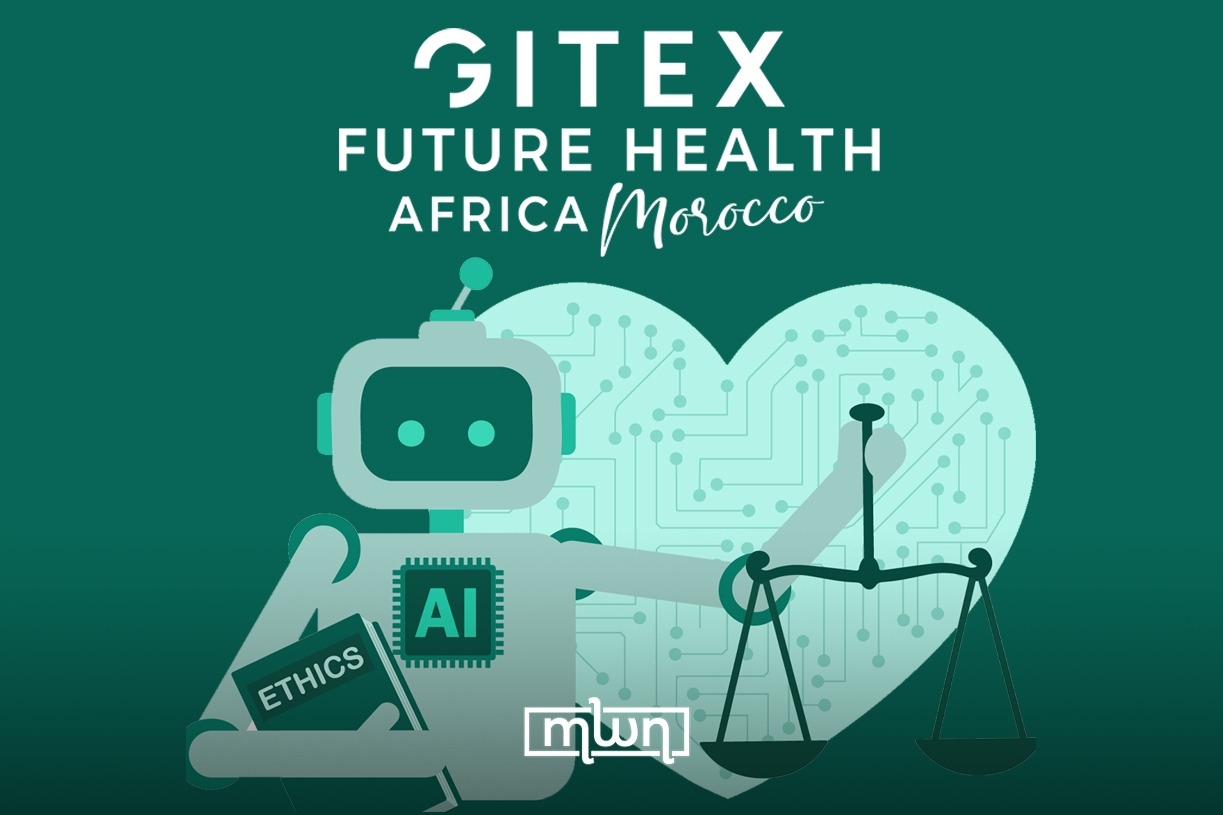
GITEX Future Health Africa 2026: The Ethics of AI in Healthcare Under Global Focus
•Rabat – In a 700-bed public hospital in Kimberley, South Africa, a sole radiologist fell ill at the height of the COVID-19 pandemic.
•With no specialist available, clinicians turned to an AI platform called RADIFY, software trained to flag critical lung findings, and ran it around the clock.
•Across the continent, in a rural Nigerian clinic, a startup called Ubenwa was training a machine learning model to detect birth asphyxia from a newborn’s cry alone.
هذا الخبر من Morocco World News. خبر يقدم أدوات ذكاء اصطناعي للتلخيص والترجمة والاستماع.
المصدر: Morocco World News | Source: Morocco World NewsRabat – In a 700-bed public hospital in Kimberley, South Africa, a sole radiologist fell ill at the height of the COVID-19 pandemic.
With no specialist available, clinicians turned to an AI platform called RADIFY, software trained to flag critical lung findings, and ran it around the clock.
Across the continent, in a rural Nigerian clinic, a startup called Ubenwa was training a machine learning model to detect birth asphyxia from a newborn’s cry alone.
These stories capture the extraordinary promise of artificial intelligence in global healthcare, while also laying bare its fragility, its limits, and ethical unease that shadows its rapid ascent.
The same tools that can save lives in the absence of specialists can entrench injustice, violate privacy, and deepen inequality when deployed without robust ethical guardrails.
As governments, hospitals, and technology companies race to implement AI-driven medicine, questions of who benefits, who is harmed, and who decides have never been more consequential.
That’s where GITEX Future Health Africa 2026 comes in, billed as the continent’s most influential event dedicated to accelerating healthcare innovation.
Opening from May 4-6, its agenda spans AI in clinical decision-making, telemedicine, hospital information systems, data interoperability, cybersecurity, and the regulation of medical AI, issues that are reshaping healthcare systems worldwide, and that carry particular urgency for a continent still in the process of building the infrastructure required to sustain them.
A market moving at speed
The numbers are staggering. The global AI in healthcare market, valued at approximately $39 billion in 2025, is projected to surpass $1 trillion by 2034, expanding at a compound annual growth rate of nearly 44%, according to Fortune Business Insights.
Deloitte’s Health Care Outlook reports that more than 80% of health system executives are prioritising AI for clinical operations.
In January 2025 alone, the US Food and Drug Administration (FDA) cleared 45 new AI-enabled medical devices, a 32% year-over-year increase, per SNS Insider.
The clinical results can be striking. In 2025, hospital networks reported a 40% average reduction in time to interpret chest X-rays and CT scans using AI-assisted diagnostic tools.
AI platforms are being deployed across drug discovery, surgical robotics, patient triage, administrative automation, and genomic medicine.
Yet speed of adoption is not synonymous with safety, and innovation is not synonymous with equity.
The bias built into the data
The most structurally dangerous ethical problem in healthcare AI is not malicious intent, but the quiet inheritance of history.
AI models learn from training data, and that data mirrors decades of unequal healthcare delivery.
A striking 97.5% of neuroimaging models draw on data from high-income populations, meaning the algorithms are trained on datasets that poorly represent much of the global population.
The consequences are documented and measurable.
Research cited by Rutgers University-Newark found that the overall mortality rate for non-Hispanic Black patients is nearly 30% higher than for non-Hispanic white patients, yet preliminary studies suggest that AI algorithms may still encode racial bias even when patients are objectively sicker.
In a now-classic 2019 case, a commercial algorithm used across population health management programs underestimated the healthcare needs of Black patients because it used prior healthcare spending as a proxy for clinical need.
Since systemic barriers had historically meant less money was spent on Black patients, the AI learned, incorrectly, that they needed less care.
A 2024 PRISMA scoping review of 309 peer-reviewed sources on AI ethics in healthcare, published in PubMed, identified bias, transparency, justice, accountability, privacy, and autonomy as the most frequently raised ethical concerns.
Disclosure of AI-generated results to patients remains among the least addressed issues, a silence that is itself a form of ethical failure.
Patient data under siege
Healthcare AI is not just a clinical tool; it is a data-hungry infrastructure, and that data is increasingly subject to cyber risk and exploitation.
A 2025 IBM Security report found the average cost of a healthcare data breach had reached $7.4 million, with 97% of organizations experiencing AI-related security incidents found to have lacked proper AI access controls.
According to Censinet, 92% of healthcare organizations reported AI-related cyberattacks in 2024.
Patient Protect’s analysis of HHS data found that 276 million patient records were compromised in 2024, a 64% increase from 2023’s already record-breaking year, representing approximately four in five Americans.
Similarly, a Wolters Kluwer Health survey of more than 500 healthcare administrators and providers found that 69% expressed concern that AI adoption would increase data privacy and security risks, while 59% of security professionals worried that staff would not be adequately trained to manage the tools being deployed.
Medical records are a uniquely valuable target: they sell on the dark web at roughly ten times the value of credit card data because they contain information, Social Security numbers, biometric identifiers, insurance records, that never expire.
Africa: the continent the algorithm forgot
If the ethical risks of AI healthcare are serious in wealthy, data-rich countries, they become existential in Africa, where the technology is being imported to serve a population it was largely never designed to understand.
The baseline figures are sobering. Africa bears 25% of the global disease burden but has only 3% of the world’s healthcare professionals, according to a 2025 paper published in Health Affairs Scholar by researchers from the University of São Paulo and the University of Zambia.
The continent has approximately one doctor per 3,000 patients, one-third of the ratio recommended by the World Health Organization (WHO), and faces a projected shortage of 4.3 million doctors by 2035, according to a Brookings Institution analysis.
Up to 20,000 healthcare professionals leave the continent annually in search of better conditions abroad.
Into this vacuum, AI arrives with enormous potential, and substantial risk.
The bias problem, already acute globally, is even more pronounced in Africa. Because most AI systems are built outside the continent, on datasets drawn overwhelmingly from populations in North America, Europe, and China, the algorithms carry embedded assumptions about physiology, disease presentation, and risk factors that may not hold for African patients.
As researchers from Frontiers in Digital Health have noted, this factor “has a more pronounced effect when AI applications are introduced to the African setting.”
Researchers and practitioners have named this digital colonization, which means the importation of technology built elsewhere, on someone else’s data, for someone else’s context, to serve a population that had no hand in designing it.
What is being built on the ground
The picture is not uniformly bleak. Across the continent, African-led innovation is emerging in direct response to these gaps.
In South Africa, the continent’s most prolific producer of AI health research, ahead of Nigeria and Ghana, according to Springer Nature’s scientometric analysis, RADIFY is helping hospitals manage critical shortages of diagnostic radiologists.
The country has just five imaging units per million people, compared with an average of 18 across The Organisation for Economic Co-operation and Development (OECD) member countries.
In Zambia, AI tools have been used to screen for diabetic retinopathy with clinically acceptable performance.
In Tanzania and Zambia, the Delft Institute’s CAD4TB software has matched expert-level human performance in diagnosing pulmonary tuberculosis from chest X-rays. In Kenya, Ilara Health uses AI to detect respiratory illness from the sound of a cough.
Investment is trickling in. The Science for Africa Foundation, with backing from the Bill & Melinda Gates Foundation, committed $2.4 million in 2023 to accelerate equitable AI health innovation across the continent. Kenya, Nigeria, South Africa, and Egypt continue to capture roughly 83% of African healthtech startup funding, according to African Private Equity and Venture Capital Association data from Q1 2025 — a concentration that itself reflects an uneven playing field.
Governance: The missing infrastructure
Effective, ethical AI in healthcare requires governance as much as it requires technology. Here, the gaps are wide on every continent, and wider still in Africa.
The European Union’s AI Act, updated in 2024, established a risk-based regulatory framework designating medical AI as high-risk and requiring conformity assessments, post-market monitoring, and documentation.
The United Nations General Assembly (UNGA) adopted its first resolution on AI in March 2024, urging member states to protect human rights in AI deployment. But these frameworks remain largely non-binding internationally, and most African nations lack even the foundational digital health policy infrastructure to engage with them.
As of 2025, 43 out of 54 African countries lacked a comprehensive national digital health plan, per MOHAC Africa.
The African Union adopted a Continental AI Strategy in 2024, but its implementation depends on national governments with competing priorities, limited technical capacity, and fragmented regulatory environments.
The stakes of ethics in medical AI
The ethical deployment of AI in healthcare is not a technical problem. It is a political one, a historical one, and, in a continent where treatable conditions become death sentences due to distance and shortage, a profoundly human one.
The technology will continue to advance. The market forecasts are clear.
What remains undecided is whether the ethical scaffolding will be built fast enough, inclusively enough, and by enough of the right voices, to prevent the world’s most powerful medical tools from becoming the world’s most sophisticated mechanism for entrenching inequality.
For the patients in Kimberley waiting on an algorithm, that question is not academic. It is the difference between a diagnosis and a death.
GITEX Future Health Africa
Positioned as Africa’s leading convening space for health innovation, GITEX Future Health Africa brings together governments, hospital systems, researchers, startups, and global technology firms to examine how emerging tools like artificial intelligence, data systems, and telemedicine are reshaping healthcare delivery.
The forum focuses on both opportunity and oversight in scaling digital health infrastructure, improving clinical decision-making, strengthening cybersecurity, and most critically, building regulatory frameworks that can keep pace with rapid technological change.
Its relevance lies not only in showcasing innovation, but in confronting a central question for the continent: how to ensure that AI-driven healthcare systems are effective, equitable, and adapted to Africa’s structural realities.
The post GITEX Future Health Africa 2026: The Ethics of AI in Healthcare Under Global Focus appeared first on Morocco World News.
ملاحظة تحريرية | Editorial Note: نُشر هذا المقال في الأصل بواسطة Morocco World News. خبر (Khabr) هي منصة إعلامية أردنية مرخّصة تعمل بالذكاء الاصطناعي. نضيف قيمة تحريرية من خلال: تحليل ذكي للأخبار، ملخصات تلقائية، رواية صوتية بالذكاء الاصطناعي، ترجمة متعددة اللغات، وتدقيق الحقائق. هدفنا جعل الأخبار أكثر وضوحاً وسهولةً للقارئ العربي.
This article was originally published by Morocco World News. Khabr is a licensed Jordanian AI-powered news platform (Registration #82086). We add editorial value through: AI-powered news analysis, automated summaries, AI audio narration, multi-language translation (Arabic, English, French, Turkish), and AI fact-checking. Our mission is to make news more accessible and understandable for Arabic-speaking audiences worldwide.