⚡ عاجل: كريستيانو رونالدو يُتوّج كأفضل لاعب كرة قدم في العالم●⚡ أخبار عاجلة تتابعونها لحظة بلحظة على خبر●⚡ تابعوا آخر المستجدات والأحداث من حول العالم●
AI اقتراحات ذكية
AI مباشر|--مشاهد مباشر
852,463مقال404مصدر نشط224قناة مباشرة4,987خبر اليوم
آخر تحديث:منذ ثانية
Funeral across Line of Control lays bare pain of divided families
MUZAFFARABAD: The death of a member of a divided Kashmiri family in Indian-held Kashmir and the agonising scenes of his relatives in Azad Jammu and Kashmir (AJK) watching his funeral from across the Line of Control (LoC) have once again underscored the human cost of the region’s protracted division, stirring an outpouring of grief on social media.
Raja Liaquat Khan, 50, a native of Keran in Kupwara district, passed away at a Srinagar hospital on Saturday after suffering a heart attack earlier in the week, family sources said.
His death, however, turned into a poignant spectacle of separation, as his siblings and other close relatives — settled in AJK for decades — could only witness his final rites from across the divide.
Liaquat’s father, Raja Izhar Khan, had migrated to AJK in 1990 along with one of his two wives and eleven children, like hundreds of other families who fled repression by Indian troops in border areas at the time. Liaquat and his mother remained on the other side of the divide, where he was raised by his uncle, Raja Sharafat Khan, a retired additional deputy commissioner.
50-year-old man’s death underscores human cost of region’s protracted division, stirs outpouring of grief on social media
After completing his education, Liaquat, the father of four, joined the revenue department and was serving as a naib tehsildar at the time of his death.
Given that all his siblings — including three brothers and two sisters from his mother, as well as six brothers from his father’s second marriage — live in AJK, the family chose to bury him in his ancestral village of Keran instead of Srinagar or Kupwara.
The village is divided from its namesake by the icy Neelum River, which also serves as the LoC in many parts of the Neelum Valley.
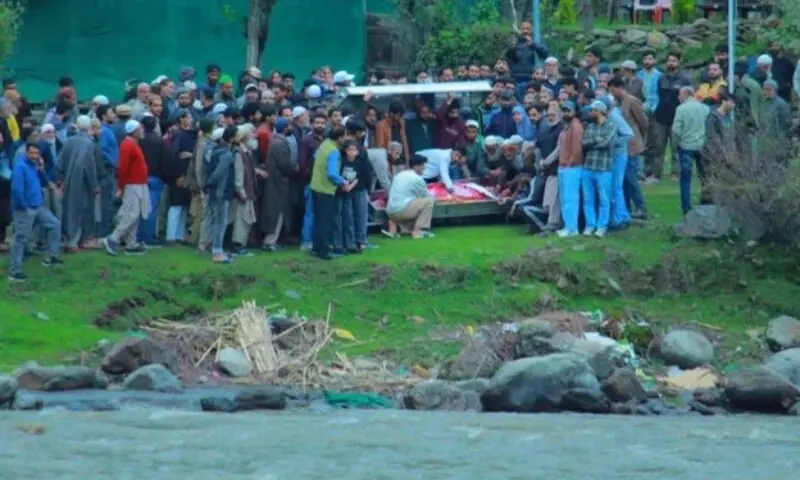
On Saturday afternoon, mourners gathered on both banks of the river, separated by a few hundred yards but unable to bridge the divide. Video clips circulating on social media showed hundreds of people accompanying the funeral procession along the riverbank on the Indian-held side. At one point, they halted and uncovered the deceased’s face from the coffin, allowing relatives across the river a final glimpse.
The scenes triggered intense grief on the AJK side, where cries and wails of family members echoed along the river.
Keran has long symbolised both separation and fleeting connection. Following the 2003 ceasefire between Pakistan and India, divided families would gather along the riverbanks here to exchange news, waving to each other, shouting across the waters, and even tossing letters and small parcels tied to stones.
But those informal contacts have largely disappeared after India’s August 2019 unilateral move, which stripped the region of its special status and reorganised it into two union territories.
On Saturday, while mourners on the AJK side waved and called out in grief, those on the opposite bank largely refrained from responding.
“You cannot imagine the level of fear that prevails there now. People avoid even waving hands, fearing they may later be questioned by security agencies,” said Raja Arif, one of the cousins of the deceased.
Funeral prayers were offered around 6pm PST in a field near the river on the Indian-held side, visible from across the divide, after which Liaquat was laid to rest in the village graveyard.
“Is there any greater agony than this — that we could see our brother lying in a coffin just a few hundred yards away, yet were deprived of giving him a shoulder?” said his brother, Raja Basharat, as mourners gathered at the family’s residence in Muzaffarabad on Sunday.
The incident resonated widely on social media, where users, including Prime Minister Faisal Mumtaz Rathore, described it as a stark reminder of the enduring pain of divided families in Kashmir.
“…What could be more agonising than losing a loved one and not even being able to see them for the last time? This dividing line does not just cut through land; it separates families and deepens human suffering,” wrote the premier on X, while extending condolences to the bereaved family.
“This incident is yet another reminder of the humanitarian crisis that has afflicted Kashmiris since 1947. The international community must recognise the gravity of the situation and take meaningful steps towards enabling Kashmiris to determine their future in accordance with the UN resolutions,” he added.
Renowned Kashmiri analyst Naila Altaf Kayani echoed these views on X.
“The coffin was brought to the river not for a final embrace, but for a final glimpse. Some borders do not just divide land — they break hearts,” she wrote.
A Facebook page operated by a group in Muzaffarabad uploaded a poster featuring the coffin and mourners on both sides.
“It wasn’t just a dead body that arrived today; it was thirty-seven years of separation, helplessness, and silent screams standing at the ceasefire line,” it read.
ملاحظة تحريرية | Editorial Note:
نُشر هذا المقال في الأصل بواسطة Dawn.
خبر (Khabr) هي منصة إعلامية أردنية مرخّصة تعمل بالذكاء الاصطناعي.
نضيف قيمة تحريرية من خلال: تحليل ذكي للأخبار، ملخصات تلقائية، رواية صوتية بالذكاء الاصطناعي، ترجمة متعددة اللغات، وتدقيق الحقائق.
هدفنا جعل الأخبار أكثر وضوحاً وسهولةً للقارئ العربي.
This article was originally published by Dawn.
Khabr is a licensed Jordanian AI-powered news platform (Registration #82086).
We add editorial value through: AI-powered news analysis, automated summaries, AI audio narration, multi-language translation (Arabic, English, French, Turkish), and AI fact-checking.
Our mission is to make news more accessible and understandable for Arabic-speaking audiences worldwide.
هذا الخبر ضمن تغطية خبر لقسم أخبار محلية.
نقدّم لك تحليلات ذكية وملخصات يومية لأهم الأخبار من مصادر موثوقة متعددة.
المصدر: Dawn.
يوجد 6 مقالات مرتبطة بهذا الموضوع.
This article is part of Khabr's coverage of Local News.
We provide AI-powered analysis, summaries, and multi-source aggregation to keep you informed.
Source: Dawn.
Tags: funeral, divided families, Line of Control.
🍪 نستخدم ملفات تعريف الارتباط لتحسين تجربتك وعرض الإعلانات المخصصة. باستخدامك للموقع، فإنك توافق على سياسة ملفات تعريف الارتباط وسياسة الخصوصية.
We use cookies to enhance your experience and show personalized ads. By using this site, you agree to our Cookie Policy and Privacy Policy.
FREEFree 1GB Internet + Free International Calls
$1 trial — eSIM in 190+ countries — No roaming charges