The closure of the Strait of Hormuz, following the conflict that began on 28 February, has triggered a global systemic cascade that has impacted not only states but also the daily lives of households, particularly following the surge in fuel prices, power cuts in some South Asian countries and the beginning of the paralysis of certain supply chains (due to shortages in critical minerals and inputs exported by GCC countries- helium, phosphate gas oil, aluminum).
Indeed, about 20 million barrels/day were interrupted, 40% of the world’s production of semiconductors and phosphate fertilizers was paralyzed, a 95% drop in maritime traffic and the grounding of 8% of the global merchant fleet. These figures reveal, if need be, the critical importance of this passageway, which is partially under Iranian control. The geo-economic manipulation of the strait gives Tehran an asymmetric deterrent capacity far exceeding its conventional military arsenal and thus constitutes its major strategic asset in the regional recomposition.
The current events in the Gulf remind us of the Suez crisis of 1956 following the nationalization of the Suez Canal by Egyptian President Jamal Abdel Nasser; the comparison is relevant on more than one level, beyond the simple operational similarities and geo-economic stakes of the Suez Canal and the Strait of Hormuz, strategic passages for fleets and international trade.
Indeed, the Suez Crisis had led to profound structural upheavals, marked by the decline of European powers in the Middle East and the emergence of a new regional order dominated by the United States and the Soviet Union. Similarly, current events in the Gulf could accelerate the transition to a new regional and international order, while promoting the assertion of new centers of power.
Undeniably, the Suez crisis is full of lessons and provides a framework for interpreting the behavior and strategic calculations of the protagonists involved in the Strait of Hormuz War, through its internal and external structuring impacts; domestically, in Egypt, President Gamal Abdel Nasser saw his legitimacy considerably strengthened, consolidating his power, popularity and influence in the Arab world; conversely, in the United Kingdom and France, the crisis caused internal political instability, leading to the fall of the Anthony Eden cabinet, also accentuating the fragility of the Fourth Republic and contributing to the return of Charles de Gaulle to the political scene; Externally, it was the decline in the influence of the European powers in the Middle East as a result of international pressure from the United States and the Soviet Union that forced the United Kingdom and France to withdraw from the Canal Zone, an injunction that accelerated the fall of European colonial empires in Africa and the Middle East.
The whole world is kept on the edge of its seats and scrutinizes the mediation efforts and statements of the belligerents while wondering how long the conflict will last. For if the date of the outbreak of a war is always known with precision, its outcome remains fundamentally unpredictable and beyond all control.
Is there a logic for the end of wars?
Crisis outcomes can be either peaceful (negotiated agreements, political compromises) or coercive, when they result from coercion, such as a military victory, sanctions, armed intervention or regime change. The former are based on the consent of the parties, while the latter are imposed by a balance of power, as was observed in the Second World War, in Kosovo in 1999, in Iraq in 2003 or in Afghanistan in 2001. However, these decisive outcomes are less frequent today when the forces involved are relatively balanced, which reduces the likelihood of a clear domination of one side over the other, hence the multiplication of frozen conflicts.
Generally, so-called “frozen” conflicts are characterized by the absence of a lasting political settlement despite the cessation of hostilities, they persist in a state of latency, reflecting an unstable balance of divergent interests. In light of game theory, they can be interpreted as Nash equilibrium conflicts where each actor prefers to maintain the status quo rather than risk a costly and uncertain escalation.
In some cases, when belligerents are near parity of retaliation, to assess the possible scenarios for ending the crisis, like the 2026 Hormuz conflict, we need to go beyond a simple military assessment (territory acquisition, destruction of vital infrastructure and military capabilities) to examine the environment of decision-makers.
In this regard, a quantitative study of 185 quarterly observations of several major conflicts (Iran-Iraq, Russia-Ukraine, Israel-Iran/United States) shows an almost unexpected result: wars do not end primarily because of the economic exhaustion of the belligerents, but when the political pressure on leaders becomes too strong and untenable. The factual results show that a significant increase in this pressure significantly increases the probability of the end of the conflict (HR = 4.2), while classical economic variables such as the growth rate or stock market and financial indices do not have a significant direct effect, they play a role as mediating variables that increase or decrease the impact of the political pressure factor.
In Western democracies, economic problems do not have a direct impact on political decisions, which come mainly from the pressure of public opinion and political actors who are the transmitters of the waves caused by economic problems and the demands of civil society.
Regarding the Gulf War and given Iran’s resilience and the near parity of retaliation that falls more on our brothers in the GCC (about 90% of missiles and drones have fallen on these countries); the end of hostilities would then depend less on a military victory and capitulation than on increasing political pressure, which could push decision-makers to end hostilities, not for military reasons, but for domestic political pressures and a risk of increased instability (risk of regime change due to unrests of the street, public opinion, parliament, the main economic centers). Cultural factors and political culture also play a major moderating role.
The GCC countries: what new strategic choices
One of the most striking effects of the current crisis is the growing disenchantment among the Gulf Cooperation Council (GCC) states. Belief in the U.S. security umbrella has little bit eroded in the face of perceptions of decline and effectiveness by population and some circles, while the credibility of the Arab League is increasingly being questioned. At the same time, the limited responsiveness of the OIC has reinforced doubts about the ability of regional organizations to ensure collective security and deterrence, particularly because of the consensus-based decision-making system (I may recall that a critical decision of Arab League endorsing the UN intervention in Kuwait in 1990 was taken at the majority vote not consensus thanks to Egyptian President Hosni Mubarak Charisma).
Furthermore, some strategic defense agreements between the GCC countries and influential OIC members have remained unimplemented due to geopolitical constraints. Several pivotal states prefer to maintain neutrality posture and positioning themselves as mediators.
Besides, some Arab and OIC states remain captives to the perceptions of their public opinions, some of whom consider the Iranian regime as “the rescuer”; a potential counterweight in the context of the settlement of the Palestinian question. However, these sentiments cannot hide the fundamental imperatives of preserving the political stability and territorial integrity of the Arab States, which must go hand in hand with the centrality of the Palestinian cause, a structuring pillar of joint Arab and Islamic action.
This social dynamic should not lead to the endorsement of bellicosities likely to erode the strategic depths of the Ummah, in particular those embodied by the Gulf Cooperation Council (GCC).
– In this context, the GCC states may need to reassess their security doctrines and gradually carry out a more explicit strategic reassessment of their external alignments and defense postures, and to carry out far-reaching reforms of the Arab League and the OIC.
In fact, the GCC countries have been aware of the limitations of the collective security system among Arab states and the US umbrella since the Obama administration, this is why they have opted for diversified strategies designed to consolidate and guarantee their security; however, if we assume that the hypothesis normalization with Iran is unrealistic at least at the short run, due to the current aggression, in the long term, two strategic options may be considered viable: first,, a hedging strategy that rejects rigid bloc alignment in favor of positive multi-alignment, by establishing balanced relations with competing powers (including the United States, the countries of the Shanghai Cooperation Organization and the BRICS) in order to preserve strategic autonomy and internal resilience, and second, deepening economic and political integration, potentially leading to the transformation of the GCC into a Confederal Union with a common military force and a unified or harmonized foreign and defense policy.
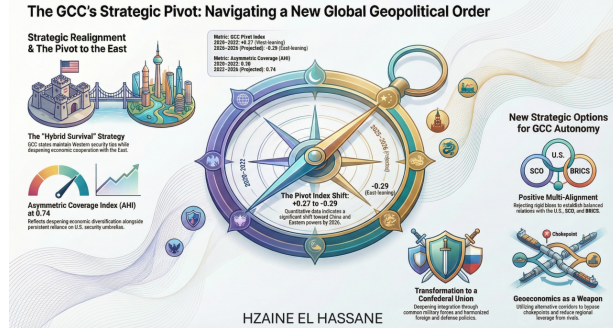
Strategic Realignment: The GCC’s Pivot to the East
Based on the theory of the strategic triangle (Dittmer 1981; Wu Yu-shan 2023), our empirical analysis confirms a paradigm shift in Gulf foreign policy; the GCC pivot index has risen from +0.27 (2020-2022) to -0.29 (2025-2026), a change that would indicate a shift towards the East and China in particular – while the asymmetric coverage index (AHI) has risen from 0.58 to 0.74, which would reflect a strategy of deepening economic diversification alongside the persistent dependence on US security, since arms providers diversification has not translated into strategic autonomy, with US arms sales to the Gulf still eclipsing those of China and Russia combined.
This quantitative observation is corroborated by diplomatic practice: Kingdom of Saudi Arabia and the United Arab Emirates are already members of the BRICS and the six GCC states have been granted the status of Shanghai Cooperation Organization dialogue partners (2023–2024), and participated at the highest level in the first ASEAN-China-GCC summit (Kuala Lumpur, May 2025), which would accelerate cooperation and integration in the Belt and Road Initiative. local currency settlement and supply chain resilience, while renewing momentum for a China-GCC free trade agreement.
One can assume, without hesitation, that the aforementioned indicators suggest a hybrid survival strategy: where the Gulf monarchies would perceive that China and Russia possess the economic leverage to moderate not only Iran’s regional role, but also to maintain their autonomy and curb dependence on the West; it is not a rupture, but a gradual recalibration where security ties with the West remain in parallel with a deepening of economic and political cooperation with China.
This approach represents a compromise and a soft version of non-alignment, far from the restrictive doxa of Nasser, Nehru and Tito, which requires the absence of military bases from both the Western and Eastern camps on the soil of the members of the Non-Aligned Movement (the five Belgrade principles in 1961).
Could federalism strengthen the resilience and autonomy of the GCC?
Even federalism seems difficult to achieve for multiple reasons, nevertheless in certain circumstances, leaders can venture to take creative decisions by forming unexpected alliances when strategic interests matter more than geopolitical rivalries or ideological differences. In such situations, leaders may cross the Rubicon when the expected gains are greater than the risks and losses, prioritizing practical benefits over constraints.
In this regard, it is worth recalling that in 1984 late King Hassan II concluded a strategic agreement with President Muammar Gaddafi, establishing the Arab-African Union. Following this agreement, the Libyan Arab Jamahiriya reportedly withdraw its support for the “Polisario terrorist militia”; this development contributed, inter alia, to a reconfiguration of the balance of power, increasingly favoring Moroccan dominance.
Historically, confederal arrangements have often emerged under conditions of external threats. The former Swiss Confederation, the United Provinces of the Netherlands, and the initial phase of the American Confederation illustrate how sovereign entities coordinated collective defense while preserving their independence.
It should also be remembered that, since its inception, the Gulf Cooperation Council was driven, among other things, by the threats emanating from the Iranian Revolution, which has greatly increased the security concerns of the Sunni monarchies (as my former Syrian colleague Al Beik pointed out in his thesis), the current time is ideal for the GCC countries to cross the Rubicon and establish a confederation.
Such a move toward confederation would represent a balanced and pragmatic compromise: it would preserve the full sovereignty of the six states as independent members of the UN while allowing them to pool key strategic capabilities. In doing so, it would strengthen collective strategic autonomy, allowing the Gulf states to act as a homogeneous bloc, thus strengthening their diplomatic weight and deterrence capacity.
A transition to a confederal architecture would therefore represent not a rupture, but a deepening of the initial integration process of the GCC and the collective security project, the Al Jazeera Shield.
Finally, such a framework could be conceived as an open and adaptive architecture – to accommodate the gradual accession of other Arab states that already have substantial security ties with the GCC and share identical political and economic values. This gradual expansion would strengthen the GCC’s strategic depth and diplomatic influence, potentially transforming it into a broader platform for political coordination and security alignment across the Arab region.
The Hormoz crisis: a turning point
The war in the Strait of Hormuz could be the decisive turning point and a major milestone in the relocation of powers and the future structure of the regional or even international system by revealing three major changes:
First, geoeconomics supplants traditional geopolitics: logistics becomes political, and states which control chokepoints (straits, logistics routes and corridors) would enhance their power and deterrence;
Secondly, the alternative corridors to the Strait of Hormuz would be a geoeconomic weapon and beneficial and vital logistically and geologically for the Gulf countries and their partners in order to secure the transit of energy products and fertilizers in order to deprive Iran of this strategic lever and lead it to change its foreign policy towards its neighbors.
Thirdly, in case of parity of deterrence, domestic and international political pressure would be the determinants factor in ending wars, which will end when pressure on top leaders becomes maximum and unsustainable much more than economic exhaustion.
On the whole emerging world is neither unipolar nor bipolar, but multiplex, where Europe is weakening, Russia is becoming stronger, and the Gulf countries are diversifying their alliances. Hormuz is not just a strait, it is the laboratory of this new world that will emerge silently, crisis after crisis.
The post From Suez to Hormuz (1956–2026): Straits at the Heart of Global Geostrategic Recomposition appeared first on Morocco World News.